


Archive for the ‘Resistance’ Category

A conflict isn’t always a bad thing – Part 6

Tuesday, August 4th, 2009

Looking at the kind of conversations one can have in a project context.  The ones I have been involved in can be categorized in three groups:

1. Polite discussions: interactions on a level of political correctness. No harm done, but nothing gained either on the level of creativity or relationship.

2. Passionate discussions: Above and beyond the exchange of information and facts. These moments can be filled with joy, sadness, fear, but most of the times they are guided by anger and frustration (Yep: such is life on large scal projects). The point is that there is a counterpart in these conversations acknowledging the feeling you are expressing. Relationship matters. I have learned that when people connect at this level, that they are capable of innovative and very high quality work.

3. Powerplay: ‘Mine is bigger than yours’  and command and control discussions where one party needs to win on the other’s expense. I have learned that these suck the last drop of motivation and commitment out of people in the long run. The result is only as good as the IQ of the winner (which, most of the times resembles Rambo’s instead of Einstein’s).

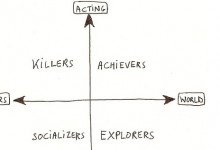
For the sake of simplifying reality so that it fits into my brain, I have plotted the categories on the chart below:

The moral of the story: you need an optimal level of conflict for a good solution, for conflict is what ensures contact. So don’t be afraid to show some guts from time to time.  Just one big warning sign so you don’t tilt to the complete righthand side: if you loose your vulnerability in the conflict, you loose your dignity and you fall into powerplay mode.

Related articles:
-
A conflict isn’t always a bad thing – Part 5 – January 12th, 2009
- A conflict isn’t always a bad thing – Part 4 – December 14th, 2008
-
A conflict isn’t always a bad thing – Part 3 – December 7th, 2008
-
A conflict isn’t always a bad thing – Part 2 – November 29th, 2008
-
A conflict isn’t always a bad thing – Part 1 – November 22nd, 2008
-
Forming – Storming – Norming – Performing  – September 12th, 2008

Parenting as a Management Skill … Huh? (part 5)

Sunday, May 24th, 2009

In addition to the articles on parenting as a management skill that I posted in February 2009, there is one more insight I’d like to add. I found out that the epicenter of organizational change management is hidden in the simple mechanism of cause-and-effect. And I found out about it by being home between television time and dinner time on an average working day.

When I ask my 3 year old son to stop watching television and to come to the dinner table, I’m most likely to receive a ‘No!’ and when I persist in my plan, tears and other forms of ‘Resistance’ will follow for the next ten minutes or so.

However, when I get involved in his frame of reference, I tell him that the television will be shut down when the clock turns seven or when the episode he is watching ends. I can also tell him he can count to three for me to turn off the television, etc. It’s a game he gladly subscribes to; running to the dinner table – eager to start dinner.

What happened here? In the first situation I would be using my parental authority to reinforce an action. This likely results in ‘Revenge’, ‘Regret’ or ‘Rescue’. In the second scenario I am using a different approach: instead of pushing harder I take one step back – BUT I STICK TO THE OBJECTIVE, i.e. television out and on to the dinner table.

By stepping back I inverse the cause-and-effect relationship: I let him be the cause instead of the effect of the situation. This is more likely to result in a ‘Responsible‘ response: I give him the opportunity or the ‘ability‘ to ‘respond‘ positively to my request.

The same is true for organizational change efforts. The point is that you can achieve most of the goals by underscoring the objectives, stepping back and then leaving people the opportunity to become involved in the solution. Instead of pushing harder straight on to ‘Resistance’ you are stepping back and allowing ‘Relationship’ and ‘Respect’.

I bet one can’t learn that lesson so profoundly and deeply at Harvard or Wharton the way I did between the dinner table and the TV set.

Related articles:
Parenting as a Management Skill … Huh? (part 4) – March 1st, 2009
Parenting as a Management Skill … Huh? (part 3) – February 21st, 2009
Parenting as a Management Skill … Huh? (part 2) – February 16th, 2009
Parenting as a Management Skill … Huh? (part 1) – February 9th, 2009

Resistance, Resentment, Regret, Rescue OR…. RESPECT?

Sunday, May 10th, 2009

A lot of R words with a particular significance on this blog. In a reaction on last week’s post I was requested to define resistance more precisely. Well, I tend to adopt the definition of resistance the way it is described by Karl Weick, that is:

Resistance is the emotion that occurs when our expectations of ‘the way things are’ are interrupted. Two words are important in this definition:
A – Emotion: the essence of resistance is that it creates an emotion. That means: not logical, not rational and most of all: not predictable.
B – Expectation: resistance does not only occur when things change, but when our expectations are interrupted, regardless of whether that makes rational sense.

As one of the commenters on LinkedIn put it:

"Resistance is an indirect expression of fears of loss of control and vulnerability. It REQUIRES "peeling the onion" to uncover the roots of the affective reaction. Rather than being a "bad" thing, I have found that resistance is more often than not a signpost indicating a potential problem or set of problems that if left unattended could derail any initiative."

Another commenter simplified the definition (I like that a lot!) in a way that negative connotations are almost gone:

"It’s often seen as a negative, however, it turns the light on to areas that really need attention. Just like the voice of our GPS saying, "recalculating" "

Yet another commenter continued:

"We struggle to find a place to put ‘resistance’, so that is doesn’t interfere with the ‘work’ or the outcomes. Seems to me that when we stop fighting it and see it for what it is (without judgment) we may understand better how to use it as a tool more effectively." - Embracing resistance (like the statue in picture above)

And that is indeed the whole point: whether or not we categorize a certain behavior such or so; the difference is in the response we give. And the response can be one of Resentment, Regret, Rescue OR…. RESPECT. The whole point is that we choose our responses to the world.

Finally: thank you to all commenters on this blog and on Linkedin for fueling this discussion!

One more time: Resistance is a good thing!

Sunday, May 3rd, 2009

This week’s post is a small reminder of something I blogged about before: THANK GOD FOR RESISTANCE! In physics, resistance refers to the force that opposes motion. Next to that, the resistance of a material against an external influence, the resistance of a human body against a disease, and even the resistance in the Second World War are uses of the term that describe quality, health and guts; three terms that I would label as positive. 

Resistance means:
- People care about the stuff;
- People are brave enough to tell you they disagree;
- People have a backbone and guts;
- People are being authenthic.

The below graph paints the picture the way I see it. 

Some additional notes:

1. The dimensions: INTENT versus BEHAVIOR
The vertical axis describes the intention we have inside of us and horizontal axis describes the behavior that we demonstrate on the outside.

2. The four quadrants

  • Commitment: what happens when your intention is willing and your behavior follows your intentions. Let’s say this is an authentic ‘yes’;
  • Resistance: what happens when your intention is unwilling and when it is in resonance with your behavior. In his book on Flawless Consulting, Peter Block lists some common types of resistance that are abundant during the lifecycle of an organizational change, they are: Need more detail, Giving a lot of detail, Not enough time, Impracticality, Confusion, Silence, Moralizing and Press for solutions. These behaviors demonstrate a ‘no’, but an authentic ‘no’.
  • The Stockholm Syndrome: The Stockholm Syndrome describes the behavior of hostages who become sympathetic to their hostage-takers. The name derives from a 1973 hostage incident in Stockholm, when several victims began to identify with their hostage-takers as a coping strategy. It is the same kind of fear of repercussions that we can find in some organizations. People lose their perspective as if they were in a hostage situation and start to act against their unwilling intent. From the outside they gladly execute, commit to the commandments that were made, so the behavior is a false ‘yes’.
  • The Otis Redding Syndrome: I borrow this one from Bob Sutton, who recalls the line from Otis Redding’s old song: Sitting By the Dock of the Bay, “Can’t do what ten people tell me to do, so I guess I’ll remain the same". Clearly, this describes people with a good intention who are somehow hindered to follow their intention. In this model I will call this a false ‘no’.

 3. Systems thinking

One of the basic laws of system thinking is ‘The harder you push, the harder the system pushes back’. The same is true for resistance – in an awkward way: the resistance will go underground and on the surface indifference will appear. As a result you have lost every bit of visibility on resistance – but that’s not the worst thing.

The point is that indifference is never positive and always energy-draining. And that is the last thing you want to create whenever you are performing a big organizational change…

So thank God for resistance and always suspect yourself first!

Once upon a time…

Monday, April 13th, 2009

A fairy tale for the suffering in the workplace.

Once upon a time there was a pond with the most exceptional fish one could think of. The man who took care of the pond wanted it to be the best pond of all times, and so did the fish.

The man took care of everything because he didn’t trust a single fish. Instead of feeding them and providing them with oxygen, he hooked them up each day. That way, he knew exactly what they were doing and how they were doing it. Each day he weighed each fish, pushed the food down their throat and told them exactly what they should do before he let them into the water again.

The man was quite proud of the way he controlled it all. Any time of the day anyone could ask how the pond was doing and he would explain in detail with colors, graphics, metrics and key performance indicators. By all measurements, this was the best pond of all times!

In order to control the fish efficiently the man threw out nasty bait: a talking worm telling the fish how bad their work was, how the quality sucked, how they were behind schedule and how it made the man nervous as hell. The man thought this kind of bait would keep the fish sharp. And it did. The bait was simply irresistible.

Below the water surface, Red Fish, Blue Fish and Yellow Fish caught every nasty worm. They were smart fish; strong and bright-colored. Each time the bait was thrown out it was only a matter of seconds before they would catch that nasty worm. Red, Blue and Yellow were the best of breed.

• Red Fish was always the first to swallow the bait; “that’s not true” he said; “I’m going to tell him!” But the rage and the misalignment grew with each catch.
• Blue Fish swallowed the bait differently; with each catch his self doubt grew, for he started to believe the accusations that worm was throwing at him.
• Yellow Fish was smarter than that. He would not fight it like Red Fish, nor feel guilty about it like Blue Fish. His approach was to solve the man’s problem. So he swallowed the bait each time, thinking he could solve the man’s problem.

These smart fish were all different in how they approached the nasty worm – so much is true. But there was one thing they all had in common: they always swallowed the bait by their own instinct and each time they got back into the water they felt sore. They didn’t know why; they were bubbled…

And then one day a duck landed on the pond. He said he had seen these situations in other ponds as well, but the fish didn’t pay attention to the duck; for they were too busy swallowing the bait that was thrown at them. Days went by and from the surface the duck could see the daily ritual the fish went through. These smart fish suffered, but they were too proud to admit it. After all, they were the best of breed and besides a duck is a duck. What could he possibly know about fish?

Until one day the hooks left them aching so hard that they needed some time to recover, so they figured they might as well listen to the duck. “OK duck, let’s hear it” Red Fish said. “Things are not OK down here, so tell us what you think is going on.” Blue Fish said.

It’s fairly simple”, answered the duck; “from up here it is obvious how you are exaggerating on the R-side”. “The R-side; what the hell is that?!” Yellow Fish replied. The duck patiently continued:
You see, there is a pattern in your daily suffering:
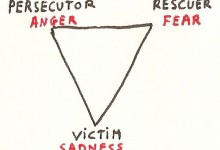
• Red Fish is driven by Revenge. That is the first R – and he is left with resentment;
• Blue Fish is driven by Regret. That is the second R, which leaves him feeling guilty;
• And you, Yellow Fish, you get hooked because you try to Rescue the man, and in the end you are scared because it didn’t work out as planned.
There is just one thing you should know about these R’s: they will always get you hooked

But that’s our nature – don’t you understand?” Red Fish said. “This pond is our destiny- there is nothing we can do about it” Blue fish said. Yellow Fish concluded: “The only way out is to change the bait”.

Hang on – there is another way out”, the duck said, “but it will require you to use a different R than you are doing today.
• I’m not asking you to change your nature, Red Fish, but you need to become aware of it;
• I’m not telling you to change for a better pond, Blue Fish, but you can think of yourself as the pond instead of the fish;
• And finally, Yellow Fish, you cannot change the bait that is thrown at you – you just need to know that you can choose not to swallow it.
So the alternative R I am talking about is called Responsibility.

The fish were bubbled…

Just try it – you have nothing to lose. When you approach the bait with Responsibility, you will be able to stop and capture the useful information without getting hooked.” Because the fish had no other alternative they decided to try this crazy idea. Days went by before they could turn off the automatic pilot that hooked them.

Eventually, they did it and they reported back to the duck:
We managed not to get hooked for a few days now.” Red Fish said. “And what were your findings?” the duck replied. “Well, it’s hard.” Blue Fish said, “because it needs all of my attention. But now at least the pain is gone and we continue our work.” Yellow Fish thoughtfully added: “This is almost as difficult as swimming upstream.

Indeed”, said the duck “approaching nasty bait with Responsibility is as hard as swimming upstream. Responsibility means that you can choose how you respond to a situation. And it’s not easy. Just remember that it’s the upstream swimming that makes you stronger!

The man never changed. Neither did the bait. But the fish grew stonger each time they realized that there is always a choice in how they respond to a situation.

Happy Easter!

The Chameleon Law

Sunday, March 8th, 2009

“It is not the mountain we conquer but ourselves.” -  Edmund Hillary

In the 1944 unfinished novel Mount Analogue, René Daumal describes the travel of a company of eight, who set sail in the yacht Impossible to search for Mount Analogue, a solid, a geographical place that “cannot not exist.

The protagonist of the book is convinced by a certain Father Sogol to undertake this “crazy” expedition. Father Sogol is a figure who likes to invert cause and effect (and is therefore called the inverse of the Greek “Logos” – representing ‘rationality’ and logical thinking).

“A crazy expedition”

The story of Mount Analogue is about making something happen that all people around you say is impossible and ridiculous.  In this novel about the expedition to a mythical mountain that reaches from earth to heaven, Daumal mentions the chameleon law, which he describes as the inner resonance to influences nearest at hand (“la résonance aux plus proches affimations” if you happen to speak French). As the protagonist of this tale is in the vulnerable starting phase of this expedition, he discovers how he is prone to peer pressure and how difficult it is to commit to something before knowing how.

Father Sogol had really convinced me, and while he was talking to me, I was prepared to follow him in his crazy expedition. But as I neared home, where I would again find all my old habits, I imagined my colleagues at the office, the writers I knew, and my best friends listening to an account of the conversation I had just had. I could imagine their sarcasm, their skepticism, and their pity.

I began to suspect myself of naiveté and credulity, so much so that when I tried to tell my wife about meeting Father Sogol, I caught myself using expressions like “a funny old fellow,” “an unfrocked monk,” “a slightly daffy inventor,” “a crazy idea.” After all that I was stupefied to hear her say at the end of my story: “Well, he’s right. I’m going to start packing my truck tonight. For there are not must two of you. There are already three of us!
So you take this all seriously?
This is the first serious idea I’ve come across in my life.

And the force of the chameleon law is so great that I came back to the thought that Father Sogol’s enterprise was, after all, entirely reasonable.

The Tipping Point

Now what could possibly be the relevance of this chameleon law for us as organizational change managers? Mount Analogue is about inner doubts and how this chameleon law rocks us asleep and prevents us from seeing the other 99% of the possibilities that are at hand in each situation. With rational thinking and conventional ‘common sense’ we easily fall prey to the chameleon law.

However, organizational change projects are mostly about creating a situation that does not yet exist. A situation, a project or any other expedition is “talked into existence”. With every word you speak about it, a seed is planted that can give birth to a new reality. Karl Weick refers to this as the process of Enactment to denote that certain phenomena (such as this crazy expedition, or your own ambitious project for that matter!) are created by being talked about. Slowly but surely – if we are persistent enough – our ideas translate to words, our words translate to actions and our actions result into tangible outcomes.

The chameleon law is the biggest enemy during organizational change efforts, because you are shaping the path for a future that has no gravity in the present. As Arthur Schopenhauer is often quoted: ‘Every truth passes through three stages before it is recognized.
In the first it is ridiculed, in the second it is opposed, in the third it is regarded as self-evident.’

Broken Windows

This is exemplified by the broken windows theory. Consider a building with a few broken windows. If the windows are not repaired, the tendency is for vandals to break a few more windows. Scientists in the field of criminology found that disorder invites even more disorder and that a small deviation from the norm can set into motion a cascade of vandalism and criminality. Litter encourages more litter – another way of saying: resonance to the influences nearest at hand.

Malcolm Gladwell was the first to bring the broken window theory to our attention when he described it as paramount in reaching a Tipping Point (an idea which he first published in 1996 as an article in The New Yorker and which he later published in a book with the same title).  As Gladwell notes: “Why was the Transit Authority so intent on removing graffiti from every car and cracking down on the people who leaped over turnstiles without paying? Because those two trivial problems were thought to be tipping points-broken windows-that invited far more serious crimes“.

So we need to beware of all the broken windows symptoms of cynism and indifference and instantly fix every broken window. This is the intense and step-by-step work of creating a new culture.

Committing without knowing how

However, preventing the chameleon law from taking over goes a little deeper than paying attention to practical details. One has to be crazy enough and stubborn enough to endeavor your objectives against all odds. The Mount Analogue expedition reveals the insight that any expedition or organizational change project is a mountaineering expedition of the inner mind and intrinsic motivation, as much as it is about delivering a project according to a certain methodology. The tipping point is as much an external and societal process as it is an inner struggle for fueling our own commitment to an expedition with an un-rational (i.e. rationally ‘unreachable’) objective. It’s the ability to pursue a dream.

Alpinism is the art of climbing mountains by confronting the greatest dangers with the greatest prudence. Art is used here to mean the accomplishment of knowledge in action.

You cannot always stay on the summits. You have to come down again… So what’s the point? Only this: what is above knows what is below, what is below does not know what is above. While climbing, take note of all the difficulties along your path. During the descent, you will no longer see them, but you will know that they are there if you have observed carefully. There is an art to finding your way in the lower regions by the memory of what you have seen when you were higher up. When you can no longer see, you can at least still know. . .

Daumal, who was apparently one of the most gifted literary figures in twentieth-century France, died before the novel was completed, providing an extra symbolic meaning to the journey. Beware of the chameleon law as you endeavor to live your dream, instead of dreaming your life!

_______________
Related post:
Better a wrong decision than no decision (February 14th, 2007)

A conflict isn’t always a bad thing – Part 5

Monday, January 12th, 2009

Unexpected – like innovation itself – another perspective that I’d like to add to this series: the newest insights on biodiversity. Some time ago, Jef Staes introduced the concept of a red monkey. According to Jef, the concept started to develop during his seminars when participants asked him where to start with very confrontational change projects.

At that moment, he just learned about the origin of the rich biodiversity in a rain forest. According to the latest insights in biodiversity, new species do not start in the middle of a forest but at the edge. At the edge! – where different species from different ecosystems ‘meet’. That’s when Jef created a metaphor of a brown monkey from the jungle who meets a red fish from the sea (an adjacent ecosystem). Through their conversation a new confrontational idea is born: a red monkey.

What would happen if that confrontational idea would be dropped in the middle of the jungle? It would be killed immediately. Jef notes that the same happens with confrontational ideas that are ‘dropped’ in the middle of an organization … they get killed as well. Innovation ‘never’ starts in the middle of an organization but on the edge, where ecosystems meet. In the below video you can see Jef explaining the concept.

In the long run, red monkeys are key if organizations are to survive.  A red monkey disturbs the balance in people, teams and organisations – it tilts the stability of an ecosystem, and therefore it will get killed if there is no ‘critical mass big enough to survive.

Innovation is the result of a red monkey that has managed to survive the initial conflict between these two opposing points of view. And that is why we need all that stuff about organizational change management: to get from the edge to the middle!  No need to mention that Jef is passionate about the subject; he even designed a bumper sticker:

For those of you who wonder how this red monkey metaphor relates to the previous articles in this small “conflict” series have a look at where I pasted the bumper sticker.

You will immediately note that it will take a serious amount of conflict before you can introduce the red monkey on the right hand side of that chasm. As I have written earlier: this is a step-by-step process and it requires a different view on resistance. Thanks to Jef it is now crystal clear that you should start at the edge and move to the middle – gradually as you implement all the stuff I’ve been blogging about over the past 2 years.

Bonus material for Dutch-speaking readers: Jef Staes talking about the next generation of young employees on a symposium about leadership in education organizations. You will note that Jef’s ideas have a lot in common with John Seely Brown when talking about the social life of information (aka: knowledge Management) and the gap / conflict / clash (whatever you want to name it) between generations.

Click here for part 1 of “Jongeren zijn anders”
Click here for part 2 of “Jongeren zijn anders”

A conflict isn’t always a bad thing – Part 3

Sunday, December 7th, 2008

The political point of view: let’s have a look at what this comes down to when the rubber hits the road: people and the games they play. There is a matrix I often use to categorize stakeholders in terms of their resistance. It is based on the 1987 model of Peter Block.
The major insight here is that conflict has two dimensions:

  • Trust: Can we rely on the stakeholder’s support or are they avoiding ownership of the program?
  • Agreement: Are we in agreement about the content of the program?

The point of the diagram below is that we need to get the most important stakeholders on the right-hand side into a relationship of trust. Second – and most important – disagreement is actually an accelerator, provided that it happens in a relationship of trust.  Never mistake a lack of agreement with a lack of trust!

The above matrix tells us that we need a healthy mix of:

  • Allies who fuel our vision, and
  • Opponents who bring out the best in us.

For those stakeholders that are situated low in trust, there are two types you are likely to encounter:

  • Bedfellows (or better even ‘one night stands’): these are the most difficult to get a hold on because they seemingly agree on the surface of face-to-face discussions and meetings. However, as we follow up on their commitments and actions we discover discrepancies. The advice here is to start an individual conversation about what is going on their level of commitment (a conversation about the conversation) in order to bring to the surface whatever is blocking them. It takes courage to start these conversations.
  • Adversaries: Just like bedfellows, they are low in trust, but at least they are straight about it. It is likely that you will run into people of this type, openly declaring that they are against this program. If you do, you should approach them in the same way as bedfellows: a conversation about their commitment.

If this all seems a bit too theoretical for you, let’s have a look at a real life example. The mapping below is one that we did for the stakeholders of a major ERP implementation for a multinational in the construction equipment industry.

Here is what we learned:
- First, we mapped the different stakeholders according to the dimensions of trust and agreement.
- Next we figured out that the conflicts we have with keys users, process owners and business representatives in the project are actually "productive conflicts". At the same time we discovered that the agreement with suppliers and customers was more of a phony type.
- Finally, when it came to mapping the support department and end users, we soon discovered that the conflicts were not of the productive type. As a consequence, between now and go-live we will need a plan to gradually involve both stakeholders and to give them a stake / some ownership of the delivery.

As you can see from the picture we also mapped three areas (A,B and C) of the population analysis (see last week’s article) on the matrix as well.

Conclusion: think twice before you categorize, because the essence of stakeholder readiness is trust, not agreement.
_____________________
Source: Peter Block, The Empowered Manager: positive political skills at work. 1987

Dorothy

Tuesday, June 24th, 2008

About 10 years ago I saw a movie about stormchasers called Twister.  In order to create a better warning system, they hunted violent tornados in Oklahoma with a complex measuring instrument called Dorothy. Dorothy contained small balls that needed to get inside the tornado whilst sending back huge amounts of data. Of course, the biggest trouble for the heroes of the movie (apart from the romance that the storywriter weaved in) was to insert the measuring device into the very heart of the tornado. Despite their skills, planning and preparation, nature wasn’t picking up Dorothy. To their frustration it took several try-outs before they discovered that Dorothy was too light and fell over each time the eye of the storm approached.

Dorothy from the movie TwisterIt is pretty much the same frustration whenever I build a measuring instrument on organizational change projects: the biggest trouble is to get the instrument inside the tornado. Quite recently my team built a Dorothy that needed to track ‘who will do what in the future’, based on a list of employees and a number of future roles, which were derived from the blueprinted business processes. We experienced quite some practical problems to get our Dorothy inside and a setback on our schedule. However, in return of my frustration, there are some major learnings that I can share with you now:

1. Designing Dorothy. A measuring instrument should be light enough to get picked up and used by the target audience and stable enough so it does not fall over once the major audience starts using it. We discovered that web-based technology is a virtue for this kind of measurements, because it allows you to have multiple users at the same time, that it needs no installation of any add-ons, and that the design allows you to make it simple to understand and easy to use.

2. Making sure that Dorothy will get picked up. We did this by making sure that users could get more out of the application than they put in; this is the so-called WIIFM (What’s In It For Me). In our case the extensive reporting allowed users to compare their input with that of others sites and users; so the ‘how am I doing compared to the rest of the organization’ proved to be an element that motivated them to massively use and refine their input.

3. Finally, never underestimate nature’s ability to frustrate the s**t out of you. It is quite tiring to bump into a tornado where you "just can’t get the data out" because people just won’t pick up your instrument before their conditions are being met. For example, one of the sites attached quite some importance to some additional check-boxes in the application and simply did not want to use it before that condition was met. Another example: it took quite a while to convince people that a spreadsheet was only half as effective as the web-based application.  We reached the tipping point by getting together in a local conversation where we spent more than 50% of the time listening instead of pushing our point-of-view and then demonstrating the tool with their datasets. We countered the so-called ‘resistance’ with ‘respect’ instead of ‘being right’.

More often than not it takes several try-outs and push-backs from the organization before people even allow you to go ahead with the measurement. But once the tornado picks up Dorothy, there is a wealth of information that becomes available – that is: if you have the perseverance to make it through the try-outs. It is my contention that frustration and failure is part of the job. Preparation is one thing, but improving your prototype based on try-outs is also a must.

Sometimes it’s Not Resistance

Monday, June 2nd, 2008

This is the title of a paragraph in Peter Block’s book ‘Flawless Consulting’. He warns against the paranoid habit of some consultants interpreting every line manager’s objections as resistance. Resistance is often a label used by consultants who want to be right – in spite of the customer relationship.

Here’s a quote of that paragraph:

As Freud once said when he was asked whether the cigar he was smoking was also a phallic symbol, “Sometimes a cigar is just a cigar”; sometimes client objections are not resistance. The client just doesn’t want to do the project.

We can all become paranoid by interpreting every line manager’s objections as resistance covering some underlying anxieties. If a manager says directly, “No, I do not choose to begin this project. I don’t believe in it”, that is not resistance. There is nothing in that statement that blames the consultant or presses the responsibility for the difficulties on the consultant. The manager is taking responsibility for his or her own organization and has a right to choose. If we think it is the wrong choice, well that’s life.

Consultants Conversation
We are getting paid to consult, not to manage. If a manager says to me, “I am too vulnerable a position to begin this project now”, I feel appreciative of the direct expression. I know where I stand with that manager. I don’t have to worry whether I should have done something differently. I also feel the manager understands the project and knows the risks, and it turned out that the risks were just too high. I may be disappointed that the project didn’t go, but the process was flawless.

As I said before, you should always suspect yourself first before jumping to conclusions, like the two consultants above are doing…