
Archive for the ‘Ben Zander’ Category

Music and Leadership (part 3)

Monday, February 22nd, 2010

Strange things happen when you look at leadership through the lens of music. Basic assumptions flip over and stay like that forever after. You untie knots that you took for granted. Like the idea that a leader is the most important person of a team.
Ask Google

When you lead a team – big or small – you feel responsible for the outcomes and sure as hell you want those outcomes to be successful by all possible measures. Maybe you got elected into this position, maybe you fought your way up or you started from scratch and built your own team step by step. It doesn’t matter, because sooner or later you will be looking for tips and tricks to increase your performance as a leader. How To’s, Cookbooks, do’s and don’ts, MBA courses and leadership master classes.

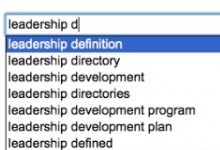
Have a look at Google as you type the word ‘leadership’ and the system returns the most popular searches that people have done before you. Turns out that you are not the only one eager to find out HOW to lead.

Unfortunately all these sources turn out to be a disappointment when I look at the return on knowledge I have gotten out of them:

- An increased sense of control that turns out to be an illusion

- A clever and witty language to explain and hide my faults

- A whole range of case studies to prove the leadership models IN HINDSIGHT

Duh. Not really getting any closer to the secret of leadership.

Surf TED Talks

Guess I’d better listen to some music or watch some TED video’s instead. And that’s what I did. (Note: If you don’t know the TED talks, this is a good time to dive in) As a starter, have a look at the below talk of Itay Talgam on leadership of the great conductors and prepare for some flipping insights on leadership.

Not About You

Talgam hits the nail on the head when he talks about the small gesture of the conductor. He continues: ‘And suddenly, out of the chaos, order. Noise becomes music. And this is fantastic. And it’s so tempting to think that it’s all about me.’

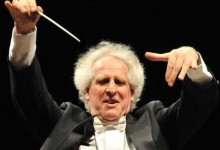
He then analyzes different leadership styles and immediately you can see the difference between a Muti style (talented, clear, controlling and commanding), a Strauss style (pure execution), a von Karajan style (…), a Kleiber style (creating the conditions for people to co-create) and finally a Bernstein style (doing without doing).

Leadership Redefined

This video definitely flipped my beliefs on the job of a leader and made it less tangible and controllable at the same time. Turns out that it’s all about enabling instead of controlling.

And if that is so we desparately need an alternative to the long checklists and cookbooks on leadership. To begin I propose a two step remedy:

Step 1: There is nothing to fix and it’s OK to be happy. So leave Mr. Grumpy home.

Step 2: Your leadership is about enabling other people’s stories to be heard at the same time. So: be the space instead of the hero. Create the conditions instead of controlling the outcome. As Talgam states: ‘You have the story of the orchestra as a professional body. You have the story of the audience as a community. You have the stories of the individuals in the orchestra and in the audience. And then you have other stories, unseen. People who build this wonderful concert hall. People who made those Stradivarius, Amati, all those beautiful instruments. And all those stories are being heard at the same time. This is the true experience of a live concert.

The Moral

Once you replace controlling the outcome by creating the conditions you will be amazed by the power and the passion that you light up in people. The only thing you need to do is ask yourself the question: “who am I being that their eyes aren’t shining?” as the KPI (Key Performance Indicator) of your leadership.

So who are you being and what has to become of your job as a leader? You are the holder of a space that enables things that are fare greater than you. Trying to control the outcomes will only reduce the performance (and make you more tired).

Instead your real power lies in the being moved and passionate about the scores of your organization and this determines the strength of the space you create for your people. Passion, not power. In the below video Bernstein explains his passion through the expressivity of music and the ability of people to respond to that.

As a finishing note, Bernstein says: ‘It is metaphor that most produces knowledge.‘ He talks about music as a sense-making language, a compelling story that communicates things that are beyond your reach.

No place for Ego there. That may be exactly why we get more ‘how to lead‘ cues from observing conductors and indulging in their music than from any other book or professor.

____________
Related articles:
- Music and Leadership (part 2) – January 18th, 2010
- Music and Leadership – July 20th, 2008
- Music and Management Consulting – September 27th, 2008

The 6 big concerns of change

Sunday, September 6th, 2009

In the below video we see Pat Zigarmi underscoring why involvement of your target audience is the single factor determining the success of your organizational change endeavor. She makes her point incredibly well by stating: "People who plan the battle rarely battle the plan."

People don’t resist change, they resist being controlled. And if we are smart enough to involve people in every step of the project lifecycle, they will be the best drivers of change we could possibly hope for.

In her research she distinguishes 6 primary concerns for change:

1. Information concerns. People respond when they know what you know, see what you see, understand what you understand.

2. Personal concerns: what’s in it for me? Will I win or lose? Will I look good? Is this a picture of the future I can succeed in?

3. Implementation concerns: where can I get help?

4. Impact concerns: will the change make any difference?

5. Collaboration: how do we get everyone involved?

6. Refinement and improvement concerns

Finally she also challenges us to redefine how we look at "concerns": they are not negative, they are just unanswered questions!

Related articles:
-
Know-Feel-Do = Bottom Line of Communication – December 28th, 2008
-
Music and Leadership – July 20th, 2008
-
It’s About Involvement, Stupid! – June 1st, 2007

How do you appraise?

Sunday, June 14th, 2009

‘Forward’ instead of ‘backward’

In the light of last week’s post (which sparked an interesting discussion on the LinkedIn Organizational Change Practitioners group) a fascinating point of view was unveiled. As one of the participants in te discussion put it:

"Instead of looking to recruit people who already have all the qualifications, we should be looking for people with the ability and willingness to develop the skills and knowledge and allow them to grow into the job."

This shows that we should actually be recruiting-FORWARD – not only because recruiting BACKWARD (by looking in the rearview mirror of predictability) is not satisfying; but rather because we need to spark potential (as opposed to ‘actual’) performance. In that sense, a recruitment interview is more than a measurement or an observation; it is a process of becoming aware of the potential (from one side) and becoming committed to the challenge (from the other side of the table). This ‘forward’ way of thinking reverses the dynamics completely.

‘Giving an A’

The same is true for performance appraisals. Ben Zander, conductor for the Boston Philharmonic Orchestra, was faced with the same problem every year for 25 years: Teaching students who were in such a chronic state of anxiety over the measurement of their performance, they were reluctant to take creative risks. So he changed his appraisal strategy: he decided to give everyone an A, at the beginning of the course. The A was not intended as a way to measure someone’s performance against standards, but as an instrument to open them up to new possibilities.

Students were required to write a letter that began with “Dear Mr. Zander, I got my A because…” and they had to describe in as much detail as possible, how they came to achieve this “extraordinary grade". Students must “place themselves in the future, looking ‘back’, and report on all the insights they acquired and the milestones they attained during the year, as if those accomplishments were already in the past.

According to Zander “the A is an invention that creates possibilities for both mentor and student, manager and employee, or for any human interaction.” Zander applied this kind of thinking to his conducting and it transformed him from being a dictator, to an orchestrator of collaboration. This new openness in communication had a huge effect on the morale of the orchestra, improving the performance of both conductor and players.

What would happen if we started to recruit and appraise by giving an A?

Related articles:
-
Music and Leadership – Sunday, July 20th, 2008
- Always Remember Rule Number 6! – Thursday, December 6th, 2007 
-
Redefining ‘Responsibility’ – Monday, October 22nd, 2007

How do you recruit?

Sunday, June 7th, 2009

I was just wondering how the hell I can be sure that the person I am interviewing is the right man/woman for the position. Sure, making a clear description of the skills, knowledge and attitudes we need in order to get the job done is a must; and so is the selection of CV’s that come your way.

But once I’ve taken those steps, I have found that the predictive validity of my interviewing skills and the list of smart and astute questions I ask is not that reassuring. Being aware of all that psychometric stuff like the halo effect, STAR questions and all that did not make the job any easier. It just left me feeling a bit more guilty (‘I should have known’)

I have come across candidates that I hired just because "we need somebody yesterday", zero confidence that they could get the job done, etc… and they turn out to be the best performers! On the other hand – and admittedly more frequent – I have recruited people with high expectations, a bright CV, outstanding answers, etc. and they turn out to be complete zero’s. On other occasions I have recruited people whilst heavily investing in a headhunter and a recruiter, just to see the new hire leave after 6 months and tons of education (note: I live in Belgium, where you are in no way insured against that phenomenon). As a result I feel a bit more guilty (‘I should have managed better’).

Though the years I’ve built up a set of fundamental question marks, such as:
- Which are the interview blind spots I am missing?;
- Am I setting the wrong expectations?
- Am I mismanaging by sticking to my own wrong expectations?
- Who am I being that their eyes aren’t shining?
- Etc.

So I was wondering ‘How do other people recruit?’. Until one day I met Eddy, the owner of a homecare nursery that employs about 30 nurses. As you may guess, nursing is a profession that requires quite some professional vocation. The jobs is tough, the pay is low, the working schedules are irregular, time pressure is high and not all patients are friendly people. In short: if you’re not made for this job, you’re not gonna make it through a working week.

Eddy told me that he had a particular way of recruiting. In fact, he was not even like recruiting at all – it was confessing.  Each time he would invite the candidates based on the same criteria as I did: a selection of the CV’s according to the job description. So far so good. The next thing he did is inviting the candidate and then he started to talk…for more than one hour long… about his passion for nursing and about where he thinks the heart and soul of good nursing lies. About the results of their work, rather than the list of tasks. About the quality he is entitled to as a patient when he gets old and helpless. He asks zero questions. Then he invites the candidate for a second conversation a few days later. A lot of people call their office before the second conversation in order to cancel the second meeting.

Those that do show up are committed and perform above expectations. Note that Eddy is an extremely empowering manager, trusting people to an extreme extent. And it pays, as they are known for being the ‘home care nurses that care more’.

Wow… passion and excellence woven into what I would call ‘viral interviewing’.

Exactly HOW can I be responsible for the communication?

Sunday, March 29th, 2009

Earlier this month I stated that the quality of a communication is determined by the extent to which the receiver feels understood and involved, rather than by the amount or even the quality of information. In other words: it is the relationship, rather than the content which determines the quality of a communication. One week later I continued by saying that the sender of a message has the most possibilities at hand by declaring oneself the context for all the circumstances that occur with regards to the communication ("being the board" as Ben Zander calls it) .

Destination: Relationship

Last week my friend Alex was kind enough to open my eyes to the fact that ‘being the board’ is about being the cause for something to occur, instead of being the outcome of a situation. He said: "If you feel like you’re the victim of a situation, that is because you see yourself as the effect of a situation instead of the cause. But the one thing you should know is that you can control your own reactions and initiatives; and these should be driven by a smarter objective. So have another look at what you would like to create, because you DO create the situation you are in by means of your reactions and initiatives."

So there I was, looking at my own knowing-doing gap; and Alex gave me the "X" on the map that told me "you are here": I’ve been writing about this stuff for quite some time, running workshops on that topic and yet I was stuck like a fish on a hook. Until Alex told me I can choose to be the pond instead of the fish in terms of how I act and react in a situation. Do I want to be a fish? Then I will get hooked every time the bait is thrown out. Do I choose to be the pond? Then I will be the context where both the fish and hook are welcome!

In terms of communication it comes down to this: if I want to be right, it’s the best guarantee for a conflict. On the other hand, when my destination is relationship there are a lot of ways to make others win and at the same time being the cause for this situation to occur. All it takes is a healthy dose of integrity.

Toolkit: Integrity

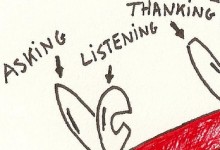
So the next question is: exactly "HOW" can I be the cause for relationship to occur?  There are 4 ways to do so and they are universal, i.e.: they are available to anyone, anytime, anywhere. They are:

1. Asking for help: The great Peter Drucker once said: "the leader of the future will be a person who knows how to ask". Asking for help opens doors with honesty and is difficult to resist. It allows your counterpart to have a stake in the solution and to ‘win’ and at the same time you are the cause for this situation to occur.

2. Listening: Attention here – listening is a two-way act, as it involves listening AND acknowledging what you have understood. You need to demonstrate that you are totally engaged. Aknowledging is the part that makes people feel understood and connected.

3. Thanking: Gratitude is a skill we can never display too often. And yet for most people it seems like they need to wait for the perfect moment … but it never comes. It is always the right time to say ‘thank you’. Gratitude is not a limited resource and an overdose is not harmful.

4. Apologizing: Marshall Goldsmith calls this ‘the magic move‘, because an apology is a recognition that mistakes have been made and it contains an intention to change for the better. But most of all, an apology is an emotional contact with the people you care about. It is a closure which lets you move forward.

Bad news for ego

You will note that these four ways have one thing in common: they require you to be humble and to position yourself ‘one down’ with regards to the person you are talking to. You can only access these tools when you let go of your need to win the competition for being right.

In his 2007 bestseller What Got You Here Won’t Get You There, Marshall Goldsmith says: "When you declare your dependence on others, they usually agree to help."  So your only way out is by putting aside ego. It is only when you decide to give up on being right that you will be able to ask for help, to acknowledge feedback, to express gratitude, or to make an apology.

Who is responsible for communication?

Saturday, March 21st, 2009

In a recent workshop I was asked: “Shouldn’t the receiver of a communication be responsible for it? We can prepare all we can, but if they don’t want to swallow it – it’s their problem!” However true, rightful and justified this attitude may seem, to the same extent it will not help you any further on an organizational change program.

To “me” or not to “me”?

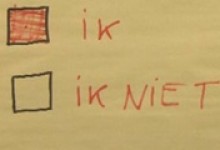
The only way to bring about change in a setting that is characterized by inertia or plain and simple “let-me-tell-you-why-this-won’t-work“-ism is by being the change you want to see in the world. Over and over again. Even when it seems hopeless. So I put the following scheme on the board (in Dutch – but I have put a translation below) (*).

The point here is that responsibility is a choice, not something that happens to you. Everything becomes clear when we study the English definition for “responsible”: It literally means “able to respond” or “being capable of responding.” When people choose to take responsibility in a situation, they co-own it. This insight is fundamental for organizational change management.

Want more possibilities? Yes you can…

… but it takes a radical (i.e. non-rational) approach! Knowing that one cannot assign responsibility  to someone else, there is a practice that can strengthen you at no-one’s expense.  It all starts with the radical declaration: “I am the framework for everything that happens in my life“.

Then, you take the practice one step further: You ask yourself in regard to the unwanted circumstances: ‘well, how is it that I have become a context for that to occur?’. You will begin to see the obvious and less obvious contributions of your past actions and thoughts. That is because when you look deeply enough into that question you will find that at some point you have sacrificed a relationship.

In their book ‘The Art of Possibility: Transforming Professional and Personal Life’ Ben and Ros Zander introduce this very practice and the call it  ‘Being the Board’. Being the board is not about turning the blame on yourself, instead it is about access to possibility.

So next time you are tempted to say: “They just won’t listen”, ask yourself: “well, how is it that I have become a context for that to occur?” And always remember rule number 6!

Related articles on this blog:

_____________
(*) I borrowed this scheme from Clint Callahan – to whom I owe quite some insights in this domain.

Grumpy Boss or Turbo Manager?

Saturday, August 2nd, 2008

Every once in a while I meet bosses and project managers who are very tired and extremely grumpy. You probably have met these kinds of managers too or maybe you are one of them. They seem to be carrying the weight of the world on their shoulders. They are literally looking after everything and are trying to manage everything into the last detail. They have everything under control and they work very hard to keep it that way.
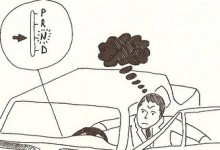
However, when I look at the results of these managers and compare it to the results of other – less grumpy and less tired – bosses and project managers I see no major differences. So there must be a way to achieve the same level of excellence with less suffering. In my humble opinion the answer is ‘yes’ and it is all tied to the manager’s maturity level: being able to let go of the control and to empower his people. Let me explain with the simple comparison of the project team and the engine of a car (*).

Grumpy Car Drivers

The grumpy managers I have met so far are action oriented, results driven and demanding so they hire the best people, which gives their project engine a lot of horsepower. Quite soon they kick off the project – the initial combustion to get the engine running. But then – since they want to control everything – they shift the gears into Neutral and they start pushing the car themselves. Every initiative of a project member to bring the project forward is scrutinized, reworked and criticized until it is completely according to the flavor of the boss. People stop using their brains as pro-active initiatives are discouraged by micromanagement. The engine is not ‘empowered’ because of fear of it getting out of control.

Grumpy Boss

The boss complains that he always has to take care of everything – and he does. He also complains that nobody ever takes any initiative – and indeed they don’t; people are discouraged to do so. The project does not advance as it should, the boss is very tired, the skilled people are also tired of being told what to do in the last detail and all the fuel (i.e. resources: time, money, manpower and attention) are wasted. These managers would be better off with a project bicycle than a project car with a powerful engine.

Turbo Managers

We all know that these bosses should just be shifting that gear into Drive and empower their team of skilled people, consciously making use of time, money, manpower and attention. However, in their minds they are already doing that and they may even be pushing the pedal to the metal – but with the gear shifted in Neutral it only makes a lot of noise. People only do what they are being told because the more our grumpy man uses his reins the less they will use their brains.

Changing the gears of this project car from Neutral to Drive will not require the boss to “do” certain things differently or to “do” more things. Instead it will require the boss to “be” a different driver. The basic question here is: “Who am I being that I always have to take care of everything and that nobody ever takes any initiative?” This type of question refers to Ben Zander’s The Art of Possibility and here is my personal answer to that question…

An empowering manager is not the driver of the project car but the turbo of the engine. Instead of controlling the engine in all its details a turbo is committed to the performance of the engine. The function of a turbo is to aerate the engine when the engine needs extra performance. Turbo managers are committing rather than controlling; they hold themselves responsible for creating the circumstances for better engine performance. So the solution is not a quick fix like changing the oil or the tires, but a transformation from a driver into an engine part.

The Real Driver

You may wonder: “when the project manager is the turbo of the engine – who is at the steering wheel and controlling the pedals?” The customer is. And the manager no longer ‘assumes’ what the customer needs. Again this requires the manager to give away another part of his control: reporting about the delivery part of the project (when the customer does not follow the project car from close by the project manager can report any status he wants).

As you can guess Turbo Management (wow, a new buzzword is born!) requires two fundamental changes:
1. The boss is no longer controlling the project like a grumpy maniac but declares himself as an empowering part of the engine;
2. The customer needs to be in the driver’s seat – which makes more sense since the customer knows the road and the destination better than the boss or the project manager.

It’s just a thought that came to my mind…

______________
(*) Regular readers of my articles will note that this article builds further on the 2003 article “Communications Antislip Training for Project Managers“.

Music and Leadership

Sunday, July 20th, 2008

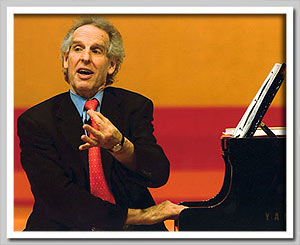
Here is a talk/performance by one of the living legends in the world of music. Ben Zander is a leading interpreter of Mahler and Beethoven and the co-author of the best selling book The Art of Possibility. To my opinion the below movie tells more about leadership than any course on that subject in any business school.
These are some of the elements that hit me most in this movie and they pretty much sum up the essence of leadership.

Learning to commit instead of control

He demonstrates how beginners concentrate on each step. As we grow up and learn we are able to see past the individual step and instead see the whole movement. The same goes for leaders: beginners always try to control each step and mature leaders are rather committing to the whole movement instead of trying to control each step.

Mature leaders are committing rather than controlling. As Zander conveys: “It is one of the characteristics of a leader that he does not doubt for one moment the capacity of the people he’s leading to realize whatever he’s dreaming.”

Later in this performance he says: “A conductor does not make a sound. He depends for his power on his ability to make other people powerful… As a leader your job is to awaken possibility in other people.”

Without mentioning the word, what Zander is talking about is ‘empowerment’. How I wish I knew about his insights when I was an MBA student – it would have helped me through those dull academic definitions that completely – utterly – miss the point.

Responsibility

Through the metaphor of music, Zander shares his insights on taking responsibility. If eyes of your audience aren’t shining you should ask yourself ‘who am I being that their eyes aren’t shining?’. This question puts you in the position of what I would call “radical responsibility” and this entails both, good and bad news. First: you declare yourself ‘being in the driver’s seat’(Zander calls this ‘being the board’) and the bad news is: there are no excuses after that declaration.

Vision

Zander demonstrates how so many different people with individual ideas and situations can all be moved by one single piece of music at the same time. All humans are different but we can all connect through music. If a conductor were the leader of an organization, his vision would be the music that connects all different minds and motivate them to commit to the same goal. Of course, in order to do so there is one final ingredient to leadership, and that is passion…

Passion

The ’shining eyes’ would not have been there if there if there wasn’t a spark from the leader. There is no better way to talk about leadership than to demonstrate it, and that is what Zander does – fuelled by his passion for music.

Related articles:
- Always Remember Rule Number 6! (December 6th, 2007)
- Redefining ‘Responsibility’ (October 22nd, 2007)

Always Remember Rule Number 6!

Thursday, December 6th, 2007

The following story is quoted from  Ben and Rosamund Zander’s book ‘The Art of Possibility: Transforming Professional and Personal Life

Two prime ministers are sitting in a room discussing affairs of state. Suddenly a man bursts in, apoplectic with fury, shouting and stamping and banging his fist on the desk. The resident prime minister admonishes him: "Peter," he says, "kindly remember Rule Number 6," whereupon Peter is instantly restored to complete calm, apologizes, and withdraws.

The politicians return to their conversation, only to be interupted yet again twenty minutes later by an hysterical woman gesticulating wildly, her hair flying. Again the intruder is greeted with the words: "Marie, please remember Rule Number 6." Complete calm descends once more, and she too withdraws with a bow and an apology.

When the scene is repeated for a third time, the visiting prime minister addresses his colleague: "My dear friend, I’ve seen many things in my life, but never anything as remarkable as this. Would you be willing to share with me the secret of Rule Number 6?" "Very simple," replies the resident prime minister. "Rule Number 6 is ‘Don’t take yourself so damn seriously."

"Ah," says his visitor, "that is a fine rule." After a moment of pondering, he inquires, "And what, may I ask, are the other rules?"

"There aren’t any."

Redefining ‘Responsibility’

Monday, October 22nd, 2007

Whenever something happens that interrupts our reality we can do one of the following:
A - Put all our energy in trying to get back to how it was before (“Why is this happening to me, it’s unfair”);
B – Take it as a starting point and look for other available options (“Something interesting happened, let’s see which options we have as a result of this change”).

This is a fascinating observation in organizational change and over the past years I have done some reading in order to gain clarity on how to get from point A to point B. What I found is that the term responsibility is fundamental on this track from A to B.

A Deliberate Choice

Responsibility is a choice, not something that happens to you. Everything becomes clear when we study the English definition for “responsible”: It literally means “able to respond” or “being capable of responding.” When people choose to take responsibility in a situation, they co-own it. This insight is fundamental for change management. We always have the choice of becoming the owner or the victim of a situation. William Glasser calls this the Choice Theory. An owner will look for solutions; a victim will search for a persecutor or a rescuer.

The Hard Stuff

So why is it so difficult for us to make a deliberate choice? In her book "The Last Word on Power", Tracy Goss explains that we are hard-coded to believe that there is always a way that things should be. And when they are that way, things are right. When they’re not that way, something is wrong with you, them, or it. As a human being, it is the source of our success and at the same time the source of our limitations. It defines our reality, our way of being, and our way of thinking. This, in turn, focuses our attention and shapes our actions, thereby determining what’s possible and not possible for us.

Goss offers a lot of advice on freeing ourselves from the illusion that we can control life so that it turns out "the way it “should”. Accepting that “life doesn’t turn out the way it should” is the equivalent of an alcoholic “hitting bottom”. You must go through a life-transforming experience before you can transform your relationship to the addiction and before you can move from denial to acceptance.

The Soft Stuff

In their book ‘The Art of Possibility’ Ben and Ros Zander introduce the practice of ‘Being the Board’. According to them one cannot assign responsibility  to someone else. Their practice of being the board is purely an invention and yet it strengthens you at no-one’s expense.
It all starts with the radical declaration: "I am the framework for everything that happens in my life". Then, you take the practice one step further: You ask yourself in regard to the unwanted circumstances: ‘well, how is it that I have become a context for that to occur?’.
You will begin to see the obvious and less obvious contributions of your past actions and thoughts. Being the board is not about turning the blame on yourself, instead it is about access to possibility.

The Compass

In case you would like to experiment with this new practice of responsibility, here is a little compass that will help you to stay on track. From what I have read in the three books that I discussed above I have learned that there are three behavioral indications that tell me how I am doing.

1. Am I controlling or am I committing?
When I blame you for something that goes wrong, I seek to establish that I am in the right. In return I gain control over the situation. However, in as much as I blame you for something that went wrong – to that degree, in exactly that proportion, I lose my power. Life does not turn out the way it should. The only behavior I can control is my own.

2. Am I being in the past, the present or the future?
The game of "shoulds and oughts" is a blame game that gives me a sense of control because it puts me in the right. Oddly enough all these conversations either occur in the past or  defer my responsibility to the future. I have no control over things that happened in the past, neither can I predict what will happen in the future.

3. Am I being right or am I being in relationship?
Whereas ’should haves’ are commonplace in the fault game, apologies are frequent when you name yourself as the board. That is because when you look deeply enough into the question "How did that thing that I am having trouble with get on the board that I am?" you will find that at some point you have sacrificed a relationship. In the fault game your attention is focused on actions – what was done or not done by you or others. When you name yourself as the board your attention turns to repairing a breakdown in relationship. That is why apologies come so easily.