
Archive for the ‘Brian Wansink’ Category

Elephants! Everywhere I look!

Monday, March 8th, 2010

Forget the cheese and the mice, organizational change management just entered a new era: that of elephants and riders. The Heath brothers published a ground-breaking book on our core business.
And the expectations were high. First, because their previous book Made to Stick was a great hit for anyone involved in communication.

Second, because I judged ‘how are they going to pull that one off, without a proven track record of publishing in our field of expertise’? Let’s face it: they are not Kotter, Block, Schein, Weick or Blanchard. So I was a little skeptic.

Compelling Style

And they proved me wrong, by every turn of the page. As we could expect, this book is well engineered from a communications point of view. They use strong and compelling stories throughout the book and – like in their previous best seller – they use ‘clinics’ to illustrate the framework they are exposing. So that’s already an A from an educational and storytelling point of view.

What about the content?

So far so good. But what about the content? Before ordering the book I felt like one of the organizational change practitioner’s on LinkedIn paraphrased it: “this book seems like it’s not going to offer me anything better than the proven techniques put out there by experts in change management.” Some other colleagues stated “this book is not transformative“.

Come again? Not transformative? My colleagues refer to the fact that some of the examples cited in the book have been used before in other change literature. Unfortunately they fail to see that the authors present a framework that is clearer than ANY methodology or phase-model I have ever seen in this area.

The authors use the analogy of an elephant and its rider. The rider represents the rational and logical. The Elephant, on the other hand, represents our emotions, our gut response. They are two parts of the human mind and the premise of the book is that change management initiatives need to address both rider and elephant in order to change. The content of the complete book is based on this metaphor:

STEP ONE: DIRECT THE RIDER
- Find the Bright Spots
- Script the Critical Moves
- Point to the Destination

STEP TWO: MOTIVATE THE ELEPHANT
- Find the Feeling
- Shrink the Change
- Grow Your People

STEP THREE: SHAPE THE PATH
- Tweak the Environment
- Build Habits
- Rally the Herd

Elephants … Once you start seeing them

Below is an early note that I scribbled while I was reading the book. On this note I visualize that the rider is analytic and sees a logical straight line from the present state to the future state. This line is best described as ‘Analyze – Think – Change’. The elephant on the other hand – representing the emotional side – tips into the cycle of change as described by Elisabeth Kuebler Ross.

the rider and the elephant in the cycle of change

This is a natural process that all of us go through when we are confronted with any change. The point is that people – or rather their elephants – need time to make sense of the change.

Meanwhile, have a look at the rider anxiously holding on to that straight line. Turns out that in times of change motivation is more important than math.

Transformation: from mice to elephants

The real reason why this book is a gem is because the authors practice what they preach: they point out that you don’t have to be a CEO, a president or a prime minister to bring about effective change. If you look for solutions that are as complex and as big as the problem (which analysts often do) you will get paralyzed. Instead, Chip and Dan Heath advice to shrink the change and adopt the Flylady strategy, fighting chaos with five minute room rescues. (by the way, she defines CHAOS as: Can’t Have Anyone Over Syndrome)

Second, the authors point out that what often looks like a people problem turns out to be a situation problem. On multiple occasions they cite Wansink’s research on Mindless Eating. The point here is that Dinner control starts with plate control. And you often have more tools available than you think: small tweaks to the environment that yield big results.

Third, the Heath brothers take a positive approach and this may be the most groundbreaking point for our field of expertise. Until now our focus has been solely on resistance and how to reduce it. In other words: focusing on the problem and looking at what is withholding change. Instead the focus should be on the bright spots the authors say. Resistance is a symptom and not a cause! Stop looking at the mice. Focus on the elephant!

This book dramatically improves your diagnosis of so-called resistance and puts it in the framework of resilience. And when you change the way you look at things, the things you look at change: from resistance busting to resilience building. And that is why I am convinced that it will transform our profession.

Fine as North Dakota Wine

Sunday, July 6th, 2008

In his 2007 book Mindless Eating, Cornell Professor Brian Wansink reports that changing the label on a wine changes diners’ opinions of their wine, opinions of their meal, and their complete dining experience that night.

Forty-one diners at the Spice Box restaurant in Urbana, Illinois were given a free glass of Cabernet Sauvignon to accompany a $24 prix-fix French meal. Half the bottles claimed to be from Noah’s Winery in California. The labels on the other half claimed to be from Noah’s Winery in North Dakota. In both cases, the wine was an inexpensive Charles Shaw wine.

Those drinking what they thought was California wine, rated the wine and food as tasting better, and ate 11% more of their food. They were also more likely to make return reservations.

Accoring to Wansink it comes down to expectations and his findings are aligned with another set of studies that were conducted about 36 years ago. These studies have consistently shown that people’s impressions are based far more upon how information is conveyed rather than the content itself. For instance, the study by Mehrabian in 1972 shows that the impact of a communication is only for 7% purely the content, for 55% body language, colors, layout, smiles and visual stuff, and for 38% how we speak, language, vocabulary, tone of voice etc.

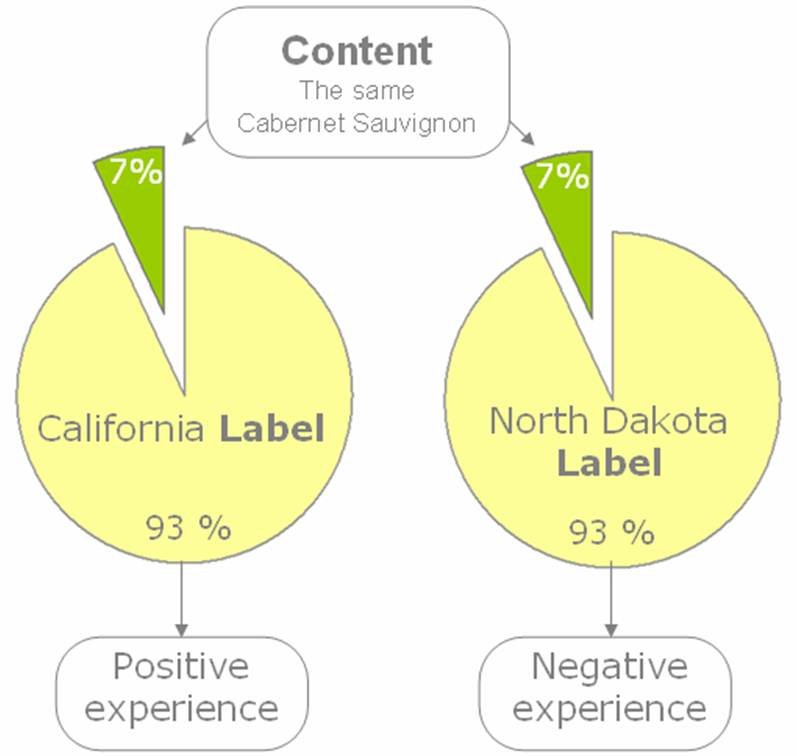
This means that our perception accounts for 93% of the impact (provided that the 7% content is to the point and correct). In terms of Wansink’s dining experiment: the content of his bottles impacted only 7 % of the perception. In the drawing below I have blended both insights to depict the impact of the wine label on the dining experience.

The impact of a wine label versus bottle content 

As Wansink asserts: Once they were given a free glass of "California" wine, they said to themselves: “This is going to be good." Once they concluded it was going to be good, their experience lined up to confirm their expectations. They no longer had to stop and think about whether the food and wine were really as good as they thought. They had already decided. This mechanism is also known as ‘cognitive dissonance’ or ‘overjustification’ and it is hard-coded into the human mind.

Of course I would not be writing about these findings if I wouldn’t attach my own ‘far fetched’ analysis on organizational change management. Well, here it is and it comes with a big disclaimer: In the same way as the label of a wine bottle can impact the dining experience, to the same extent – that is approximately 93% – your change management efforts can influence the experience of your systems implementation (be it SAP or any other ERP platform) or reengineering effort. This is depicted in the drawing below: the impact of change management on the experience of your target audience.


The impact of change management efforts on perception

The disclaimer – of course – resides in the fact that good change management does not compensate a bad implementation or bugged ERP software. The content has got to be right, although it will only positively impact the user experience for 7%.

Conversely, if the content is not good (corked wine or a bugged ERP software for that matter) there is no way a nice label or good change management practices can make up for it. In this respect, good ERP software is a hygiene factor and change management is a motivation factor.

As I stated in an earlier article, it’s all a matter of managing the attention we give to the one and (not: "or") the other.

______________
Sources:
– Albert Mehrabian “Nonverbal Communication” Walter De Gruyter;  1972
– Brian Wansink "Mindless Eating: Why We Eat More Than We Think", Bantam, 2007