

Archive for the ‘Virginia Satir’ Category

Miffy

Sunday, March 2nd, 2008

There is a 5 minute DVD of my daughters titled ‘Miffy and the shadow’ (Miffy is a little rabbit) that I often show before I start the Change Management Cooking Class workshop. At first the participants to the training are surprised, so I get their attention.

Miffy, the cute little bunny

Miffy and FriendsThe video is about how Miffy learns about the shadow in the classroom. Through the instructions of the teacher she becomes aware of light and shadow in her environment. Later we see her walking home while the sun sets and she notices her own shadow. At the dinner table she even tells her parents about what she learned.

However, at night she is very frightened by the moonlight shadow and she needs the support of her parents to calm her down. Her parents help her to make sense of it all and to link it to the concept that she learned about in class.

That’s quite a big step for Miffy, because although she was taught the concept of ’shadow’ in the classroom and although she demonstrated that she understood it to her parents at the dinner table, she had been unable to ‘use’ her knowledge in practice. She needed a gentle nudge to do that.

In case you would wonder: I do lecture in business schools and to MBA students and I use this DVD a lot! While I am switching off the DVD most of them still have that "what the fuck?" look on their faces and that is when I tell them that this is a good example of what Viginia Satir refers to as ‘foreign element’. However, there are two other insights that occur from this DVD that are fundamental to organizational change management. They are: how people develop and learn, and the importance of psychological safety.

How people learn

Miffy reveals about 90% of the major insights of development psychologists Jean Piaget and Jerome Bruner. Both of them have produced ground breaking insights on how people learn. Their main point is that knowing is a process rather than a product. In the words of Bruner(*): "We teach a subject not to produce little living libraries on that subject, but rather to get a student to think mathematically for himself, to consider matters as an historian does, to take part in the process of knowledge-getting."

Piaget, on the other hand, talks of a process of adapting. This is a constant give-and-take between modifying reality in order to fit into our minds (assimilation) and modifying our minds so the new reality can fit in (accommodation). The change-pain that results from this process is how I make a living.

In terms of Miffy’s shadow this means that the end of the ’shadow-class’ is where the process of learning begins. When the teaching stops, Miffy still needs to ‘learn’ 99% of the subject. This is fundamental for those who think that training alone is enough in order to make an organizational change happen. At the very best it is a starting point; From there on you will need to coach your way to the future state!

We are all afraid

And that is where the second insight is necessary: the psychological safety that is needed so badly in times of change. In order for this process of learning to happen, we need to make sure that the environment outside of the classroom is not one that stigmatizes mistakes.

As a starting point in times of change I think it is fair to say that we are all afraid. However, as a change agent, it is your own maturity, expressed by how well you deal with your own fear, which determines to what extent you will allow the process of learning to take place.

Pretty fundamental insights from a DVD for 4-year olds, don’t you think?

___________________
Bruner, J. S. (1966) Toward a Theory of Instruction, Cambridge, Mass.: Belkapp Press.

Virginia, To Thee I Pray

Sunday, February 3rd, 2008

Over the past months I have been shaking up the realities of a team that is supposed to deliver IT services to my team. Deadlines are tight, stakes are high and communication gaps are deep.In God we trust and to Virginia I now pray.
Upfront I should be posting a big disclaimer on this article, stating that you are reading only one part of the story: mine. To my experience, the parties on either side of a communication gap tell stories that have very few elements in common.

So here’s my part: one of the big deliverables on the critical path of my project requires a custom-built web-application. From the beginning I have been putting quite some pressure implicitly (never explicitly: I’m slicker than most) suggesting that IT guys were incompetent if they were unable to commit to a timing, a budget and a delivery date. To me that seemed obvious, so I used every legitimate power at hand to make my point. As a result, 4 liaison persons have been appointed, some of the C-level hotshots are copied in emails and next week a web-programmer will start physically in our team, expatriated from the IT department. As I said, stakes are high, deadlines are tight … and I’m the bad guy. Juicy details all over the place, I can feel the spotlights burning on my skin. How fascinating!

As I am writing this I realize that I am on an important crossroad. I now have to suspect myself first and make a choice between being right or being in relationship. Arguing and justifying my past actions will not speed up results; neither will it close the gap that I am – at least partially – responsible for. Here are the facts: the deadline is not-negotiable, the programmer starts on Monday and all the rest is my interpretation.

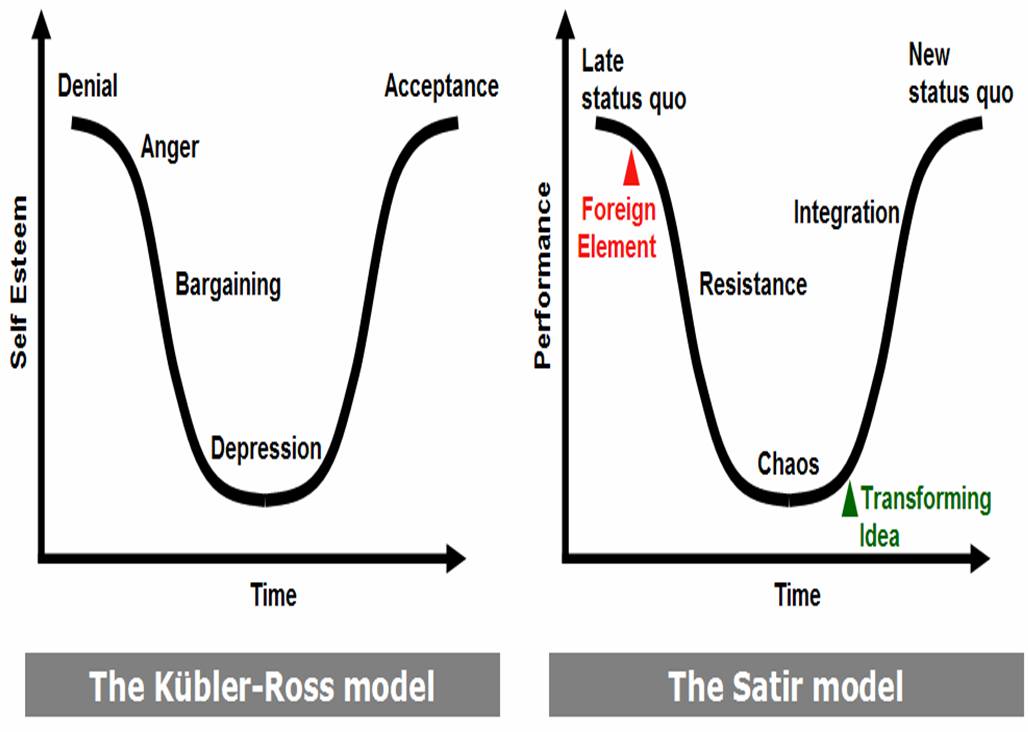
One of my biggest flaws that I am aware of is my need to win at all cost in all situations – when it matters, when it doesn’t, and when it’s totally beside the point. So I pray to Virginia Satir to help me out here. Virginia Satir is a family therapist whose models and techniques are highly applicable in organizational settings. The wonder I am hoping for is that the insights of the Satir Change Model will keep me on the right track here. It is a model that highly resembles the classical Kübler-Ross model of change.

The Kuebler-Ross model compared to the Satir model

According to the Satir model, the resistance stage is triggered by a foreign element. Next, people get out of the dip by discovering a transforming idea that shows how the foreign element can benefit them. So here’s my next week’s challenge: 1. discover the foreign element (it could be me!); 2. Find out how this can become a transforming idea; 3. Stay in relationship and keep away from being right. Phew … Virginia, to thee I pray!!