
Archive for the ‘Tracy Goss’ Category

Dying Before Going Into Battle

Friday, August 1st, 2008

This is the title of the fourth chapter of the 1996 book ‘The Last Word on Power’ by Tracy Goss. In this chapter, Goss draws our attention to the Japanese Samurai warriors who, in reminding themselves of the inevitability of loss, used the phrase “Die before going into battle.” This practice allowed a warrior to enter an episode of combat without fear of death. He had brought himself through an experience of the acceptance of death ahead of time. His death was a plausible outcome. In this way the warrior was able to fully give himself to his mission without concern for survival. Such freedom made all the difference between defeat and victory.

A few weeks ago I advised a good friend to apply that exact same technique. His "battle" was an interview where the stakes were very high for the rest of his career. Instead of providing him with tips and tricks on the level of action ("doing") I advised him to change his position on the level of "being". As Goss argues, freeing yourself from the illusion that you can control life so that it turns out the way it ’should’ means that you accept defeat as a plausible outcome. Along the lines of Goss’ advice I gave to my friend the assignment to free himself from the illusion that he could control the outcome of the interview so it would turn out the way he wanted.

At first he was a bit puzzled by the advice because he expected me to give him tasks, assignments, stuff to read, issues to analyze and research, MBTI style surveys to fill out and lots of homework. Not. What I asked him to do is to shut all his plans, one-liners and prepared scenarios for the interview down, to go to a quiet place and to really imagine himself getting it all wrong and picking up life after failing the interview. Then I asked him to accept that scenario as a plausible outcome.

As you can guess I would not be writing about this event if it weren’t successful for my friend. A few days later I got a phone call in which he explained: "Before I got in for the interview I was convinced that the game was over and I accepted that outcome. As a result I was so relaxed that I forgot about scenario A or strategy B that I would apply during the interview – because it did not matter anymore – and I could engage fully in the interview without any distraction." This sudden ‘liberty’ and ‘letting go of the urge to be in control’ is something I have written about before (The Rattle Snake exercise): the more you prepare for a conversation, the more you will get stuck because your preparation takes over from the real source of a fruitful conversation: yourself.

To my opinion this is a practice we should apply more often in our lives – be it private or professional. As Goss explains: "You cannot control the outcome of your life. In the end, the outcome will be the same. One day you will die. Someone with a shovel will throw dirt over your face. You will be, at that time, as satisfied or unsatisfied as you will be. In the meantime, life won’t follow the pattern of the controls you are trying to put in place. Your life will not turn out as you hope it will. There is no hope of life ‘turning out as it should.’ Life turns out as it does."

Redefining ‘Responsibility’

Monday, October 22nd, 2007

Whenever something happens that interrupts our reality we can do one of the following:
A - Put all our energy in trying to get back to how it was before (“Why is this happening to me, it’s unfair”);
B – Take it as a starting point and look for other available options (“Something interesting happened, let’s see which options we have as a result of this change”).

This is a fascinating observation in organizational change and over the past years I have done some reading in order to gain clarity on how to get from point A to point B. What I found is that the term responsibility is fundamental on this track from A to B.

A Deliberate Choice

Responsibility is a choice, not something that happens to you. Everything becomes clear when we study the English definition for “responsible”: It literally means “able to respond” or “being capable of responding.” When people choose to take responsibility in a situation, they co-own it. This insight is fundamental for change management. We always have the choice of becoming the owner or the victim of a situation. William Glasser calls this the Choice Theory. An owner will look for solutions; a victim will search for a persecutor or a rescuer.

The Hard Stuff

So why is it so difficult for us to make a deliberate choice? In her book "The Last Word on Power", Tracy Goss explains that we are hard-coded to believe that there is always a way that things should be. And when they are that way, things are right. When they’re not that way, something is wrong with you, them, or it. As a human being, it is the source of our success and at the same time the source of our limitations. It defines our reality, our way of being, and our way of thinking. This, in turn, focuses our attention and shapes our actions, thereby determining what’s possible and not possible for us.

Goss offers a lot of advice on freeing ourselves from the illusion that we can control life so that it turns out "the way it “should”. Accepting that “life doesn’t turn out the way it should” is the equivalent of an alcoholic “hitting bottom”. You must go through a life-transforming experience before you can transform your relationship to the addiction and before you can move from denial to acceptance.

The Soft Stuff

In their book ‘The Art of Possibility’ Ben and Ros Zander introduce the practice of ‘Being the Board’. According to them one cannot assign responsibility  to someone else. Their practice of being the board is purely an invention and yet it strengthens you at no-one’s expense.
It all starts with the radical declaration: "I am the framework for everything that happens in my life". Then, you take the practice one step further: You ask yourself in regard to the unwanted circumstances: ‘well, how is it that I have become a context for that to occur?’.
You will begin to see the obvious and less obvious contributions of your past actions and thoughts. Being the board is not about turning the blame on yourself, instead it is about access to possibility.

The Compass

In case you would like to experiment with this new practice of responsibility, here is a little compass that will help you to stay on track. From what I have read in the three books that I discussed above I have learned that there are three behavioral indications that tell me how I am doing.

1. Am I controlling or am I committing?
When I blame you for something that goes wrong, I seek to establish that I am in the right. In return I gain control over the situation. However, in as much as I blame you for something that went wrong – to that degree, in exactly that proportion, I lose my power. Life does not turn out the way it should. The only behavior I can control is my own.

2. Am I being in the past, the present or the future?
The game of "shoulds and oughts" is a blame game that gives me a sense of control because it puts me in the right. Oddly enough all these conversations either occur in the past or  defer my responsibility to the future. I have no control over things that happened in the past, neither can I predict what will happen in the future.

3. Am I being right or am I being in relationship?
Whereas ’should haves’ are commonplace in the fault game, apologies are frequent when you name yourself as the board. That is because when you look deeply enough into the question "How did that thing that I am having trouble with get on the board that I am?" you will find that at some point you have sacrificed a relationship. In the fault game your attention is focused on actions – what was done or not done by you or others. When you name yourself as the board your attention turns to repairing a breakdown in relationship. That is why apologies come so easily.

Making Culture is No Rocket Science

Sunday, July 22nd, 2007

But it Takes Guts

In this article I want to pick up the broken pieces that resulted from my organizational culture rant of an earlier post. I stated that measuring culture is the wrong pot to piss in (well, not in those exact words, but I did meet some HR managers who were not too happy about the directness). In contrast to that particular article, I now want to focus on how to approach organizational culture. More in particular, I argue that philosophy and not psychology holds the keys to organizational culture.

Doing Versus Being
Without getting too philosophical we should note that the way you are being is the source of your reality, which in turn is the source of your actions. But the domain of being is hidden because it is not referred to in everyday action oriented language. ‘Being denies its own coming into existence’, as Martin Heidegger notes.

The point is that changing an organizational culture is creating something that is currently not possible in your reality. It is not improving something that is now already possible in your context by making it better, different or more (which is the domain of DOING). Instead, it is exchanging the current context for a new one in which certain things all of a sudden become possible (context is the domain of BEING).

Again the key insight comes from the philosopher Martin Heidegger. According to him, language is the only leverage for changing the world around you. This is because people apprehend and construct reality through the way they speak and listen. In her book The Last Word On Power, Tracy Goss continues Heidegger’s statement. According to her, by learning to uncover the concealed aspects of your current conversations and learning to engage in different types of new conversation, you can alter the way you are being, which, in turn, alters what’s possible.

The Anatomy of our Perception
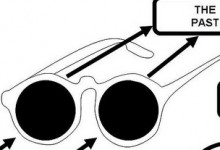
In the previous article on culture I ended by saying that hat our inability to measure culture does not prevent us from creating one. But first, let us have a look at what it is made out of. As you remember, culture is a sense making mechanism that works like a pair of glasses you are wearing. It determines your perception, i.e.: the data you select.

Sense making is hard coded into all human beings. It is something we do all the time (you can not ‘not do it‘, like it is impossible to ‘not taste’ the food that is in our mouth) and it always follows the seven steps that are derived from Karl Weick’s seven characteristics of Sense Making in organizations:
(Click on the drawing to enlarge)

1. The Past: We make sense of our experiences by comparing them with previous experiences. The organizational past is an important indicator in predicting the reaction to the current organizational change. The past is something that comes walking in through the back door of emotions. People remember events that have the same emotional tone as what they currently feel. Past events are reconstructed in the present as explanations, not because they look the same but because they feel the same.

2. My Relations: We make sense of changes in organizations while in conversation with others, while reading communications from others, and while exchanging ideas with others.

3. My Labels: People are sense-making creatures. Whenever a change happens that affects us we give it a label and put it into a known category (dangerous, stupid, beautiful, etc.). Almost instinctively, we respond with familiar questions: Who is behind this? What are the credentials of those people? Who said so? What will become of us after that change? Do they have the support of management?

4. A Declaration: Words have consequences. We should never underestimate the power of words and conversations. A situation is “talked” into existence, and the basis is laid for action to deal with it. Declarations are the way we translate stuff from below the surface into explicit knowledge. As a simple example, when people constantly say that “this project stinks” they create a climate in which the observation of difficulties is stimulated and the observation of possibilities is constrained.

5. The Real Story: People are interested in the truth, not the details. And people are not stupid. We construct the meanings of things based on reasonable explanations of what might be happening rather than through scientific discovery of “the real story.” Here is a warning flag to heed at this point: What is a simple truth for one group, such as managers, often proves implausible for another group, such as employees.

6. The Timeslot: Sense making is linked to timing. Like an airplane waiting for takeoff, an event will only get a limited slot for takeoff in the attention span of an individual. If that moment of attention happens to be the right one, it helps in setting a culture.

7. The Triggers: Nobody is capable of observing it all. Our observation is based on extracted cues. The cues that we observe depend on what we expect to observe, As a kind of self-fulfilling prophecy, we shape our reality according to how we expect it to be. When we think we are going to succeed at something, we will be triggered by every cue that confirms this reality and act upon it, and vice versa.

The Anatomy of Culture Creation
In the table below and the drawing on the right I have taken the anatomy of our perception and created seven matching steps that are necessary for creating an new organizational culture.

(Click on the drawing to enlarge)

Working on these seven components, all at the same time ensures a shift on the level of ‘being’ of the organization by setting a new context in which different things are possible.


Audit your “ROC” – Return On Communications
All of these elements (not necessarily in that order) constitute the key points of an organizational culture. This is what you need to monitor during the complete lifecycle of any change program. A successful communication strategy during organizational change takes into account the anatomy of our perception and works towards a similar mechanism in order to create a new culture.

Eventually, when scanning through your communication plan, all of these steps should be catered for; either in communication principles or in concrete actions. More important, this should also work the other way around: if you identify any communication action that does not accomplish any of the seven steps above, you should seriously question its added value for the program and the return on investment of attention, time, and money (exactly in that ranking order of scarcity).
__________________________
Sources used in this article:
Goss, T.: The Last Word On Power, Currency: Doubleday. 1996
Weick, K.: Sensemaking in Organizations, Thousand Oaks: Sage Pubications. 1995