
Archive for the ‘Robert Cringely’ Category

Execution: Organizational Change Management in Practice

Sunday, April 20th, 2008

In an earlier article I have argued that Organizational Change Management is a discipline and not a leisure activity. Here I would like to focus on the part where it gets real: execution and how to get all that stuff done in practice. In short: in order to be successful, organizational change efforts are not exercises in democracy but rather military deployments. This article builds further on that military metaphor to clarify my point.
Lessons Learned from Silicon Valley

In the chapter "On The Beach" of his 1993 book Accidental Empires, Robert Cringely talks about the three distinct groups of people that define the lifetime of a company: Commandos, Infantry, and Police. Whether invading countries or markets, the first wave of troops to see battle are the commandos. A start-up’s biggest advantage is speed, and speed is what commandos live for. They work hard, fast, and cheap, though often with a low level of professionalism, which is okay, too, because professionalism is expensive. Their job is to do lots of damage with surprise and teamwork, establishing a beachhead before the enemy is even aware that they exist. Ideally, they do this by building the prototype of a product that is so creative, so exactly correct for its purpose that by its very existence it leads to the destruction of other products. They make creativity a destructive act.

Grouping offshore as the commandos do their work is the second wave of soldiers, the infantry. On big projects these are the multitudes of ‘big 5′ consultants who get the job done: blueprinting, designing, testing, training, collecting and cleansing data, etc. The most important thing here is that an infantry takes on a structured approach. In the words of Cringely :
"While the commandos make success possible, it’s the infantry that makes success happen. These are the people who hit the beach en masse and slog out the early victory, building on the start given them by the commandos. [...] Because there are so many more of these soldiers and their duties are so varied, they require an infrastructure of rules and procedures for getting things done."

What happens then is that the commandos and the infantry head off in the direction of Berlin or Baghdad, advancing into new territories, performing their same jobs again and again, though each time in a slightly different way. But there is still a need for a military presence in the territory they leave behind, which they have liberated. These third-wave troops hate change. They aren’t troops at all but police. They want to fuel growth not by planning more invasions and landing on more beaches but by adding people and building economies and empires of scale. They can’t even remember their first- and second-wave founders.

UN Peace Keeping Troops

To my experience, this same distinction applies to big organizational change projects. However, in order to make this approach effective in that context, Cringely fails to notice that you need UN Peace Keeping Troops between the infantry and the local police.

Once your prototype is ready to be tested, you will find that UN Peace Keeping Troops are quintessential in order ‘to get organizational change management done’. This is the fragile process of handing over knowledge from project agents (infantry) to the target users (police and citizens) and to manage the process of political buy-in. 

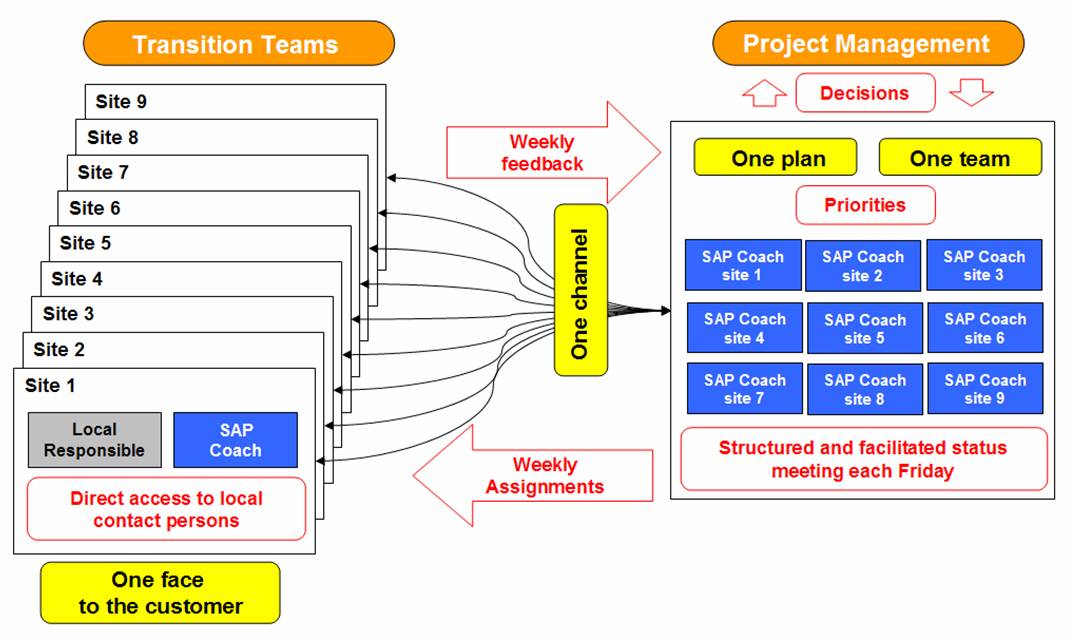
In most of the SAP projects where I am involved we call them ‘local coaches’ or ‘transition teams’ They manage the fragile process of handing over knowledge from project agents to the target users. Their only purpose is to stabilize the new order and eventually to hand over to the local peacekeepers: the police.

A Best Practice from SAP Implementations

The below drawing shows a model that I would tag as ‘best practice’ because I have been refining it over the course of multiple projects. The yellow boxes indicate the basic principles we want to achieve.

drawing-un-troops.jpg

Examples of typical coaching assignments include the following:
– Attaching people to new functional roles and having the subsequent trainings validated
– Communicating the vision and strategy and translating these to the level of the site (‘does this make sense to you?’)
– Communicating the future processes and highlighting the what’s in it for me (WIIFM)
– Local testing of processes
– Implementation and follow up of key performance indicators (KPIs)
– Following up data collection and data cleansing
– Supporting local training initiatives and evaluate the learning of the users after they went to training
– Assisting with the local technical systems deployment

The most important thing is to note that underneath these examples are some fundamental ’soft’ returns on investment:
– By their physical presence and time they spend locally the coaches can do the job of ‘handholding’ that is necessary in times of change
– They provide psychological safety by translating the central concepts to local practice
– UN Peace Keeping Troops leverage the impact of the experts in the central team on a local level because they have direct access to all implementation team members
– If you gather them on a weekly basis and if you facilitate their weekly meeting, they will accelerate best practices and stick to common standards.

UN Peace Keeping Troops need to be there to prevent simple things from going wrong and to help people make their first small victories in ‘real life’.

Why Marketeers outperform Organizational Change Experts (PART II)

Monday, April 16th, 2007

What’s in a word: Sponsors—Agents—Targets
I always wonder why a glossary is mostly the last part of a document – it just makes no sense. So, let’s not do that and start with the glossary of this very article…
Leading change involves building demand for change by managing three different groups: sponsors, agents, and targets. According to Connor (1992) these groups can be defined as follows

Target
This is an individual or entity that will be required to change behavior and actions. They are the most important people in the change process, because if the they reject change, it will fail. However, the way they are commonly referred to is: ‘not me’, ‘they’, ‘them’, ‘those people’, ‘the users’, ‘it’, etc. Of course people love to be tagged like that!

Sponsor
This is the individual or entity with responsibility for the success of a change initiative, and the necessary authority to commit required resources to the initiative. They possess sufficient organizational power to either initiate resource commitment (Authorizing Sponsor) or reinforce the change at the local level (Reinforcing Sponsor).
Common denominator? ‘They’, ‘them’, ‘it’, ‘the ivory tower’, ‘because they said so’, etc. Of course we make sure they never hear us tagging them as such.

Agent
This person is empowered by the sponsor to carry out specific tasks related to the change initiative. Mostly tagged as: ‘they’, ‘them’, ‘who do they think they are’, ‘the project’, ‘not me’, ‘over my dead body’, ‘those consultants’, etc. Of course, change agents are appointed robots, trained and paid to hear that stuff all day, so they don’t mind.

Warcraft Wisdom
OK – so let’s put the sarcasm aside and get to the point: oddly enough the best knowledge on how to guide an organization through a change comes from the army. As Robert Cringely (**) points out in his book Accidental Empires, the founding of the personal computer industry and the history of Silicon Valley is based on different kinds of people, like the different segments of an army.

As you know by now, I am quite keen on recycling any good marketing insight and applying it on the inside of an organization. When we apply Cingley’s analysis we can formulate a clear advise on how to behave as a change agent during the different stages of an organizational change, i.e.: we come to the conclusion that agents of change projects should adopt different styles according to the phase of the change.

Initially, they take responsibility for breaking the fundamental structures that underpin the current context and beliefs. Robert Cringely compares this destructive work to the job of commandos who prepare territory for the infantry:
“Commandos parachute behind enemy lines or quietly crawl ashore at night. Their job is to do lots of damage with surprise and teamwork, establishing a beachhead before the enemy is even aware that they exist.”

In order to get things started, agents take on a commando style in order to create the circumstances for change. Most of the times, the project leader gets the honor of preparing the territory. Whether it is to obtain commitment for blueprinting, design, testing, training or go-live, without the commando actions the efforts will be ignored by business as long as there is no pressure or hard evidence that things will change.

Once the path is cleared, changing can start. Now you will need an infantry of agents to get the job done: blueprinting, designing, testing, training, collecting and cleansing data, etc. The most important thing here is that an infantry takes on a structured approach. In the words of Robert Cringely:
“While the commandos make success possible, it’s the infantry that makes success happen. These are the people who hit the beach en masse and slog out the early victory, building on the start given them by the commandos. […] Because there are so many more of these soldiers and their duties are so varied, they require an infrastructure of rules and procedures for getting things done.”

Finally, the new structures are in place, and it is time to refreeze the new processes that have been installed by the infantry. This is the fragile process of handing over knowledge from project agents to the target audience. You will find that there is still the need for a military presence by means of local coaching. These are the UN peacekeeping troops, a remainder of the infantry (note: you will find nothing about UN peace keeping troops in Cringely’s book – please allow me to stretch the concept). Their only purpose is to stabilize the new order and eventually to hand over to the local peacekeepers: the police.

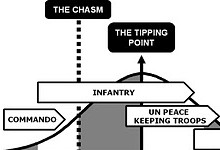
As you remember from the previous post on this topic, over time different target segments are reached by pushing the boulder of your project work past the Chasm to the Tipping Point. The insight that Cringely adds to this drawing is that this takes different team styles: the commandos are the change agents that make success possible (unfreezing), the infantry make success happen (changing) and UN peace keepers and police are needed to refreeze the new structures and habits like a stabilizing force. Does this call for a different staffing according to the phase of your project? Ab-so-lu-te-ly!
________________________
(*) Connor, D. :Managing at the Speed of Change, John Wiley and Sons 1992
(**) Cringely, R.: Accidental Empires: How the Boys of Silicon Valley Make Their Millions, Battle Foreign Competition, and Still Can’t Get a Date, HarperCollins 1993