
Archive for the ‘Philip Kotler’ Category

More Marketing Mumbo-Jumbo: 4 P’s

Thursday, July 12th, 2007

The Marketing Mix of Organizational Change
By now you must know that I am a firm believer and a copycat of successful marketing concepts. The ‘marketing mix’ of Philip Kotler is another one of those basics I keep referring to. Remember what the 4 P’s of marketing are? (they are: Place, Product, Promotion and Price) Well, in organizational change management, there is also a mix that applies. And it equally contains 4 P’s…

Marketing Made Simple
The 4 P’s of Organizational Change are not a plain copy of the marketing mix as the context is not one of consumers with a buying potential but one of employees with an attention potential. The idea comes from Bill Jensen as he builds a case for simplicity. According to him it is essential to formulate the need for change as clear and simple as possible, because people tolerate management’s logic but still they will draw their own conclusions. As a result you need to practice what he calls ‘behavioral communication’; i.e.: communicating on the level of the information needs of the receiver (as opposed to: ‘the justification needs of the sender’).

Cooking Class
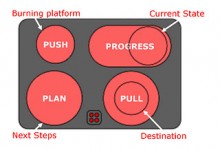
In my trainings I often compare an organizational change effort with the chemistry that is involved in cooking. Even though the comparison with cooking may not seem so obvious, it’s worth noting that the chemistry of cooking involves molecules of different ingredients to be blended through heating into a new form: a prepared meal. The same goes for organizational change: heating up existing ingredients, occasionally adding some elements and blending them into a new shape with a new objective. In this perspective the 4 P’s are the boiler plates that you need in order to create the exact heat that is needed for the chemistry to happen.

Ok now, back to the 4 P’s of Organizational Change; what are they and do I have a simple trick to remember them?

Well, just as a good cook knows his way around the kitchen and knows how to handle the kitchen equipment, a compelling case for change is always built up along the lines of these 4 boiler plates:

1. PUSH: people will only take the leap into the unknown if their house is on fire. That is why the first step always serves to indicate that there is no other option than change.

2. PROGRESS: the answer to the question: ‘where are we and what have we accomplished to date?’, which clearly indicates which certainties and means are at our disposal to undertake this process of change.

3. PLAN: a clarification of the different steps ahead of us and actions that we need to undertake in order to reach the nearest milestone and the one after that and so on.

4. PULL: the final destination, which serves as the magnetic North or the lodestar in case people would lose a sense of direction.

There is also a 5th P: getting all the information on one and the same Page!

The Daily Routine of Great Cooks
The point is that these 4 P’s are so essential that you should not keep them as a one-off exercise or a ‘nice brain teaser’ (this statement is usually followed by "and now back to work"). If you are serious about making a compelling case for change and weaving it into to your approach of managing your project then these 4 P’s should be shaping your status reporting at all levels.

If you want be become a good cook, it will take some practice and “failing forward”. Along the road you will discover how the heating equipment works and how to make best use of it: gas, electricity, induction, fire, grill,…In the language of Organizational Change Management: along the way you will find out what works best in your environment to heat up or cool down things in your organization. All the best in practicing the 4 P’s!

Branding of projects inside your organization…huh?

Friday, February 23rd, 2007

It’s more than just a logo
In an earlier post I have argued that marketing people know more about how to cope with a changing environment than any other people inside an organization. More precicely I stated that the survival of the majority of organizations depends on their marketers’ ability to respond to the “more-better-faster-now” changes in customer environment. Changing is what marketeers are good at, and that is why their insights are valuable when making change happen inside a company.

In this post I would like to treat a second example that underscores this fact: project branding.

What is Branding?

A brand is the image of the project you want to create in the mind of the stakeholders. It is your promise to deliver the outcomes and benefits to thestakeholders. The best brands imply a warranty of quality. A brand can deliver up to four levels of meaning (*). These are examinedbelow:

  • Attributes A brand first brings to mind certain product attributes. For example, your project’s name may suggest such attributes as standardized processes, common data, better customer service, and so on. The project may use one or more of these attributes in its name and catchphrase.
  • Individual Benefits Stakeholders are not interested in individual attributes. They want benefits. Therefore attributes must be translated into functional and emotional benefits. The attribute “standardized” could represent the functional benefit: “It will reduce the complexity, and consequently lead times will be reduced.”
  • Values A brand also says something about the stakeholders’ values. This is the translation into the WIIFM (What’s In It For Me).
  • Personality A brand should project a personality. Motivation researchers sometime ask: “If this brand were a person, what kind of person would it be?” A brand attracts people whose actual or desired self-images match the brand’s image.

How Branding Works
All of the above factors are necessary, but not sufficient. For example, in the context of SAP implementations, your purpose is to create a new culture, and this requires trust and community building.

  • Trust Through branding, the implementation team opens an “emotional bank account” (**) for each stakeholder. The account status displays the value of the relationship between the team and the stakeholder. Trust is the currency of this bank account. As with a financial bank account, deposits and withdrawals are made that affect the value of the relationship. If you stick to your promises, people will make deposits of trust, and the value of your brand will grow. When you make mistakes, the “emotional reserves” will compensate for it, but the value of the brand will decrease.
  • Community Building If the value of the brand is high, more people will want to open an emotional bank account, because depositing trust on your brand gives high returns. That is how you create community: First you provide an image, and then you walk your talk for each individual stakeholder. Pushing an advertising campaign on stakeholders who have a negative balance in their emotional bank accounts will only create cynicism.

Why Branding is Important
There are two reasons why it is important to create an attractive brand that reflects the vision of the project.

  • Psychological Safety If a brand’s trustworthiness reduces anxiety and doubt. Branding creates the emotional link that is necessary for people to experience psychological safety. People need a sense of psychological safety that it is OK to try something new and to give up something old and familiar. However, this building of trust takes time.
  • Reaching the Tipping Point Stakeholders base their ultimate trust about a brand (to support or not to support) on its clarity of purpose. To truly commit, stakeholders try to assess the authenticity with which the project team acts across its entire relationship network. Because that network is largely invisible to them, stakeholders use close relationships (friends, colleagues, opinion leaders, etc.) and symbols (logo, language used, leadership declarations, physical presence, etc) to assess the project (***).

_____________________

(*) Kotler, P., Armstrong; G., Wong, V.: Principles of Marketing, Prentice Hall, 2005
(**) Covey, S.: The 7 Habits of Highly Effective People, Free Press, 1990

(***) Ind, N.: Beyond Branding: How the New Values of Transparency and Integrity Are Changing the World of Brands, Kogan Page, 2003