
Archive for the ‘Peter Senge’ Category

Mindset, Membership and the Matthew Effect

Monday, July 19th, 2010

I have grown up with the firm belief that in order to achieve something in life you need to have a degree. Although I resent that statement with all of my heart I have come to a point that I no longer can deny it.

There are three ‘M’s involved in explaining why I capitulate to the non-sense of the way things are. They are: Matthew Effect, Membership and Mindset.

Matthew Effect

For to all those who have, more will be given, and they will have an abundance; but from those who have nothing, even what they have will be taken away.
—Matthew 25:29

Those who have shall be given – and if you happen to be on the other side: bad luck. But it’s more subtle than one may think at first sight. In his book Outliers: The Story of Success, Malcolm Gladwell compares the misfortune of the genius Chris Langan to the successful achievements of another genius: Robert Oppenheimer.

Both men were equally gifted, so the Matthew effect is not applicable on first sight. However, Gladwell states that – while both men were comparable in terms of intelligence – it is their sense of entitlement that has shaped the opportunity (or lack thereof) to grow and have a successful career.

Being talented, good-looking, intelligent, etc. may be the entry criterion for the achievement contest we call life; eventually it is the access to opportunities that will determine the outcome.

Membership

When researching the main causes of hunger and poverty in Third World countries, 1998 Nobel Prize winner Amartya Sen discovered that hunger is not caused by a lack of food, but by a lack of entitlement.

In the book Poverty and Famines: An Essay on Entitlement and Deprivation he demonstrates that famine occurs not only from a lack of food, but from inequalities built into mechanisms for distributing food.

At the age of nine, Sen witnessed the Bengal famine of 1943. Later he concluded that the loss of 3 million lives was unnecessary. He presents data that there was an adequate food supply in Bengal at the time, but particular groups of people including rural landless laborers and urban service providers like haircutters did not have the monetary means to acquire food.

Mindset

Back to the importance of degrees and the perversity of entitlement. Although entitlement was described by Sen as a matter of having the opportunity to influence your own mortality, I recently came to think of it as an illusion. It seems to me that entitlement to the fruits of a degree is mostly felt by those on the lower side of the glass ceiling.

I also think that the ignorance of how little a degree is worth once you crossed that fence, makes people blind to the real gravitational forces of the Matthew effect. That is: it pulls people down, not up.

A degree is a hygiene factor in terms of Herzberg’s two-factor theory: it is necessary, but not sufficient to succeed. It doesn’t push you up, but lacking it can pull you down.

Tragedy

The tragedy of it all is that it is the degree-less people with the most outspoken talents who suffer the most from this downward spiral of I-am-not-worthy-ness. They carry the lack of entitlement as a burden every day.

They are the victims of a ‘false negative‘ or simply a stupid coincidence.  As a consequence, this world not only suffers an inflation of stock markets. Most of all, it suffers an inflation of degrees.

Hope

Ken Robinson, who recently published ‘The Element: How Finding Your Passion Changes Everything‘ became popular after his 2006 TED talk titled “Do Schools Kill Creativity?” In this talk he makes the case for a radical shift from standardized schools to personalized learning.

Robinson claims our education has dislocated us from our natural talents. Most talents are like real natural resources: they are buried deep. And education as we know it is designed to flatten out the individuality of our talent.
However, we are blocked by the tyranny of common sense as paraphrased by Abraham Lincoln: ‘The dogmas of the quiet past are inadequate to the stormy present. The occasion is piled high with difficulty, and we must rise WITH the occasion. As our case is new, so we must think anew and act anew.’

Conformity

Many of our ideas have been formed not to meet the circumstances of this century but to cope with the circumstances of previous centuries. However, our minds are still hypnotised by them. In other words: college degrees – just like CV’s – are a form of entitlement that made sense in the previous centuries but not anymore. Yet, they continue to rule our lives.

Robinson goes on to talk about the root cause: conformity and a longing for the ‘future quo’. We have built our education systems on the models of fast food: everything is standardized instead of customized to local circumstances. In turn, this is impoverishing our spirits and our energies in the same way that fast food is downgrading our physical bodies.

Passion

He concludes that passion and not conformity is needed to cope with today’s challenges. Doing stuff that feeds your spirit. The kind of thing you are doing when time seems to fly. Like Seth Godin in his book Linchpin: Are You Indispensable?, Ken Robinson links the search for passion to the end of the industrial revolution.

We need to get out of our industrial model of education, which is based on linearity and conformity to an organic model. And with it we need to abandon our attachment to the entitlement of a degree.

Gardening

The one thing we need to understand is that learning and education are organic instead of manufacture-like.  As Peter Senge is often quoted: “We keep bringing in mechanics–when what we need are gardeners. We keep trying to drive change–when what we need to do is cultivate change.”

The only difference between a mechanic and a gardener is the entitlement of their degree and time has come to recalibrate these degrees to the challenges of today’s world.

Love & Work (Part 2) – The Meaning of Life

Monday, May 10th, 2010

“Work itself is but what you deem it.”
Marcus Aurelius

Love and work bring meaning to life. The hardest part to align them according to our strengths. Happiness turns out to be about knowing our strengths. But first things first: what is it exactly we are after?
Reframing the Question

In the last chapter of the book the Happiness Hypothesis, Jonathan Haidt underscores the importance of asking the right question.  It makes sense to pause and examine the kind of answer we are expecting whenever we ask for the ‘meaning’ of something.

To ask “what is the meaning of life” is not asking to define life. Rather than expecting a direct answer, we are hoping for some enlightenment – or an aha experience. An insight in which things we have not understood before begin to make sense.

So what we are really after is not the purpose OF work but the purpose WITHIN work. So we will not get hooked into a debate on ‘do you live to work or do you work to live?’. Instead we dive a little deeper. The below paragraphs and drawings are all inspired on the last chapter of Haidt’s magnificent 2009 best-seller – more in particular: the paragraph called ‘Love and Work’.

Job, Career or Calling?

Recent research suggests that most people approach their work in one of three ways: as a job, a career or a calling.

If you see your work as a job, you do it only for the money and you tend to look at the clock frequently while dreaming about the weekend ahead.

If you see your work as a career you have larger goals of advancement and promotion. The pursuit of these goals often energizes you and you sometimes take work home because you want to get the job done properly. Yet at times you wonder why you work so hard.

If you see your work as a calling however, you find your work intrinsically fulfilling. You see your work as contributing to a greater good. You have frequent experiences of flow during the workday and you don’t have the desire to shout ‘Thank God It’s Friday’.

Growing Instead of Fixing

Peter Senge pointed to the mechanistic mindset of change initiatives when he said “We keep bringing in mechanics–when what we need are gardeners. We keep trying to drive change–when what we need to do is cultivate change.” The same is true for work itself and the way we look at work.

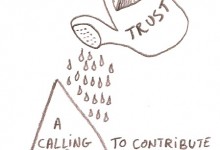
When you approach employees as plants to grow  instead of robots to fix, you will easily find that you can’t fix a plant like you can fix a robot. You can only give it the right conditions: water, sun and soil and then… wait. It will do the rest.

Love and work are to people what water and sunshine are to plants. People have this intrinsic need to contribute beyond themselves. According to Jonathan Haidt, the craving for a realization of love and work can even be found in Maslow’s pyramid as Esteem – which is mostly earned through one’s work. The question we should ask ourselves is ‘what is the best way to tap into this energy so that people can find self esteem in their work?

Aligning Instead of Alienating

The search for purpose within life turns out to be a matter of aligning love and work in your life. Getting the right relationship between you and your work is not easy. However, if you think that blue-collar workers have jobs, managers have careers and the more respected professionals (doctors, scientists and clergy) have callings, you are wrong. In his book Haidt cites research that suggests that ‘occupational self-direction‘ is the determining factor.

In earlier posts I have described this occupational self-direction as ‘job control’ and ‘job autonomy’ and came to the same conclusions. Nevertheless, I would like to quote the inspiring example he used  to state this fact. In a study of hospital workers, Amy Wrzesniewski, a psychologist at Yale University, found that the employees who cleaned bedpans and mopped up vomit, sometimes saw themselves as part of a team whose goal was to heal people. They went beyond the minimum requirements of their job description, for example by trying to brighten up the rooms of very sick patients, or by anticipating the needs of the doctors and nurses. They viewed their work as a calling, and enjoyed it far more than those who saw it as a job.

The conclusion coming out of this research in positive psychology is that most people can get more satisfaction from their work. In this respect, Haidt cites the research of Mihaly Csikszentmihalyi on Vital Engagement, described as a relationship to the world that is characterized by both experiences of flow and meaning.

The first step is to know your strengths. Look for the aspects in your work that make use of your strengths. Haidt advises to re-cast and re-frame your work in order to reflect your strenghts even if that would involve some extra time. Sadly, I have experienced first-hand that the opposite is also true: focus on your weaknesses and you are spiraling downwards: zombies at work.

If you can find your strengths in your work you will find more gratification in work. If you find gratification you will shift in a more positive mind-set. Finally, it will be easier for you to see the bigger picture and the contributions you are making. Your job might turn into a calling. The meaning of work then becomes connection, engagement and commitment. 

Work done with love is the meaning within life. Love and work are crucial for human happiness because they can draw us out of ourselves and into connection with people and projects beyond ourselves.

What about Chris Argyris?

Monday, October 26th, 2009

A few weeks ago at work Danny pointed out that after more than two years of posting articles on this blog I have never mentioned Chris Argyris. Well … what can I say? Shame on me!
Chris Argyris is one of the founding fathers of organizational psychology. His main focus is on learning and most of all: the pitfalls that inhibit learning. Here’s my top 3 of reasons why I should have quoted Argyris earlier.

1. Organizational Darwinism

There is a difference between "doing things the right way" and making sure that you are "doing the right things". It’s a different kind of thinking. Argyris refers to this as ’single loop’ versus ‘double loop’. Single-loop learning is like a thermostat that learns when it is too hot or too cold and turns the heat on or off. The thermostat can perform this task because it can receive information (the temperature of the room) and take corrective action. Double-loop learning occurs when error is detected and corrected in ways that involve the modification of an organization’s underlying norms, policies and objectives. Double loop learning uses feedback from past actions to question assumptions underlying current views.

Relevance to organizational change practitioner on a scale from 1 to 10:"10"!! In fact, double loop learning is exactly what you do when you work yourself or your organization through a change.

2. We are all liars

Another famous theory of Argyris isthe "theory-in-action concept". There is a clear gap between what individuals say they want to do (espoused theory) and what they actually do (theory in use). People always behave consistently with their mental models (theory-in-use) even though they often do not act in accordance with what they say (espoused theory).

Relevance to organizational change practitioner on a scale from 1 to 10:"10"!! Without any doubt in times of transition and change people are constantly eaten by dilemmas of how they should behave what they believe. It helps to be aware of this duality in order to understand the dynamics of what is happening below the surface. In order to effectively come to grips with new situations, the espoused theories need to be aligned with the theories in use.

3. We see the world as we are (not as it is)

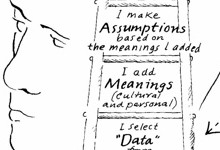
Argyris was the first to introduce the ladder of inference (Peter Senge made extensive useof this concept in the Fifth Discipline). This is a model of how people process information and assign meaning. In other words: ‘how we make sense’. What the diagram implies is that we begin with real data & experience. We then choose a set of selected data & experience that we pay attention to. To this selected data & experience we attach meaning, develop assumptions, come to conclusions, and finally develop beliefs. Beliefs then form the basis of our actions which create additional real data & experience.

Relevance to organizational change practitioner on a scale from 1 to 10:"10"!! Pretty much all of the steps on this ladder are within your scope during an organizational change: altering the experience, influencing the attention, offering new ways of assigning meaning and new ways of making assumptions and changing these beliefs. That is: if you endeavor sustainable change! If not: never mind this ladder and enforce people on the level of action (so they become helpless and dependent).

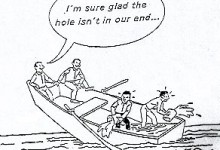
Without any doubt Chris Argyris is of great importance in the field of organizational change management. Phew – I’m glad I fixed that hole!
____________________
Related articles:
- Making Culture is No Rocket Science – July 22nd, 2007

Shut up!! (The Best Management Advice Ever)

Monday, December 24th, 2007

This is one of those articles which is as much meant for myself as it could be helpful to you – dear reader. I presume about every language of the world has a saying that means ’speech is silver, silence is golden’. More often than not I have experienced this saying to be true when it is too late. In my consulting work as well as in my private life I have an array of experiences ranging from small misunderstandings to damaging communication bloopers. So this nudge is to myself in the first place.
I always claim that the value of ‘communication’ is best measured through the extent that one contributes to creating something in ‘common’. In that sense, a large part of the information that we exchange is non-communication. Sometimes we’d be better off if we said something else instead, but most of the times we’d be better off if we said nothing at all.

Panic

There is an awesome exercise that I run during the Communication Cockpit training. It is called ‘Rattle Snake’. All participants gather in a circle, each holding an object that they needed to pick. When I announce the assignment – "You have 60 seconds to sell this object to your neighbor, and we will do this one by one so the rest of the participants can feedback and coach" – all their faces turn pale.

You can almost literally feel the heartbeat going up as the eyeballs are grasping the ceiling and silence settles in. I explicitly ask them to resist the temptation to prepare a catchphrase or to engineer a script. Unfortunately, by the time I speak this sentence, panic drives their troubled minds. Then the exercise starts and each participant gets 60 seconds to sell their object. Here is what typically happens: the first participants don’t even face their counterparts, instead they describe the object as if they are reading an advertisement out loud and after about 30 or 40 seconds they turn to me (as timekeeper) with a sheepish face that screams ‘please release me’.

Rattling Learning

After some tries and sharing of observations the following learning points come to the surface:

- Preparing a script or a catchphrase is a trap: it gives you a false sense of security. It is actually driven by the fear of not knowing and the fear of silence. So we end up blabling into the space and our counterparts are silently wondering ‘what about me?’.

- Set the context first, then open the conversation: After 3 to 4 participants, people understand that they will need to ask questions in order to find out if what they are selling suits the needs of their customer. However, without setting the context upfront (‘Hello, my name is Luc and I sell pens like this one’) some eager sellers engage into an suspicious investigation which leaves their counterpart puzzled.

- Dangerous questions: the best conversations occur at the end of the rattle snake when the group has learned from the previous sales talks. That is when we start to engage in a conversation and ask questions without a guaranteed successful answer. The best sellers even take the risk of handing over the lead of the conversation to their counterpart. The search to find out ’what is in it for me’, then becomes the co-creation of a common purpose.

- ‘Shut up!’: Let silence do its part of the work. Suppress the need to fill silences. Leave the customer time to absorb what you are communicating and to come up with his/her version of what your product or service means to him/her.

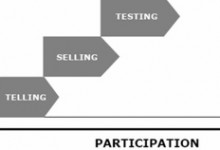
What we experience in this rattle snake exercise summarized in the drawing above (based on Peter Senge’s Fifth Discipline Fieldbook). In case you would wonder: the exercise is called rattle snake because of the rattling observations of the participants as we go along. At the end of the exercise, the group has learned from their own observations. Finally, as a trainer, the probability of success in this exercise is closely correlated to my own ability to back off and shut up!

The Laws of Systems Thinking

Sunday, March 18th, 2007

Refresher’s Course

“Nature loves a balance,but many times human decision makers act contrary to the balances and pay the price.” Peter Senge (*) says.

The human body requires “homeostasis” to survive, so does any other system, be it an organization or a society.


So here’s to systems thinking. Ten laws to disolve our day-to-day illusions of linear cause-and-effect. Thank you for not only using them on dinner parties and PowerPoint presentations. Think of them when preparing your budgets, plans and soultions.

1. Today’s problems come from yesterday’s “solutions.”
2. The harder you push, the harder the system pushes back. (aka “compensating feedback.”)
3. Behavior grows better before it grows worse. Our “solutions” often make things look better only in the short run.
4. The easy way out usually leads back in.
5. The cure can be worse than the disease.
6. Faster is slower.
7. Cause and effect are not closely related in time.
8. Small changes can produce big results — but the areas of highest leverage are often the least obvious. It’s the difference between our “snapshot” views and the deeper, better understanding achieved through “process” thinking.
9. Dividing an elephant in half does not produce two small elephants. It produces a mess!
10. There is no blame. Senge asserts: “You and the cause of your problem are part of a single system. The cure lies in your relationship with your ‘enemy’.” This is wrapped inside an overarching reality, according to Senge, and that is: “There is no outside.”
__________________________________
(*) Peter Senge, The Fifth Discipline: The Art & Practice of The Learning Organization, ISBN: 0385517254