
Archive for the ‘Peter Drucker’ Category

Exactly HOW can I be responsible for the communication?

Sunday, March 29th, 2009

Earlier this month I stated that the quality of a communication is determined by the extent to which the receiver feels understood and involved, rather than by the amount or even the quality of information. In other words: it is the relationship, rather than the content which determines the quality of a communication. One week later I continued by saying that the sender of a message has the most possibilities at hand by declaring oneself the context for all the circumstances that occur with regards to the communication ("being the board" as Ben Zander calls it) .

Destination: Relationship

Last week my friend Alex was kind enough to open my eyes to the fact that ‘being the board’ is about being the cause for something to occur, instead of being the outcome of a situation. He said: "If you feel like you’re the victim of a situation, that is because you see yourself as the effect of a situation instead of the cause. But the one thing you should know is that you can control your own reactions and initiatives; and these should be driven by a smarter objective. So have another look at what you would like to create, because you DO create the situation you are in by means of your reactions and initiatives."

So there I was, looking at my own knowing-doing gap; and Alex gave me the "X" on the map that told me "you are here": I’ve been writing about this stuff for quite some time, running workshops on that topic and yet I was stuck like a fish on a hook. Until Alex told me I can choose to be the pond instead of the fish in terms of how I act and react in a situation. Do I want to be a fish? Then I will get hooked every time the bait is thrown out. Do I choose to be the pond? Then I will be the context where both the fish and hook are welcome!

In terms of communication it comes down to this: if I want to be right, it’s the best guarantee for a conflict. On the other hand, when my destination is relationship there are a lot of ways to make others win and at the same time being the cause for this situation to occur. All it takes is a healthy dose of integrity.

Toolkit: Integrity

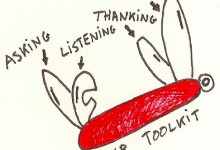
So the next question is: exactly "HOW" can I be the cause for relationship to occur?  There are 4 ways to do so and they are universal, i.e.: they are available to anyone, anytime, anywhere. They are:

1. Asking for help: The great Peter Drucker once said: "the leader of the future will be a person who knows how to ask". Asking for help opens doors with honesty and is difficult to resist. It allows your counterpart to have a stake in the solution and to ‘win’ and at the same time you are the cause for this situation to occur.

2. Listening: Attention here – listening is a two-way act, as it involves listening AND acknowledging what you have understood. You need to demonstrate that you are totally engaged. Aknowledging is the part that makes people feel understood and connected.

3. Thanking: Gratitude is a skill we can never display too often. And yet for most people it seems like they need to wait for the perfect moment … but it never comes. It is always the right time to say ‘thank you’. Gratitude is not a limited resource and an overdose is not harmful.

4. Apologizing: Marshall Goldsmith calls this ‘the magic move‘, because an apology is a recognition that mistakes have been made and it contains an intention to change for the better. But most of all, an apology is an emotional contact with the people you care about. It is a closure which lets you move forward.

Bad news for ego

You will note that these four ways have one thing in common: they require you to be humble and to position yourself ‘one down’ with regards to the person you are talking to. You can only access these tools when you let go of your need to win the competition for being right.

In his 2007 bestseller What Got You Here Won’t Get You There, Marshall Goldsmith says: "When you declare your dependence on others, they usually agree to help."  So your only way out is by putting aside ego. It is only when you decide to give up on being right that you will be able to ask for help, to acknowledge feedback, to express gratitude, or to make an apology.

Parenting as a Management Skill … Huh? (part 4)

Sunday, March 1st, 2009

The past three weeks  I have argued that parenting and family life outperform any MBA education when it comes to learning some essential leadership skills: taking care of oneself (I’m not kidding; even Peter Drucker wrote about it!), understanding and accepting how people develop, and setting boundaries. Finally, there is another leadership characteristic we can instantly learn from being a parent: it is how men and women’s brain architecture and hormones are fundamentally different.

Woman tend to think in webs of factors, not straight lines; therefore biological anthropologist Helen Fisher labeled this broad, contextual, feminine way of reasoning as ‘web thinking’. Men are more likely to focus their attention on one thing at a time. They tend to compartmentalize relevant material, discard what they regard as extraneous data, and analyze information in a more linear, causal path. Helen Fisher calls this male pattern ’step thinking’.

Fisher’s evidence is further supported by biologists, who found that the female brain has more nerve cables connecting the two brain hemispheres. Apparently, the male brain is more compartmentalized, so sections operate more independently. On top of that, testosterone tends to focus one’s attention. Women’s lower levels of this hormone may contribute to their broader, more contextual view.

Ok – so we can learn about that in business school by having a philosophical group discussion. After that, we go home and we safely end our day while the kids are already in bed. Now consider the less conventional way of getting this point across: a young male human being coaxing three toddlers through dinner, spoon feeding the youngest as the other two are bouncing off the walls – unwinding from a hectic day at school; getting them to bath, brushing teeth, bed time story, etc. At the same time: phone is ringing, there is somebody at the door and you run out of diapers. I guarantee: learning occurs instantly and closing that skills gap takes far more courage than attending any widely accredited business course that pretends to get the same point across.

No need to paint a picture or to write a scientific article about it: women outperform men when it comes to splitting attention and multitasking. Nevertheless, do read this article by Helen Fisher on woman and leadership!

My Inconvenient Truth – part 1

Sunday, May 18th, 2008

A few months ago I was a co-guest-speaker for a foundation of voluntary workers who give support to adolescents in trouble (problematic family situations, psychiatric disorders, young mothers, etc.). The topic was innovation and how they could learn from best practices in both the non-profit and the profit sector. There were less than 15 participants – each of them managing a foundation in the ‘adolescent care sector’ – and there was good interaction and sharing of ideas.

Together with the other guest speaker – the director of a foundation that is considered an innovator in that segment - we concluded that innovation is a matter of human factors and mindsets, rather than technological acumen. To summarize, there were six levers to innovation we put on the forefront:

1. Pragmatism: this is the theme that Tom Peters would translate as ‘They say plan it, I say do it‘. In each innovation and renewal exercise there is a thinking phase and a doing phase. The geniality of innovation lies in the second phase. ‘Real innovation’ so to speak is ‘a reaction to the prototype’.

2. Naivety: some would say ‘ignorance is bliss‘. My co-speaker rephrased it as ‘if it’s a good project it will get funded‘. Naivety also means putting an unconditional trust in your peers and co-workers as you are implementing the innovation. If you open the oven every five minutes as you are baking the bread, I guarantee it wil be lost.

3. People: Marcus Buckingham would summarize this one as: ’People don’t change that much. Don’t waste time trying to put in what was left out. Try to draw out what was left in. That is hard enough.‘ Innovation in that case is a process of ‘drawing out‘ rather than ‘putting in‘. Regular readers of this blog know that it’s all about involvement.

4. Approach: Adopt a structured approach of getting on the other side of your boundaries on a regular basis. My co-speaker found that simple ideas and contact moments with volunteers, parents, neighbors, etc. were very fruitful from a serendipity point of view. The quote that fits best here is: ‘Do one thing every day that scares you.’ from Eleanor Roosevelt.

5. Leadership: It is not the bold statements and Rambo-aspects of leadership that wil bring about innovation. It is rather the ‘stop doing things‘ leadership style that Peter Drucker promoted that will bring about innovation. To name but a few examples: ’stop your addiction of knowing and controlling things’ and ’stop stigmatizing mistakes’.

6. Thresholds: When it comes to expanding boundaries and doing stuff we never did before, all organizational change practitioners know that the greatest source of bullshit with which we must contend is ourselves. Asking the question ‘What would I do if I was not afraid?’ -just like Hem and Haw in the famous tale of Who Moved My Cheese, you will discover that your relationship with fear determines your ability to innovate. It is our own maturity, expressed by how well we deal with our own fear, which will determine how well we ‘allow’ innovation.

My inconvenient truth and that of many others is that the true genius resides in interaction with people and co-incidence. Getting the added value out of those moments places a different emphasis on intelligence than we were used to.

Intelligence and innovation from that perspective is not ‘the ability to know and to accumulate and analyze facts‘ but rather ‘the ability to interact, the courage not to judge and the naivety to commit before knowing how’. Duh… never seen a management guru praising those skills…

The Handy Guide to the Gurus of Management

Sunday, March 25th, 2007

The Best Things in Life are Free, Including Management Literature!

True, there is a lot of rubbish on the internet, but for those who are good at using search-strings on Google heaven awaits. As you may have guessed I found the Handy Guide by Googling my way through the information clutter. I found it on the site of BBC World Service under the sub-section ‘Learning English’ (Huh?!).

Charles Handy – a management guru himself – guides you through the lives and works of his choice of management gurus. I could not have imagined a better introduction to management. And as the text is being used in an online course of business English you will find short sentences and clear language (in management literature this is sometimes rare).

 
"To those of you who have just tuned in, I’m Charles Handy and you’re listening to the Handy Guide to the Gurus of Management, from the BBC World Service. There will be twelve gurus in all but, as I said earlier, I am going to begin with myself and my ideas. That’s so that you can get to know me and my prejudices, my way of looking at the world, even the way I talk."
 
Here is the list of management gurus that he brings to our attention:
Twelve gurus described by a guru in plain English – if it would be a book I would be the first one to buy it. All these summaries are available in audio as well in 15 minute talks. The best introduction one can find, although as Handy asserts in his concluding remark:
 
"It is impossible to do justice to someone’s lifetime collection of ideas in fifteen minutes. All I have been able to do is to introduce to you some of the best thinkers of our time in the hope that I can persuade you to get to know them better; I trust that the twelve gurus we’ve met in this Handy Guide will help you find your own way in the world."