
Archive for the ‘Naomi Karten’ Category

Prevent Survey Fatigue

Monday, October 12th, 2009

During large programs it is very difficult to keep an eye on what is cooking inside the organization and how people’s perceptions of the upcoming change are evolving. Hence, a commonly used instrument to check this ‘change readiness’ is holding surveys. Last week I mentioned the Top-10 signs your employee survey needs to change.

In addition to that list, Naomi Karten describes 6 recommendations for conducting surveys and avoiding that they become a waste of time.


1. Set survey objectives
. Define those objectives before you start, or you will end up with a list of questions that are unanswered because they were unasked.

2. Keep survey length under control. Avoid nice-to-know-but-so-what questions. A well-designed survey can be completed in less than ten minutes.

3. Make the survey action-oriented. Surveys are often full of thermometer questions. For example, "Did this course match your expectations?" is a thermometer question. Responses may suggest the existence of a problem, but provide too little information for you to understand the problem or recommend changes. If, instead, you ask questions like ‘are you now able to go back to your workplace and put what you have learned into practice?’, ‘Which difficulties did you experience when making the exercises?’, or ‘which topics will require extra attention before using them in practice?’ , you can use the responses you receive to plan a course of action.

4. Balance open-ended and closed questions. Closed questions ask respondents to select from a set of fixed responses. Respondents can answer these questions quickly, and responses can be tabulated, summarized, graphed, charted, analyzed and reported. Open-ended questions, by contrast, ask respondents to answer in their own words. Responses take time to review and are subject to interpretation. However, open-ended questions frequently provide a level of insight into the customer perspective that is impossible to obtain from closed questions. 

5. Ensure an adequate survey response. To generate interest, set the stage by publicizing the importance of the survey in helping you improve your service effectiveness. Explain your objectives and how quickly the survey can be completed. Marketing, branding the survey can dramatically influence the level and quality of the responses you will receive.

6. Tell stakeholders about your survey findings. This is the most important and yet most forgotten about element. Inform stakeholders of your findings and changes you will make as a result of their feedback. When you implement suggested changes, announce that you’re doing so because of their feedback. Don’t overlook this essential element of providing feedback to customers about their feedback to you.

Gathering feedback and taking no action based on the findings is worse than not gathering feedback at all!

Level 1: Attention please!

Sunday, October 7th, 2007

Why so-called Smiley-sheets are important

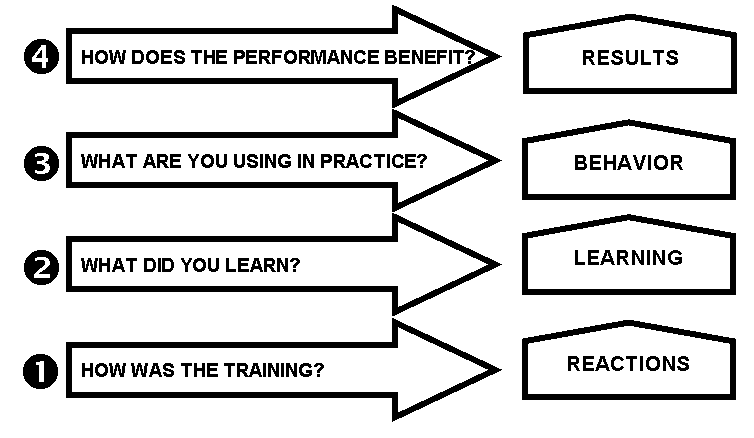
Donald Kirkpatrick first published his ideas on training evaluation in 1959. His four-level model is now considered an industry standard across the HR and training communities. It was later redefined and updated in his 1998 book ‘Evaluating Training Programs: The Four Levels’.

According to Kirkpatrick, each of these evaluation levels tells you something different. They are:
1. reaction of student – what they thought and felt about the training
2. learning – the resulting increase in knowledge or capability
3. behavior – extent of behavior and capability improvement and application
4. results – the effects on the business or environment resulting from the trainee’s performance

Although there is a lot of discussion going on about the measurability and the isolation of cause-and-effect relationships of level 3 and 4, I would like to point out another problem. It is a problem of arrogance or bad attitude towards the first level.

Now that the Kirkpatrick model has become a standard way of thinking, I see training departments taking their own smiley-sheets not so serious anymore. Reactions are not interesting anymore, ‘because they’re just level 1; no insights to gather there!’ This is a big mistake, for the following reasons:

1. You have created an expectation
In many organizations, feedback gathering is viewed as an isolated activity. They gather feedback but do nothing with the information they’ve obtained. This failure to take action is mostly a major step backwards in building trust because, having been asked for their feedback, participants then watch for changes to take place as a result of their input.
As Naomi Karten states: gathering feedback and taking no action based on the findings is worse than not gathering feedback to begin with. A smiley-sheet creates an expectation for a follow-up action.

2. Training is a Moment of Truth
Reactions (or: satisfaction) will give you an indication of how well the training initiative is perceived. This is more than just smiley sheets about coffee, temperature, and trainer friendliness. The undertone of the wording will give you an impression of the extent to which participants will decide to trust the program. Eventually, trust is the currency of change. in previous posts I have explained that training is most of the times the first real confrontation of participants with their new future. This is an emotional moment that can cause a lot of different reactions (from pure apathy to furious anger).

Looking at the smiley-sheet from a participant’s ‘point of view’ AND ‘point in time’ is essential here. We should take into account that about 90% of the training participants in a change program get a smiley-sheet right after they’ve been told that their wolrd is going to change. With this insight you may want to alter your current smiley-sheets or add a question about the participant’s feelings. I am convinced that spending time on smiley sheet reengineering and disciplined follow-up is a wise investment of attention: it communicates that you care about their reaction.

In short: not only are you creating an expectation for follow-up; you have the unique opening of a slot to demonstrate that you care about the participant’s needs. I’d say that’s pretty fundamental from a customer relationship management (CRM) point of view.

30 Dirty Truths about SAP & Organizational Change

Friday, December 29th, 2006


Here they are , in arbitrary order:
1. People don’t want to change. Not for the worse, not for the better.
2. Things will get worse before they get better.
3. Automate your project administration, not your project planning.
4. We think we see the world as it is, but in fact we see it as we are (Stephen Covey).
5. Change is in the details.
6. The real purpose of change management is to help people make sense of the change-pains – not to avoid them.
7. HR is not an agent of change but an agent of stability.
8. If integration is the destination, then make it part of the strategy and reorganize before you deploy systems.
9. The more accurate I start to plan, the more precise co-incidence will hit me (aka: ‘death by detail’).
10. Software does not replace discipline (aka: ‘the Debby rule’)
11. Legacy systems will always be better – from a rearview mirror point of view.
12. A good project manager is like a good parent: trustworthy, predictable and unpopular.
13. Real change takes time because it requires perception shifts.
14. The purpose is to make agents of your targets.
15. Uncertainty is worse than bad news.
16. Trust is the currency of change.
17. Communication will happen anyway, so better be at the steering wheel.
18. Seek first to understand, then to be understood (Stephen Covey).
19. Real participation means allowing people have a stake in the sense-making (this includes whining and letting-go rituals).
20. The essence of communication is to create community. Any exchange of information that does not accomplish this purpose is non-communication. Scan your meeting behavior as you keep this rule in mind.
21. Approach resistance with respect because it covers people’s most vulnerable and valuable part: their motivation and inspiration.
22. We choose our responses to the world – perception is a choice.
23. A vision is the shortest path between what is in my head and what people will see or hear (Bill Jensen). Compare this to your 180 slides Power Point presentation.
24. Communication is the message sent, not the message received (Bill Jensen).
25. Change all you want – but execution happens at the speed of sense making (Bill Jensen).
26. Although Organizational Change is not mathematical science, one truth stands out: OO + NT = EOO (Old Organization + New Technology = Expensive Old Organization) (Michael Hammer).
27. The bottleneck to human performance is in the limitations of available attention and learning capacity.
28. Gathering feedback and not taking action based on the findings can be more damaging than not gathering feedback at all (Naomi Karten).
29. In order to understand a system, you should try to change it (Kurt Lewin).
30. Culture is by far the best excuse for not changing. Don’t try to understand, rationalize or categorize culture. Rather, take it as a given and learn to navigate it.