
Archive for the ‘Michael Porter’ Category

Monday Morning Mandate for HR VP’s

Sunday, August 24th, 2008

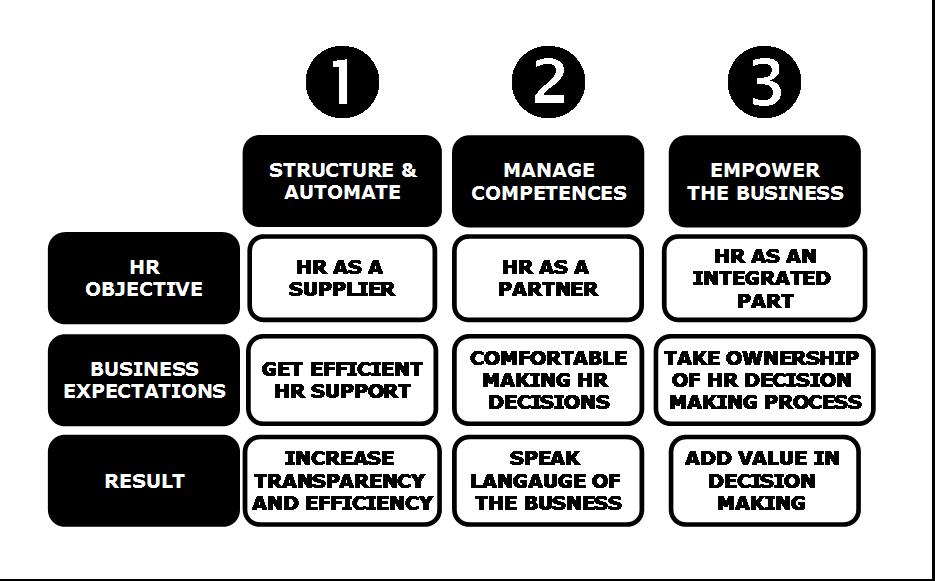
In previous articles I have made my point on why HR is not an agent of change and the miserable state HR is in nowadays. In this article I want to focus on what HR should be doing in order to get out of this isolation and into the value chain (*). More precisely, there are 3 steps to take for HR in order to become a business partner.

The first step consists of structuring and automating the basic HR processes. This requires documenting the procedures, drawing the HR processes and streamlining them, and most of all: holding HR people accountable for them. As such, the first milestone to achieve is to become a reliable supplier to the business.

The second step consists of managing the competences. This implies diving into the business and spending at least 30% of your time out of the office and into the business. Competence, performance, career and succession are empty words if there are no activities in a value chain to put them against. Putting the right person on the right place requires some knowledge of that person’s role in the value chain of the organization.

The third step for HR is empowering the business by outsourcing the core part of their activities … to the business. Whereas step 1 may include the outsourcing of administrative tasks to a shared service center, this step will require a handover of activities to the business. That way, HR processes get managed where they live and exist: on the shop floor among the people.

As the diagram above indicates the business expectations change as HR follows this step-by-step approach. These business expectations indicate the value HR should be creating for each step on the way. From this diagram it is clear that one should not try to empower the business in HR decision making from the very first step. Instead you should get the basics right first and get to know the business in the second place before you even know which decisions you can outsource to the business.

In the beginning of this three step process most of the attention will be spent ‘below the bottom line’: automating the basic and repetitive stuff. However, as you move along, automation and outsourcing of the basic personnel administration will free up time.

It is my contention that HR should be spending every minute of extra time as a result of automation in going (physically) to the business; even if that means joining their sales force on the road or getting their hands dirty on the shop floor. The point is that during step 2, HR will be building solutions (systems, procedures, structures, trainings, etc.) that are tailored to the business and then aligning them with the firm backbone that was established in step 1.

Finally, the third step is to shift a part of the HR responsibilities to the business. This only works with a firm backbone of basic HR processes (step 1) and HR solutions that are tailored to the business (step 2). This is where business people really start to use the HR tools at their hand in order to drive business decisions. In other words, at this point HR has shifted from a cost center to a value driver for the business.

It is a myth that HR needs a seat at the executive table in order to practice strategic HRM. Strategic HRM is a matter of reclaiming your place in the value chain in three steps: get the basics right, get into the business and shift the ownership to the business. As controversial as it may seem, giving away parts of the personnel administration to outsourcing entities and giving away parts of the HR decision making to the business makes HR more powerful as a business partner.
_________________
(*) The value chain was first described by Michael Porter in his 1985 book, Competitive Advantage. The value chain categorizes the generic value-adding activities of an organization. The "primary activities" include: inbound logistics, operations, outbound logistics, marketing and sales, and services. The "support activities" include: administrative infrastructure management, human resource management, information technology, and procurement. The value chain is a powerful analysis tool for strategic planning. Its ultimate goal is to maximize value creation while minimizing costs.

The Handy Guide to the Gurus of Management

Sunday, March 25th, 2007

The Best Things in Life are Free, Including Management Literature!
True, there is a lot of rubbish on the internet, but for those who are good at using search-strings on Google heaven awaits. As you may have guessed I found the Handy Guide by Googling my way through the information clutter. I found it on the site of BBC World Service under the sub-section ‘Learning English’ (Huh?!).

Charles Handy – a management guru himself – guides you through the lives and works of his choice of management gurus. I could not have imagined a better introduction to management. And as the text is being used in an online course of business English you will find short sentences and clear language (in management literature this is sometimes rare).

 
"To those of you who have just tuned in, I’m Charles Handy and you’re listening to the Handy Guide to the Gurus of Management, from the BBC World Service. There will be twelve gurus in all but, as I said earlier, I am going to begin with myself and my ideas. That’s so that you can get to know me and my prejudices, my way of looking at the world, even the way I talk."
 
Here is the list of management gurus that he brings to our attention:
Twelve gurus described by a guru in plain English – if it would be a book I would be the first one to buy it. All these summaries are available in audio as well in 15 minute talks. The best introduction one can find, although as Handy asserts in his concluding remark:
 
"It is impossible to do justice to someone’s lifetime collection of ideas in fifteen minutes. All I have been able to do is to introduce to you some of the best thinkers of our time in the hope that I can persuade you to get to know them better; I trust that the twelve gurus we’ve met in this Handy Guide will help you find your own way in the world."