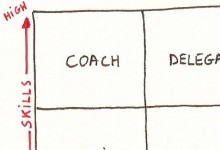
The skill-will matrix
Saturday, April 18th, 2009The essence of organizational change management is in the execution of it – not in the planning and strategizing about it. In terms of organizational change this means that the work is done in interaction, through participation. And this will get you hurt, surprised, confused, excited, bored, scared, etc…
So you may need some tools to navigate and keep an overview throughout the adventures of human interaction. One of the tools that I often use is the so-called Skill-Will matrix. I discovered it about 10 years ago in the book ‘The Tao of Coaching’ by Max Landsberg.
4 coaching styles
Landsberg explains how a coach can divide his or her time with the team he or she has been assigned to. The easiest anchor point for coaches is found in the combination of motivation and skills. In order to know the optimal frequency of your coaching, you need to examine the combination of these two ingredients.
The Skill-Will Matrix is often used to estimate the frequency of coaching. The model is based on four combinations, each with a different follow-up.

- Supervising: The coach clearly defines the roles and tasks and supervises their execution. Decisions are made by the coach and communication is unidirectional;
- Coaching: The coach still determines the tasks and roles but also asks the coached person for suggestions. Decisions are made by the coach, but communications are dialogue-based;
- Support: The coached person accepts the decisions and executes against them. The coach facilitates decision-making but is no longer in the driver’s seat;
- Delegating: The coach is still involved in problem-solving, but the coached person is in the driver’s seat. The coached person decides when and how the coach is involved.
Careful!
After a day or two of walking around and helping out people, you should be able to map the people on the Skill-Will Matrix. However, in practice we often find that coaches use this matrix to confirm their prejudices – so be careful with the self fulfilling prophecy that is hidden in these coaching styles. Supervision for instance, will not inspire people to take responsibility and to work independently.
The skill-will balance of a person is not a constant given; it evolves as time goes by. Nevertheless, it is a good guideline for estimating your timekeeping as a coach, especially when you are coaching an entire team. For instance, you can map every individual of your team on this matrix and balance your time-keeping as a coach accordingly.