
Archive for the ‘Martin Heidegger’ Category

Making Culture is No Rocket Science

Sunday, July 22nd, 2007

But it Takes Guts

In this article I want to pick up the broken pieces that resulted from my organizational culture rant of an earlier post. I stated that measuring culture is the wrong pot to piss in (well, not in those exact words, but I did meet some HR managers who were not too happy about the directness). In contrast to that particular article, I now want to focus on how to approach organizational culture. More in particular, I argue that philosophy and not psychology holds the keys to organizational culture.

Doing Versus Being
Without getting too philosophical we should note that the way you are being is the source of your reality, which in turn is the source of your actions. But the domain of being is hidden because it is not referred to in everyday action oriented language. ‘Being denies its own coming into existence’, as Martin Heidegger notes.

The point is that changing an organizational culture is creating something that is currently not possible in your reality. It is not improving something that is now already possible in your context by making it better, different or more (which is the domain of DOING). Instead, it is exchanging the current context for a new one in which certain things all of a sudden become possible (context is the domain of BEING).

Again the key insight comes from the philosopher Martin Heidegger. According to him, language is the only leverage for changing the world around you. This is because people apprehend and construct reality through the way they speak and listen. In her book The Last Word On Power, Tracy Goss continues Heidegger’s statement. According to her, by learning to uncover the concealed aspects of your current conversations and learning to engage in different types of new conversation, you can alter the way you are being, which, in turn, alters what’s possible.

The Anatomy of our Perception
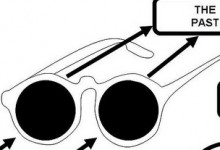
In the previous article on culture I ended by saying that hat our inability to measure culture does not prevent us from creating one. But first, let us have a look at what it is made out of. As you remember, culture is a sense making mechanism that works like a pair of glasses you are wearing. It determines your perception, i.e.: the data you select.

Sense making is hard coded into all human beings. It is something we do all the time (you can not ‘not do it‘, like it is impossible to ‘not taste’ the food that is in our mouth) and it always follows the seven steps that are derived from Karl Weick’s seven characteristics of Sense Making in organizations:
(Click on the drawing to enlarge)

1. The Past: We make sense of our experiences by comparing them with previous experiences. The organizational past is an important indicator in predicting the reaction to the current organizational change. The past is something that comes walking in through the back door of emotions. People remember events that have the same emotional tone as what they currently feel. Past events are reconstructed in the present as explanations, not because they look the same but because they feel the same.

2. My Relations: We make sense of changes in organizations while in conversation with others, while reading communications from others, and while exchanging ideas with others.

3. My Labels: People are sense-making creatures. Whenever a change happens that affects us we give it a label and put it into a known category (dangerous, stupid, beautiful, etc.). Almost instinctively, we respond with familiar questions: Who is behind this? What are the credentials of those people? Who said so? What will become of us after that change? Do they have the support of management?

4. A Declaration: Words have consequences. We should never underestimate the power of words and conversations. A situation is “talked” into existence, and the basis is laid for action to deal with it. Declarations are the way we translate stuff from below the surface into explicit knowledge. As a simple example, when people constantly say that “this project stinks” they create a climate in which the observation of difficulties is stimulated and the observation of possibilities is constrained.

5. The Real Story: People are interested in the truth, not the details. And people are not stupid. We construct the meanings of things based on reasonable explanations of what might be happening rather than through scientific discovery of “the real story.” Here is a warning flag to heed at this point: What is a simple truth for one group, such as managers, often proves implausible for another group, such as employees.

6. The Timeslot: Sense making is linked to timing. Like an airplane waiting for takeoff, an event will only get a limited slot for takeoff in the attention span of an individual. If that moment of attention happens to be the right one, it helps in setting a culture.

7. The Triggers: Nobody is capable of observing it all. Our observation is based on extracted cues. The cues that we observe depend on what we expect to observe, As a kind of self-fulfilling prophecy, we shape our reality according to how we expect it to be. When we think we are going to succeed at something, we will be triggered by every cue that confirms this reality and act upon it, and vice versa.

The Anatomy of Culture Creation
In the table below and the drawing on the right I have taken the anatomy of our perception and created seven matching steps that are necessary for creating an new organizational culture.

(Click on the drawing to enlarge)

Working on these seven components, all at the same time ensures a shift on the level of ‘being’ of the organization by setting a new context in which different things are possible.


Audit your “ROC” – Return On Communications
All of these elements (not necessarily in that order) constitute the key points of an organizational culture. This is what you need to monitor during the complete lifecycle of any change program. A successful communication strategy during organizational change takes into account the anatomy of our perception and works towards a similar mechanism in order to create a new culture.

Eventually, when scanning through your communication plan, all of these steps should be catered for; either in communication principles or in concrete actions. More important, this should also work the other way around: if you identify any communication action that does not accomplish any of the seven steps above, you should seriously question its added value for the program and the return on investment of attention, time, and money (exactly in that ranking order of scarcity).
__________________________
Sources used in this article:
Goss, T.: The Last Word On Power, Currency: Doubleday. 1996
Weick, K.: Sensemaking in Organizations, Thousand Oaks: Sage Pubications. 1995

Stop it – seriously – STOP IT!

Wednesday, June 6th, 2007

No to the Non-sense of Measuring Culture!
Every now and then I meet HR managers who are keen on measuring culture and who claim to be working on the essential layer of their organization, the source-code so to speak. To those managers I would like to say: you missed the point. In this article I have summarized why we should stop pretending that we can measure culture and propose an alternative instead.
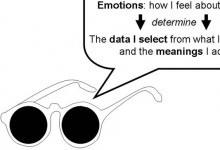
Culture as a Pair of Glasses
We see the world as we are, not as it is. Another way of putting it is by saying ‘perception is reality’. As the drawing shows, culture is a sense making mechanism that works like a pair of glasses you are wearing. Pink-lensed glasses will make you feel happier than black-lensed glasses; that much is certain. What is less obvious, though, is that glasses of a certain color will make you see certain things more clearly and completely ignore other things; in other words, they determine the data you select.

So, as a starting point: culture is a sense making mechanism that determines our perception; culture IS the glasses. By the way, since taking off these glasses is not an option, none of us human beings is capable of looking at the glasses, investigating and analyzing the components or comparing one pair to another.

Deceiving Belly Button Measurements
Then, what are we actually looking at when we measure culture with long and complex surveys? The answer is: we are staring at our belly button. The model which we choose for looking at the reality is already distorted by our perception to begin with. Based on this model we will distill dimensions which we assume are important to measure. Then these get translated to survey questions which supposedly reflect and measure these dimensions. As you can see there are a lot of bridges to cross and the distortions increase each time. Finally, in the majority of the organizations these surveys get distributed with a minimum of communication.

As for the responses – they only get returned by a group of people who are willing to fill out and return the survey – again another filter on the population. All of these filters are unintentional, but they do occur. Now, let’s have a look at what this amounts to.

Cultural surveys are interruptions that confuse the hell out of people. How would you react when a survey comes falling out of the sky that basically says: please fill out this awkward questionnaire and we will push you in a stereotype category and tell your management about it. Feel safer now? It gets people out of their comfort zone, that’s for sure, but what’s the benefit and will people respond truthfully – swear to God – what they feel and think?

We simplify the world into the dimensions of the survey (that part is OK – it’s called ‘focus’) and we desperately try to make cause-and-effect relationships with these dimensions (this is the not-OK part – it’s called ’stereotyping’). Not only will you be restricted to measure what you want to measure, you will also push the organization into the forced ranking of your statements and purge any other cause-and-effect relationship.

OK Smartass, What’s the Alternative?
Organizational change teams should ask themselves whether they are really that low on trust that they need a survey to justify an organizational change program? Or would they rather start from a vision and a strategy? Surprisingly, the mechanism behind implementing a strategy is exactly the same, but the intent is different. A strategy also molds reality into "We see the world as we are", but by implementing a strategy we co-create the future state instead of manipulating people into categories.

Second, managing organizational change is about getting people out of their comfort zone, but never ever without providing them a platform of psychological safety. And there’s a million ways to do that – although the best way is to do nothing, i.e. to shut up, listen and acknowledge receipt of what people tell you. Feeding them back what you have understood is an essential part of providing psychological safety. The next part is called integrity, i.e. acting on their feedback (and letting them know that you are). And then – only then will people be ready to get on board (that is: because they want to, not because they have to).

There Is No Outside
Another awkward thing is that organizations who want to do cultural surveys use a lot of ‘they’, ‘them’, ‘those people’ and ‘over there’ words when referring to their own organization. Karl Marx referred to this as alienation, and I would add that this is a behavior and not a circumstance. Also Heidegger described this phenomenon quite precise when he referred to ‘Das Man’ (‘The They‘). My most favourite way of countering this is by telling that there is no outside (N° 10 of Senge’s Laws of Systems Thinking).

The point I’m trying to make here is that our inability to measure culture does not prevent us from creating one. And it’s really simple: first, as Ghandi said, be the change you want to see in the world; second, shut up, listen and acknowledge feedback, third, walk your talk. Deceivingly simple? Yes. Darn difficult? Indeed, because you’re gonna get naked, vulnerable and hurt.