
Archive for the ‘Malcolm Gladwell’ Category

Welcome to my Bell-Shaped World

Tuesday, August 31st, 2010

Take a seat on the other side of my eyeballs. You will discover that I look at the world through a pair of bell-curve-shaped lenses. I keep tinkering until they make sense. So there you go: Ten Tinkered Bells!
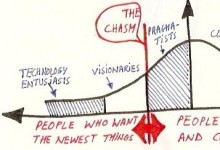
It all started in 1809, when Carl Friedrich Gauss published the monograph  “Theoria motus corporum coelestium in sectionibus conicis solem ambientium” (now repeat that one more time with your eyes closed…) where among other things he introduced the normal distribution. This is a bell-shaped curve where most values cluster around a mean, while outliers can be found above and below the mean.

For example, human height often follows a bell  curve, with outliers who are unusually short and tall and the bulk of people being concentrated around a mean height, such as 70 inches (178 centimeters) for American men. When data which follows a normal distribution pattern is graphed, the graph often resembles a bell in cross section, explaining the term “bell  curve.”

These Normal or Gaussian distributions can be found in a wide variety of contexts, and if you ask me: they are everywhere! As you go through these 10 bell-shaped thoughts you will note that I am recycling some stuff I have published over the past three years. Also, I am mixing in some new elements. Old wine in new bottles if you will – but for me it does the trick.

1. The Diffusion of Innovations

What is it?


For starters, in a 1962 book called The Diffusion of Innovations, Everett Rogers stated that adopters of any new innovation or idea could be categorized on a classic bell-shaped curve as described here:

  • Innovators (2.5 %) Venturesome, educated, multiple information sources, greater propensity to take risk;
  • Early Adopters (13.5%) Social leaders, popular, educated;
  • Early Majority (34%) Deliberate, many informal social contacts;
  • Late Majority (34%) Skeptical, traditional, lower socio-economic status;
  • Laggards (16%) Neighbors and friends are main information sources, fear of debt.

Why is it important?

If you are about to introduce and organizational change you will find the exact same diffusion of crowds inside organizations.

How do I use it?

In short: I use it as a compass. Rogers found out that this diffusion – and these proportions form a reliable pattern. Therefore, this chart gives me patience and reassurance in difficult moments.

Imagine you have just kicked off an organizational change program and you get nothing but very bad reactions. Of course there is some feedback in there, but chances are that you just landed your change vehicle in the middle of the laggards’ nest. So stay positive and keep looking for the other slices of the curve!

2. The Chasm

What is it?


Building further on Rogers’ observations, Geoffrey Moore’s key insight is that the groups adopt innovations for different reasons. According to Moore, early adopters are technology enthusiasts looking for a radical shift, while the early majority wants a productivity improvement. Both groups are divided by a chasm. According to Moore:

  • Technology Enthusiasts (Innovators) are explorers;
  • Visionaries (Early Adopters) are more geared towards exploitation. They are not especially bothered by the fact that the product doesn’t work. They are willing to make it work;
  • Pragmatists (Early Majority) want a product that works. They want a 100% solution to their business problem. If they get the 80 % that delighted the visionary, they feel cheated, and they tell their pragmatist friends;
  • Conservatives (Late Majority) buy products because they really have no choice. They are not reassured by having books about the product, because the existence of books implies the product isn’t simple enough to use. Conservatives will not tolerate complexity;
  • Skeptics (Laggards) are not going to buy, though they may talk other people out of buying.

Why is it important?

Now that we know that different crowds come to the surface each time you introduce a change, Moore’s observations tell us where the real challenge lies: crossing the chasm; i.e.: winning the hearts and minds of the 85% who want solutions and convenience. The problem in crossing the chasm is that the visionaries aren’t good references for the pragmatists. They provide tales of heroics. Pragmatists want references from other pragmatists.

How do I use it?

In short: I use it to keep my head out of the clouds and to get my feet on the shop floor. It is obvious that the innovators and the early adopters will never oppose or object the changes you are implementing. Another word for the left hand side of the chasm is a project cocoon: a safe group of like-minded people. On the right hand side of the chasm you will find people who want solutions and convenience. And they represent 85% of your target population!

The challenge of organizational change management is to get your ass to the other side of the chasm. And it takes a great deal of emotional intelligence to cross the chasm. The interactions you have at the other side increase the quality of the solution you are building – to the same extent as they are grinding your nerves. Just remember: the best work is done with the heart breaking or overflowing.

3. The Tipping Point

What is it?


In his book The Tipping Point: How Little Things Can Make a Big Difference, Malcolm Gladwell investigated what determines the moment of critical mass, the threshold, or even the boiling point of a marketing effort.

Wikipedia describes it even better: “the levels at which the momentum for change becomes unstoppable.”

Why is it important?

Once you hit a tipping point all the dynamics change. All of a sudden your product, idea or trend you have been pushing starts spreading like a virus. What once seemed impossible now all of a sudden has become unstoppable. Inexperienced project managers are often taken by surprise when the tipping point pulls them into an ugly acceleration.

In times of ugly acceleration hanging on to control will kill you. Experienced project managers know that ‘control’ is the way to the tipping point, but they also know that they need to switch to coordination and trust once their project becomes unstoppable.

How do I use it?

In short: managing expectations. I integrate the expectation of “ugly acceleration” into my approach. Tipping points are points of no return – the very times when procrastination ends. From here on it’s action, so one should keep it simple and make sure to be on the same page.

Each project – big or small – has a tipping point, and it occurs when your deliverables hit solid ground: usability testing, user training, physical changes on the shop floor, etc.
That is when you meet the pragmatists face-to-face. They want solutions and convenience. You no longer need to tell WHY the program exists. Instead, you are prompted to explain in detail HOW it is going to work. They won’t let up until it makes sense to them.

Wanna know another lesson learned? Don’t over-promise. It is painful to be applauded for announcing or demonstrating a feature only to discover it won’t be part of the solution. Trust me: on large scale projects this happens all the time.

4. Broken Windows Theory

What is it?


The broken windows theory is a notion that comes from the same book by Gladwell. Consider a building with a few broken windows. If the windows are not repaired, the tendency is for vandals to break a few more windows. Scientists in the field of criminology found that disorder invites even more disorder and that a small deviation from the norm can set into motion a cascade of vandalism and criminality.

Why is it important?

Litter encourages more litter. A broken window is a crack that allows negative behavior to slip in. And human beings are herding animals: we resonate to the influences nearest at hand.

As Gladwell notes: “Why was the Transit Authority so intent on removing graffiti from every car and cracking down on the people who leaped over turnstiles without paying? Because those two trivial problems were thought to be tipping points-broken windows-that invited far more serious crimes“.

How do I use it?

People who work with me know that I’m a neurotic when it comes to broken windows. When I see a crack, I want to repair it instantly. Right now. An unpleased customer, a deliverable missing a beat, a target group we forgot to involve, or resistance brewing underground (mostly you pick that up accidentally standing by the coffee machine).

Attention here: fixing a broken window is not the same as denying it. Saying it ain’t so won’t solve the tension; neither does jumping to conclusions. Fixing the broken windows of dissatisfaction is done with respect instead of judgement. The broken windows theory reminds me to be sensitive for cynicism and indifference and to provide platform for these emotions to turn into contributions.

Final note: the strange thing about change management broken windows is that they are best fixed by the inhabitants. Your role is to spot them and to provide the means, the time and the space to do so.

5. The Red Monkey

What is it?


Jef Staes introduced the concept of a red monkey. According to the latest insights in biodiversity, new species do not start in the middle of a forest but at the edge. At the edge! – where different species from different ecosystems ‘meet’. That’s when Jef created a metaphor of a brown monkey from the jungle who meets a red fish from the sea (an adjacent ecosystem). Through their conversation a new confrontational idea is born: a red monkey.

Why is it important?

What would happen if that confrontational idea would be dropped in the middle of the jungle? It would be killed immediately. Jef notes that the same thing happens with confrontational ideas that are ‘dropped’ in the middle of an organization … they get killed as well. Innovation ‘never’ starts in the middle of an organization but on the edge, where ecosystems meet.

By default your red monkey disturbs the balance in people, teams and organizations. It tilts the stability of an ecosystem, and therefore it will get killed if there is no critical mass to protect it in order to survive and mature.

How do I use it?

Think of red monkeys as your next innovation project. And think of yourself as the one responsible for its survival. It takes a serious amount of conflict handling skills to coax a red monkey to the right hand side of the chasm. This is a step-by-step process and it requires a different view on resistance. One thing is sure: you should start at the edge and move gradually to the middle.

When I look at my job that way, I tend to see it as a vocation and myself as a linchpin instead of a cog. And this – in its turn – radically influences my persistence and the quality of my work.

6. The Elephant Dilemma

What is it?


Just like Jef Staes constructs theories involving monkeys, I do the same thing with elephants. It started when I was attending a phone conference that lasted too long. I started drawing randomly and without knowing it uncovered an elephant out of my favorite bell-shaped curve.

Why is it important?

In all organizational change programs there is a moment when the work ahead looks so massive that you don’t know where and how to start. Those moments are paralyzing and you feel pretty small. Project managers refer to this situation as the ‘how to eat the elephant dilemma’. The elephant is hidden in the target population and the chunks of the elephant are the audiences that you encounter while introducing a new product or initiative.

The secret?  On the drawing above you go tail first: making sure that the innovators and the early adopters (most of the times this is your own core team and the sponsor of your program) get through that change cycle first. Once you have won their minds and hearts they will help you to attack the next big chunk: the pragmatists (these may be key users or testers of whatever you are implementing) and so on.

How do I use it?

The elephant reminds me that I can shape the path of the project just by channeling the emotions and the energy towards the main deliverables. If you think people will whine or be angry you should make sure that they ‘whine forward’ or ‘complain forward’ People make sense of the change as they react to the prototype of your deliverables.

The solution is to provide a series of deliverables that people can shoot at, nicely ordered in the same direction: forward. Not only will this improve the quality and the accuracy of the deliverables, it will also get their minds in motion and their noses pointed in the direction of the program.

7. Warcraft Wisdom

What is it?


In the chapter “On The Beach” of his 1993 book Accidental Empires, Robert Cringely talks about the three distinct groups of people that define the lifetime of a company: Commandos, Infantry, and Police.In my opinion these forces all represent the management styme that is needed as you progress through the lifecycle of an innovation.

For instance, the destructive (literally: ‘ground-breaking’) work of commandos who prepare territory for the infantry is described by Robert Cringely as follows: “Commandos parachute behind enemy lines or quietly crawl ashore at night. Their job is to do lots of damage with surprise and teamwork, establishing a beachhead before the enemy is even aware that they exist.”

This is exactly how difficult and large change projects kick-off: they have been planned and budgeted for long before they officially kick-off. Once the path is cleared, changing can start. Now you will need an infantry of agents to get the job done: blueprinting, designing, testing, training, collecting and cleansing data, etc.

Finally, the new structures are in place, you will find that there is still the need for a military presence by means of local coaching (often referred to as ‘hypercare’). These are the UN peacekeeping troops, a remainder of the infantry (note: you will find nothing about UN peace keeping troops in Cringely’s book – please allow me to stretch the concept). Their only purpose is to stabilize the new order and eventually to hand over to the local peacekeepers: the police.

Why is it important?

You need a commando style in order to create the circumstances for change.  Whether it is to obtain commitment for blueprinting, design, testing, training or go-live, without the commando actions the efforts will be ignored as long as there is no pressure or hard evidence that things will change.

For the infantry the most important thing here is to take on a structured approach. In the words of Cringely: “While the commandos make success possible, it’s the infantry that makes success happen.”

How do I use it?

The one thing to remember is that it takes different team styles: the commandos are the agents that make success possible, the infantry make success happen and UN peace keepers and police are needed to refreeze the new structures and habits like a stabilizing force.

8. Mapping the Added Value

What is it?


After reading Seth Godin’s Purple Cow, blogger Thomas Baekdal wrote a wonderful piece on what you should plan, do and support. He calls for a strategy with 4 layers: plan and prepare for the future, work in the present, support what you did yesterday, and ignore out-of-date ideas. To illustrate this, he tops the bell-shaped curve with a value curve.

Why is it important?

The value curve illustrates where you should focus your energy and resources. If you want to be successful, then most of your time must be spent on what Baekdal calls ‘the next thing,’ and the rest should be maintained and automated to the best of your abilities.

How do I use it?

This is what your project plan should look like from a time management perspective:

  1. Actively devote attention to your future plans and test out new ideas
  2. Spend most of your time making sure that your deliverables cross the chasm and get picked up at the other side.
  3. Continue to support the project phases that you launched ‘yesterday,’ even if they are no longer an active part of your dashboard. As Baekdal puts it: “Answer people’s questions, provide tips and gently push them towards your new ideas.”
  4. Finally, you need to unhook your attention from the laggards (usually they are experts at sucking up your precious time for futile details that add no value what-so-ever.)

9. The Long Tail

What is it?


The long tail refers to the statistical property that a larger share of population rests within the tail of a probability distribution than observed under a Gaussian distribution. The term has gained popularity in recent times because it identifies the digital economy and the effects of the internet on business as we know it.

In his book The Long Tail, Chris Anderson does a very good job at explaining these dynamics in depth. According to Anderson, the internet flips some basic economic theories of Adam Smith, Vilfredo Pareto, Karl Marx and very basic concepts such as transaction costs, distribution, shelf space and (above all) scarcity.

Why is it important?

The long tail of normal distributions has changed since the internet mainly through three dynamics:

  1. The means of production are available to anyone in the digital economy;
  2. Transaction costs and shelf-space costs are close to 0 in this digital economy;
  3. “Wisdom of crowds”: your brand is no longer a logo or a slogan: it is the story your customers tell about your product.

The point is not that you should no longer try to get into the top position of big hits. Since the internet the niches have become the new big. But in order to survive in the niches you should be a platform for these niches instead of a final big hit destination.

How do I use it?

Being platform  (aka: ‘crowdsourcing‘)instead of a know-it-all destination is a good thing. Rather than seeking uniformity, and the full control of one single ‘hit’ destination, the long tail tells us it is better to be a platform for a crowd of alternative solutions.

10. The Three Strategies

What is it?


Building further NYU professor Clay Shirky’s statement that ‘Institutions will try to preserve the problem to which they are the solution.’ More specifically, Shirky refers to how the media industry is incapable of changing because they are solving the wrong problem.

Let’s face it: newspapers are the solution to the problem of … news gathering and news distribution. AND THAT PROBLEM NO LONGER EXISTS. That inspired me to identify three strategies to cope with the reversed dynamics of the digital economy: No Problem, Extrapolating the Problem, and Reinventing the Problem from Scratch.

Why is it important?

Let’s take my favorite example: the dying newspaper industry. Nowadays if we all want news we simply go to Google to get it.  Who published it isn’t nearly as important to readers any more.  Nor is the packaging. There are 3 strategies for newspapers to react to the downturn in their business:

  • NO PROBLEM: This is where most newspapers and magazines are today: Do nothing unless the competition forces you to. Paper is the main business and the internet, well… because we have to.
  • EXTRAPOLATING THE PROBLEM: these companies know that printing will be out of business some day, so they just make the technical switch to a new medium (the internet and e-readers). However, they have fallen in love with the problem that no longer exists: they still view themselves as gatherers and distributors of news (and what sucks even more: they still package the news on these e-readers in ‘pages’ and ‘issues’ – a constraint that was due to the printing press!)
    Note on the drawing:  be careful here because this area splits in half:
    - The left part is EXTRAPOLATING the problem that no longer exists.
    - The right part is what one could call the LONG TAIL
  • REINVENTING THE PROBLEM FROM SCRATCH: Today’s problem is an abundance of news and a need to make sense of it all. So the future is to be a platform for sense-making. This will require the newspapers business to let go of their attachment to the producer-consumer model. Only then will they be able to search for new revenues and growth.

How do I use it?

To me these three strategies are a razorsharp analysis tool to separate wanna-be innovations from real innovations. The three strategies open my eyes to the fact that each product and each project has a lifecycle and that you have the choice to:

  • Do nothing and – to you own amazement – die at the end of the lifecycle;
  • Try out a new lifecycle but with both feet firmly anchored in your current world-view: you will never be a leader in your segment;
  • Take a risk; jump; and invent your own game.

11. What’s In a Bell?

As I was writing this article it became obvious that there is more to my bell-shaped world than this. Have a look at the following dilemma’s which somehow- will fit in a bell-shaped world, but I still need to map them on a chart to discover what is holding us back.

  • Money as an exchange mechanism versus the revival of the gift economy. Let’s face it: money has not been there since the beginning of business and trade. And in the beginning it came into being rather as a side-effect of some smart traders.
  • Fossil fuel versus renewable energy sources. How and when will we switch? Someone pointed out that this is a classical example of the prisoner’s dilemma. The prisoner’s dilemma is a fundamental problem in game theory that demonstrates why two people might not cooperate even if it is in both their best interests to do so.

Fascinating … to be continued!

(but I think it’s enough for now…)

Mindset, Membership and the Matthew Effect

Monday, July 19th, 2010

I have grown up with the firm belief that in order to achieve something in life you need to have a degree. Although I resent that statement with all of my heart I have come to a point that I no longer can deny it.

There are three ‘M’s involved in explaining why I capitulate to the non-sense of the way things are. They are: Matthew Effect, Membership and Mindset.

Matthew Effect

For to all those who have, more will be given, and they will have an abundance; but from those who have nothing, even what they have will be taken away.
—Matthew 25:29

Those who have shall be given – and if you happen to be on the other side: bad luck. But it’s more subtle than one may think at first sight. In his book Outliers: The Story of Success, Malcolm Gladwell compares the misfortune of the genius Chris Langan to the successful achievements of another genius: Robert Oppenheimer.

Both men were equally gifted, so the Matthew effect is not applicable on first sight. However, Gladwell states that – while both men were comparable in terms of intelligence – it is their sense of entitlement that has shaped the opportunity (or lack thereof) to grow and have a successful career.

Being talented, good-looking, intelligent, etc. may be the entry criterion for the achievement contest we call life; eventually it is the access to opportunities that will determine the outcome.

Membership

When researching the main causes of hunger and poverty in Third World countries, 1998 Nobel Prize winner Amartya Sen discovered that hunger is not caused by a lack of food, but by a lack of entitlement.

In the book Poverty and Famines: An Essay on Entitlement and Deprivation he demonstrates that famine occurs not only from a lack of food, but from inequalities built into mechanisms for distributing food.

At the age of nine, Sen witnessed the Bengal famine of 1943. Later he concluded that the loss of 3 million lives was unnecessary. He presents data that there was an adequate food supply in Bengal at the time, but particular groups of people including rural landless laborers and urban service providers like haircutters did not have the monetary means to acquire food.

Mindset

Back to the importance of degrees and the perversity of entitlement. Although entitlement was described by Sen as a matter of having the opportunity to influence your own mortality, I recently came to think of it as an illusion. It seems to me that entitlement to the fruits of a degree is mostly felt by those on the lower side of the glass ceiling.

I also think that the ignorance of how little a degree is worth once you crossed that fence, makes people blind to the real gravitational forces of the Matthew effect. That is: it pulls people down, not up.

A degree is a hygiene factor in terms of Herzberg’s two-factor theory: it is necessary, but not sufficient to succeed. It doesn’t push you up, but lacking it can pull you down.

Tragedy

The tragedy of it all is that it is the degree-less people with the most outspoken talents who suffer the most from this downward spiral of I-am-not-worthy-ness. They carry the lack of entitlement as a burden every day.

They are the victims of a ‘false negative‘ or simply a stupid coincidence.  As a consequence, this world not only suffers an inflation of stock markets. Most of all, it suffers an inflation of degrees.

Hope

Ken Robinson, who recently published ‘The Element: How Finding Your Passion Changes Everything‘ became popular after his 2006 TED talk titled “Do Schools Kill Creativity?” In this talk he makes the case for a radical shift from standardized schools to personalized learning.

Robinson claims our education has dislocated us from our natural talents. Most talents are like real natural resources: they are buried deep. And education as we know it is designed to flatten out the individuality of our talent.
However, we are blocked by the tyranny of common sense as paraphrased by Abraham Lincoln: ‘The dogmas of the quiet past are inadequate to the stormy present. The occasion is piled high with difficulty, and we must rise WITH the occasion. As our case is new, so we must think anew and act anew.’

Conformity

Many of our ideas have been formed not to meet the circumstances of this century but to cope with the circumstances of previous centuries. However, our minds are still hypnotised by them. In other words: college degrees – just like CV’s – are a form of entitlement that made sense in the previous centuries but not anymore. Yet, they continue to rule our lives.

Robinson goes on to talk about the root cause: conformity and a longing for the ‘future quo’. We have built our education systems on the models of fast food: everything is standardized instead of customized to local circumstances. In turn, this is impoverishing our spirits and our energies in the same way that fast food is downgrading our physical bodies.

Passion

He concludes that passion and not conformity is needed to cope with today’s challenges. Doing stuff that feeds your spirit. The kind of thing you are doing when time seems to fly. Like Seth Godin in his book Linchpin: Are You Indispensable?, Ken Robinson links the search for passion to the end of the industrial revolution.

We need to get out of our industrial model of education, which is based on linearity and conformity to an organic model. And with it we need to abandon our attachment to the entitlement of a degree.

Gardening

The one thing we need to understand is that learning and education are organic instead of manufacture-like.  As Peter Senge is often quoted: “We keep bringing in mechanics–when what we need are gardeners. We keep trying to drive change–when what we need to do is cultivate change.”

The only difference between a mechanic and a gardener is the entitlement of their degree and time has come to recalibrate these degrees to the challenges of today’s world.

The Chameleon Law

Sunday, March 8th, 2009

“It is not the mountain we conquer but ourselves.” -  Edmund Hillary

In the 1944 unfinished novel Mount Analogue, René Daumal describes the travel of a company of eight, who set sail in the yacht Impossible to search for Mount Analogue, a solid, a geographical place that “cannot not exist.

The protagonist of the book is convinced by a certain Father Sogol to undertake this “crazy” expedition. Father Sogol is a figure who likes to invert cause and effect (and is therefore called the inverse of the Greek “Logos” – representing ‘rationality’ and logical thinking).

“A crazy expedition”

The story of Mount Analogue is about making something happen that all people around you say is impossible and ridiculous.  In this novel about the expedition to a mythical mountain that reaches from earth to heaven, Daumal mentions the chameleon law, which he describes as the inner resonance to influences nearest at hand (“la résonance aux plus proches affimations” if you happen to speak French). As the protagonist of this tale is in the vulnerable starting phase of this expedition, he discovers how he is prone to peer pressure and how difficult it is to commit to something before knowing how.

Father Sogol had really convinced me, and while he was talking to me, I was prepared to follow him in his crazy expedition. But as I neared home, where I would again find all my old habits, I imagined my colleagues at the office, the writers I knew, and my best friends listening to an account of the conversation I had just had. I could imagine their sarcasm, their skepticism, and their pity.

I began to suspect myself of naiveté and credulity, so much so that when I tried to tell my wife about meeting Father Sogol, I caught myself using expressions like “a funny old fellow,” “an unfrocked monk,” “a slightly daffy inventor,” “a crazy idea.” After all that I was stupefied to hear her say at the end of my story: “Well, he’s right. I’m going to start packing my truck tonight. For there are not two of you. There are already three of us!
So you take this all seriously?
This is the first serious idea I’ve come across in my life.

And the force of the chameleon law is so great that I came back to the thought that Father Sogol’s enterprise was, after all, entirely reasonable.

The Tipping Point

Now what could possibly be the relevance of this chameleon law for us as organizational change managers? Mount Analogue is about inner doubts and how this chameleon law rocks us asleep and prevents us from seeing the other 99% of the possibilities that are at hand in each situation. With rational thinking and conventional ‘common sense’ we easily fall prey to the chameleon law.

However, organizational change projects are mostly about creating a situation that does not yet exist. A situation, a project or any other expedition is “talked into existence”. With every word you speak about it, a seed is planted that can give birth to a new reality. Karl Weick refers to this as the process of Enactment to denote that certain phenomena (such as this crazy expedition, or your own ambitious project for that matter!) are created by being talked about. Slowly but surely – if we are persistent enough – our ideas translate to words, our words translate to actions and our actions result into tangible outcomes.

The chameleon law is the biggest enemy during organizational change efforts, because you are shaping the path for a future that has no gravity in the present. As Arthur Schopenhauer is often quoted: ‘Every truth passes through three stages before it is recognized.
In the first it is ridiculed, in the second it is opposed, in the third it is regarded as self-evident.’

Broken Windows

This is exemplified by the broken windows theory. Consider a building with a few broken windows. If the windows are not repaired, the tendency is for vandals to break a few more windows. Scientists in the field of criminology found that disorder invites even more disorder and that a small deviation from the norm can set into motion a cascade of vandalism and criminality. Litter encourages more litter – another way of saying: resonance to the influences nearest at hand.

Malcolm Gladwell was the first to bring the broken window theory to our attention when he described it as paramount in reaching a Tipping Point (an idea which he first published in 1996 as an article in The New Yorker and which he later published in a book with the same title).  As Gladwell notes: “Why was the Transit Authority so intent on removing graffiti from every car and cracking down on the people who leaped over turnstiles without paying? Because those two trivial problems were thought to be tipping points-broken windows-that invited far more serious crimes“.

So we need to beware of all the broken windows symptoms of cynism and indifference and instantly fix every broken window. This is the intense and step-by-step work of creating a new culture.

Committing without knowing how

However, preventing the chameleon law from taking over goes a little deeper than paying attention to practical details. One has to be crazy enough and stubborn enough to endeavor your objectives against all odds. The Mount Analogue expedition reveals the insight that any expedition or organizational change project is a mountaineering expedition of the inner mind and intrinsic motivation, as much as it is about delivering a project according to a certain methodology. The tipping point is as much an external and societal process as it is an inner struggle for fueling our own commitment to an expedition with an un-rational (i.e. rationally ‘unreachable’) objective. It’s the ability to pursue a dream.

Alpinism is the art of climbing mountains by confronting the greatest dangers with the greatest prudence. Art is used here to mean the accomplishment of knowledge in action.

You cannot always stay on the summits. You have to come down again… So what’s the point? Only this: what is above knows what is below, what is below does not know what is above. While climbing, take note of all the difficulties along your path. During the descent, you will no longer see them, but you will know that they are there if you have observed carefully. There is an art to finding your way in the lower regions by the memory of what you have seen when you were higher up. When you can no longer see, you can at least still know. . .

Daumal, who was apparently one of the most gifted literary figures in twentieth-century France, died before the novel was completed, providing an extra symbolic meaning to the journey. Beware of the chameleon law as you endeavor to live your dream, instead of dreaming your life!

_______________
Related post:
Better a wrong decision than no decision (February 14th, 2007)

The Speed of Change

Tuesday, May 27th, 2008

This is just a reminder of two things we all know but fail to understand when it matters most: simplicity and synchronization. To my opinion these are the factors that determine the speed of change and the moment when they matter most is the delivery phase of your project. In this article I would like to point out why.

Simplicity: Keeping it Simple

One of my favorite quotes in this regard is the one of Bill Jensen: ‘Change all you want, just know that execution happens at the speed of making sense’. This means that people – and that includes you and me – will only do what they understand. At this point we are not even at the level of resistance – comprehension is the issue here!

However, there is a relationship: if you do a good job in sense-making you will be rewarded with less resistance. This implies that you not only tell people what they need to know to make the change happen, but you also listen, involve them and feed-back to them your understanding.

Synchronization: Staying on the Same Page

In the beginning of a project you may not be aware of the need for synchronization. Your project may still be building a prototype and you want to spread the word. In that phase any communication is good communication; whether it is structured or not, prepared or not, accurate or not – anything is better than radio silence (disclaimer: this is not an advice, it is an observed behavior).

But as you are approaching delivery and increasing the contact moments with your target audience people will urge you to get concrete, specific, accurate and fast. That is when your bunch of people (aka: the project team) needs to get disciplined about communication, testing and training (i.e.: the most important contact moments with the target audience).

The speed of change

As the drawing above illustrates, during the implementation phase more people become closely involved in the work of the program. You should be aware that this is also the first time that you meet pragmatists that hook into the details of the testing and conservatives who start to wonder what this is going to mean for them.

You will feel as if the big boulder of the project has reached a tipping point and is now rolling downhill. In other words: from now on you will have to pace the majority of pragmatists and conservatives who will be pushing you for concrete details. Therefore, during your communication it is important that you set the right expectations and that you do not over-promise with regards to delivering prototypes and demonstrating solutions. It is painful to be applauded for the demonstration of a certain solution only to find out that you overlooked some important elements because you did not consult the implementation team at large.

Your team is probably a big team by now and you must align solutions internally first before making promises to the organization. Minor and major incidents in this area will make you aware that you will need to centralize communication as you are approaching the delivery.

So if there is one sentence that you should keep telling yourself when your project is in the delivery mode it’s this one: Let’s keep it simple and make sure we’re on the same page’.

Good luck!

______________________
In the illustration I make use of the following specific terms and representations:
1. The bell-shaped graph: Rogers, E.: Diffusion of Innovations, Free Press 1962
2. "The Chasm": Moore, G.A.: Crossing the Chasm: Marketing and Selling High-Tech Products to Mainstream Customers, HarperBusiness 1999
3. "The Tipping Point": Gladwell, M.: The Tipping Point. How Little Things Can Make a Big Difference,Little Brown 2000

Spaghetti Sauce and Organizational Change

Friday, October 12th, 2007

In this presentation Malcolm Gladwell introduces us to a man named Howard Moskowitz. In the seventies, Pepsi wanted Moskowitz to figure out the perfect amount of sweetener for a can of Diet Pepsi. Moskowitz looked for the concentration that people liked the most.  But the data were a mess—there wasn’t a pattern—and one day, sitting in a diner, Moskowitz realized why.  They had been asking the wrong question.  There was no such thing as the perfect Diet Pepsi.  They should have been looking for the perfect Diet Pepsis.

The End of the Platonic Dish
Moskowitz discovered that consumers don’t know what they desire if what they desire does not yet exist. This was a major breakthrough because until then people in the food industry thought that there was only one way to make a perfect dish that looked and tasted absolutely right. Gladwell calls this the ‘platonic dish’.
 
Horizontal Segmentation
Moskowitz ended the search of human universals (‘one best way’) and started looking for the sources of human variability.  Howard Moskowitz created a new paradigm in the food industry when he proved that there are no universals. If you offer a variety of perfect dishes the satisfaction of your target audiences is higher than the overall satisfaction of the platonic dish. Moskowitz invented horizontal segmentation that is abundant in todays food industry.

A Case for Blended Learning and Blended Communication
However, this fundamental insight is still untapped for organizational change management programs. Would it be true that you can reach a higher satisfaction if you embrace the diversity of the target population? This would mean that segmentation and a proper marketing approach would lead to higher satisfaction and less resistance against the change program.

In practice, one would be offering different ways to support the change so the target audience can pick and mix their perfect Pepsi (i.e. learning blend or communication blend). I’d say it’s worth a try since our goal in organizational change is to foster a learning relationship with the target audience. In the end, what would lead to more ownership of the future state? A. the platonic dish? B. the variety that suits my needs?

Why Marketeers outperform Organizational Change Experts (PART II)

Monday, April 16th, 2007

What’s in a word: Sponsors—Agents—Targets
I always wonder why a glossary is mostly the last part of a document – it just makes no sense. So, let’s not do that and start with the glossary of this very article…

Leading change involves building demand for change by managing three different groups: sponsors, agents, and targets. According to Connor (1992) these groups can be defined as follows

Target
This is an individual or entity that will be required to change behavior and actions. They are the most important people in the change process, because if the they reject change, it will fail. However, the way they are commonly referred to is: ‘not me’, ‘they’, ‘them’, ‘those people’, ‘the users’, ‘it’, etc. Of course people love to be tagged like that!

Sponsor
This is the individual or entity with responsibility for the success of a change initiative, and the necessary authority to commit required resources to the initiative. They possess sufficient organizational power to either initiate resource commitment (Authorizing Sponsor) or reinforce the change at the local level (Reinforcing Sponsor).
Common denominator? ‘They’, ‘them’, ‘it’, ‘the ivory tower’, ‘because they said so’, etc. Of course we make sure they never hear us tagging them as such.

Agent
This person is empowered by the sponsor to carry out specific tasks related to the change initiative. Mostly tagged as: ‘they’, ‘them’, ‘who do they think they are’, ‘the project’, ‘not me’, ‘over my dead body’, ‘those consultants’, etc. Of course, change agents are appointed robots, trained and paid to hear that stuff all day, so they don’t mind.

Warcraft Wisdom
OK – so let’s put the sarcasm aside and get to the point: oddly enough the best knowledge on how to guide an organization through a change comes from the army. As Robert Cringely (**) points out in his book Accidental Empires, the founding of the personal computer industry and the history of Silicon Valley is based on different kinds of people, like the different segments of an army.

As you know by now, I am quite keen on recycling any good marketing insight and applying it on the inside of an organization. When we apply Cingley’s analysis we can formulate a clear advise on how to behave as a change agent during the different stages of an organizational change, i.e.: we come to the conclusion that agents of change projects should adopt different styles according to the phase of the change.

Initially, they take responsibility for breaking the fundamental structures that underpin the current context and beliefs. Robert Cringely compares this destructive work to the job of commandos who prepare territory for the infantry:
“Commandos parachute behind enemy lines or quietly crawl ashore at night. Their job is to do lots of damage with surprise and teamwork, establishing a beachhead before the enemy is even aware that they exist.”

In order to get things started, agents take on a commando style in order to create the circumstances for change. Most of the times, the project leader gets the honor of preparing the territory. Whether it is to obtain commitment for blueprinting, design, testing, training or go-live, without the commando actions the efforts will be ignored by business as long as there is no pressure or hard evidence that things will change.

Once the path is cleared, changing can start. Now you will need an infantry of agents to get the job done: blueprinting, designing, testing, training, collecting and cleansing data, etc. The most important thing here is that an infantry takes on a structured approach. In the words of Robert Cringely:
“While the commandos make success possible, it’s the infantry that makes success happen. These are the people who hit the beach en masse and slog out the early victory, building on the start given them by the commandos. […] Because there are so many more of these soldiers and their duties are so varied, they require an infrastructure of rules and procedures for getting things done.”

Finally, the new structures are in place, and it is time to refreeze the new processes that have been installed by the infantry. This is the fragile process of handing over knowledge from project agents to the target audience. You will find that there is still the need for a military presence by means of local coaching. These are the UN peacekeeping troops, a remainder of the infantry (note: you will find nothing about UN peace keeping troops in Cringely’s book – please allow me to stretch the concept). Their only purpose is to stabilize the new order and eventually to hand over to the local peacekeepers: the police.

As you remember from the previous post on this topic, over time different target segments are reached by pushing the boulder of your project work past the Chasm to the Tipping Point. The insight that Cringely adds to this drawing is that this takes different team styles: the commandos are the change agents that make success possible (unfreezing), the infantry make success happen (changing) and UN peace keepers and police are needed to refreeze the new structures and habits like a stabilizing force. Does this call for a different staffing according to the phase of your project? Ab-so-lu-te-ly!
________________________
(*) Connor, D. :Managing at the Speed of Change, John Wiley and Sons 1992
(**) Cringely, R.: Accidental Empires: How the Boys of Silicon Valley Make Their Millions, Battle Foreign Competition, and Still Can’t Get a Date, HarperCollins 1993

Why Marketeers outperform Organizational Change Experts

Thursday, March 8th, 2007

Because they share basic insights of Evrett Rogers, Goeffrey Moore, Seth Godin and Malcolm Gladwell! So here is my small manifesto for less academic mumbo jumbo and more marketing common sense.


Population Analysis
For starters, in a 1962 book called Diffusion of Innovations, Everett Rogers (*) stated that adopters of any new innovation or idea could be categorized on a classic bell-shaped curve as described here:

  • Innovators (2.5 %) Venturesome, educated, multiple information sources, greater propensity to take risk
  • Early Adopters (13.5%) Social leaders, popular, educated
  • Early Majority (34%) Deliberate, many informal social contacts
  • Late Majority (34%) Skeptical, traditional, lower socio-economic status
  • Laggards (16%) Neighbors and friends are main information sources, fear of debt

Building further on Rogers’ observations, Geoffrey Moore’s (**) key insight is that the groups adopt innovations for different reasons. According to Moore, early adopters are technology enthusiasts looking for a radical shift, while the early majority wants a productivity improvement. Both groups are divided by a chasm.

Moore’s observations come close to what you can expect when introducing a shift inside your organization, be it a new performance evaluation system, new software or simply moving from one building to another. According to Moore:

  • Technology Enthusiasts (Innovators) are explorers.
  • Visionaries (Early Adopters) are more geared towards exploitation. They are not especially bothered by the fact that the product doesn’t work. They are willing to make it work.
  • Pragmatists (Early Majority) want a product that works. They want a 100% solution to their business problem. If they get the 80 % that delighted the visionary, they feel cheated, and they tell their pragmatist friends.
  • Conservatives (Late Majority) buy products because they really have no choice. They are not reassured by having books about the product,because the existence of books implies the product isn’t simple enough to use. Conservatives will not tolerate complexity.
  • Skeptics (Laggards) are not going to buy, though they may talk other people out of buying.

The problem in crossing the chasm is that the visionaries aren’t good references for the pragmatists. They provide tales of heroics. Pragmatists want references from other pragmatists. This brings us to the basic insight that it is going to take strong marketing and employee relationship management (i. e., customer relationship management from the implementation team towards the organization) in order to reach the majority.

Lessons from Customer Relationship Management
Customer relationship management (CRM) is the art of building learning relationships with your target public. In practice we often find a lack of interest when it comes to building a learning relationship between the implementation team and the organization. CRM tells us how to do that if we are willing to replace the “c”of customer with the “e” of employee.

Seth Godin (***), one of the pioneers of CRM, introduced the concept of Permission Marketing in 1999. The list below mentions the six levels of permission that can depict the relationship with a customer, according to Godin.

  • Intravenous Treatment The doctor treating you in the emergency room doesn’t have to sell you very hard on administering a drug.
  • Green Stamps Executives suffer through long layovers to gain frequent-flyer miles. Here, the company rewards customers in currency they care about.
  • Personal Relationships The corner dry cleaner enjoys implicit permission to act in your best interest. A favorite retailer can "upscale” you (recommend something more expensive) without offending you.
  • Branding Given a choice between the known and the unknown, most people choose the known.
  • Situational Selling If you’re in a store and you’re about to make a purchase, you often welcome unsolicited marketing advice.
  • Spam Where most marketers live most of the time: calling a stranger at home, during dinner, without permission. You wouldn’t do it in your personal life. Why do it to potential customers?

Pushing and Pulling
The six levels of permission can help us to get more clarity about our position in relationship with the organization. It becomes even more interesting when we start weaving in the insights of Malcolm Gladwell (****), who investigated what determines the moment of critical mass, the threshold, or even the boiling point of a marketing effort. He calls it the Tipping Point.

From an organizational change point of view, the combination of Gladwell’s and Godin’s observations is illustrated in below:Starting an organizational change program may at times resemble pushing a boulder up a hill. You seem to be making an 80 % selling effort for barely a 20 % response. Your learning relationship with the organization hinges on the lower levels of permission, as you are in the beginning of a relationship. You will soon find out that as the permission level evolves, you will get the buy-in from pragmatists and conservatives.

Before you know it, the boulder starts rolling as a result of the people going through the change cycle. Instead of you pushing a boulder alone, the organization is now pulling at your sleeves to move it forward. From now on, you will have to pace the majority of pragmatists and conservatives,who will be pressing you for concrete details.

Therefore, during your communication it is important that you set the right expectations and that you do not over-promise with regard to delivering prototypes and demonstrating solutions. It is painful to be applauded for the demonstration of a certain solution only to find out that you overlooked some important elements because you did not consult the implementation team at large. You must align solutions internally first before making promises to the organization. Minor and major incidents in this area will make you aware that you will need to centralize communication as you are approaching the date of delivery.

___________________
(*) Rogers, E.: Diffusion of Innovations, Free Press 1962
(**) Moore, G.A.: Crossing the Chasm: Marketing and Selling High-Tech Products to Mainstream Customers, HarperBusiness 1999
(***) Godin, S.: Permission Marketing. Simon & Schuster 1999
(****) Gladwell, M.: The Tipping Point. How Little Things Can Make a Big Difference,Little Brown 2000