
Archive for the ‘Kurt Lewin’ Category

Three is the magic number

Monday, November 2nd, 2009

"All good things come in threes" – that is my way of saying that I can not cope with more things at the same time. So I tend to reduce reality to a maximum of three dimensions.
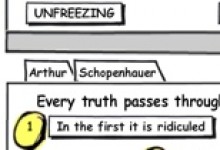
As a matter of fact, there are three insights about organizational change management that are somewhat related because I can see three distinct phases in each of them. Have a look at the drawing below:

First, Elisabeth Kübler Ross, in her research on death and dying distilled the five stages of grief. Ever since its publication in 1973 it has been commonly regarded as the "cycle of change".

Second, about 25 years earlier, Kurt Lewin published his thoughts on overcoming inertia and dismantling the existing mindsets in a model commonly referred to as the "unfreezing – changing – refreezing" model.

Third, Arthur Schopenhauer, who produced most of his writings even 100 years earlier than Lewin, made this remarkable statement about three stages of "truth".

I find some "truth" in all of them, but most of all I find the combination inspiring:

1. As ‘unfreezing’ actions and initiatives are being set up you are likely to receive responses that ridicule your initiatives. Most people react from a position of denial and anger.

2. In ‘changing’ times opposition takes all kinds of faces and you should prepare for a drop in performance and self esteem. People hit the bottom of desperation once they realize that the world as they know it will never return.

3. Finally, once the transition stage is accomplished and people start to accept the aspects of their new reality, most of the things they ridiculed in he first stage are regarded as self-evident. That’s when you know refreezing actions can start, anchoring the new reality.

A conflict isn’t always a bad thing – Part 1

Saturday, November 22nd, 2008

Have you ever tried to introduce something new in your team or organization? In case you already have, there is a fair chance that you have come across some hesitation, a bit of friction or even a blunt and painful conflict. A conflict is never a nice experience when you are in the middle of it. There is tension, ambiguity and emotions going in all directions. Things get shaken up. One would be tempted to conclude that a conflict is something to avoid because it doesn’t do any good.

However, avoiding conflicts altogether is the best recipe for a failed change program. Molecules need to be unfrozen, moved towards a new shape and then refrozen in that exact new shape. Like it or not: unfreezing involves conflict: shaking up a status quo, questioning obvious beliefs, letting go of certainties. In fact, change is hardly even possible without conflict.

In 1942, Harvard economist Joseph Schumpeter introduced the term ‘creative destruction’ to describe the innovative entry by entrepreneurs as a source of long-term economic growth, even as it destroyed established companies who were guaranteeing stability in terms of employment. In his words: "the process of industrial mutation —if I may use that biological term—that incessantly revolutionizes the economic system  from within, incessantly destroying the old one, incessantly creating a new one. This process of Creative Destruction is the essential fact about capitalism. It is what capitalism consists in and what every capitalist concern has got to live in.

As Schumpeter elaborates this thought, it gets even more interesting for organizational change managers: "the problem that is usually being visualized is how capitalism administers existing structures, whereas the relevant problem is how it creates and destroys them. As long as this is not recognized, the investigator does a meaningless job."

The point for us is to focus on the emotional process of unfreezing-changing-refreezing rather than (solely) on the project methodology or project plan at hand. An organizational change program is more than a set of project actions – it is a disruptive experience full of conflicts between the current state and the future state.

___________________
Sources:
Schumpeter, J. A. (1950), Capitalism, socialism and democracy, 3rd enlarged edn, New York: Harper.

30 Dirty Truths about SAP & Organizational Change

Friday, December 29th, 2006


Here they are , in arbitrary order:
1. People don’t want to change. Not for the worse, not for the better.
2. Things will get worse before they get better.
3. Automate your project administration, not your project planning.
4. We think we see the world as it is, but in fact we see it as we are (Stephen Covey).
5. Change is in the details.
6. The real purpose of change management is to help people make sense of the change-pains – not to avoid them.
7. HR is not an agent of change but an agent of stability.
8. If integration is the destination, then make it part of the strategy and reorganize before you deploy systems.
9. The more accurate I start to plan, the more precise co-incidence will hit me (aka: ‘death by detail’).
10. Software does not replace discipline (aka: ‘the Debby rule’)
11. Legacy systems will always be better – from a rearview mirror point of view.
12. A good project manager is like a good parent: trustworthy, predictable and unpopular.
13. Real change takes time because it requires perception shifts.
14. The purpose is to make agents of your targets.
15. Uncertainty is worse than bad news.
16. Trust is the currency of change.
17. Communication will happen anyway, so better be at the steering wheel.
18. Seek first to understand, then to be understood (Stephen Covey).
19. Real participation means allowing people have a stake in the sense-making (this includes whining and letting-go rituals).
20. The essence of communication is to create community. Any exchange of information that does not accomplish this purpose is non-communication. Scan your meeting behavior as you keep this rule in mind.
21. Approach resistance with respect because it covers people’s most vulnerable and valuable part: their motivation and inspiration.
22. We choose our responses to the world – perception is a choice.
23. A vision is the shortest path between what is in my head and what people will see or hear (Bill Jensen). Compare this to your 180 slides Power Point presentation.
24. Communication is the message sent, not the message received (Bill Jensen).
25. Change all you want – but execution happens at the speed of sense making (Bill Jensen).
26. Although Organizational Change is not mathematical science, one truth stands out: OO + NT = EOO (Old Organization + New Technology = Expensive Old Organization) (Michael Hammer).
27. The bottleneck to human performance is in the limitations of available attention and learning capacity.
28. Gathering feedback and not taking action based on the findings can be more damaging than not gathering feedback at all (Naomi Karten).
29. In order to understand a system, you should try to change it (Kurt Lewin).
30. Culture is by far the best excuse for not changing. Don’t try to understand, rationalize or categorize culture. Rather, take it as a given and learn to navigate it.