
Archive for the ‘Ken Robinson’ Category

Mindset, Membership and the Matthew Effect

Monday, July 19th, 2010

I have grown up with the firm belief that in order to achieve something in life you need to have a degree. Although I resent that statement with all of my heart I have come to a point that I no longer can deny it.
There are three ‘M’s involved in explaining why I capitulate to the non-sense of the way things are. They are: Matthew Effect, Membership and Mindset.

Matthew Effect

For to all those who have, more will be given, and they will have an abundance; but from those who have nothing, even what they have will be taken away.
—Matthew 25:29

Those who have shall be given – and if you happen to be on the other side: bad luck. But it’s more subtle than one may think at first sight. In his book Outliers: The Story of Success, Malcolm Gladwell compares the misfortune of the genius Chris Langan to the successful achievements of another genius: Robert Oppenheimer.

Both men were equally gifted, so the Matthew effect is not applicable on first sight. However, Gladwell states that – while both men were comparable in terms of intelligence – it is their sense of entitlement that has shaped the opportunity (or lack thereof) to grow and have a successful career.

Being talented, good-looking, intelligent, etc. may be the entry criterion for the achievement contest we call life; eventually it is the access to opportunities that will determine the outcome.

Membership

When researching the main causes of hunger and poverty in Third World countries, 1998 Nobel Prize winner Amartya Sen discovered that hunger is not caused by a lack of food, but by a lack of entitlement.

In the book Poverty and Famines: An Essay on Entitlement and Deprivation he demonstrates that famine occurs not only from a lack of food, but from inequalities built into mechanisms for distributing food.

At the age of nine, Sen witnessed the Bengal famine of 1943. Later he concluded that the loss of 3 million lives was unnecessary. He presents data that there was an adequate food supply in Bengal at the time, but particular groups of people including rural landless laborers and urban service providers like haircutters did not have the monetary means to acquire food.

Mindset

Back to the importance of degrees and the perversity of entitlement. Although entitlement was described by Sen as a matter of having the opportunity to influence your own mortality, I recently came to think of it as an illusion. It seems to me that entitlement to the fruits of a degree is mostly felt by those on the lower side of the glass ceiling.

I also think that the ignorance of how little a degree is worth once you crossed that fence, makes people blind to the real gravitational forces of the Matthew effect. That is: it pulls people down, not up.

A degree is a hygiene factor in terms of Herzberg’s two-factor theory: it is necessary, but not sufficient to succeed. It doesn’t push you up, but lacking it can pull you down.

Tragedy

The tragedy of it all is that it is the degree-less people with the most outspoken talents who suffer the most from this downward spiral of I-am-not-worthy-ness. They carry the lack of entitlement as a burden every day.

They are the victims of a ‘false negative‘ or simply a stupid coincidence.  As a consequence, this world not only suffers an inflation of stock markets. Most of all, it suffers an inflation of degrees.

Hope

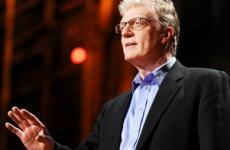
Ken Robinson, who recently published ‘The Element: How Finding Your Passion Changes Everything‘ became popular after his 2006 TED talk titled “Do Schools Kill Creativity?” In this talk he makes the case for a radical shift from standardized schools to personalized learning.

Robinson claims our education has dislocated us from our natural talents. Most talents are like real natural resources: they are buried deep. And education as we know it is designed to flatten out the individuality of our talent.
However, we are blocked by the tyranny of common sense as paraphrased by Abraham Lincoln: ‘The dogmas of the quiet past are inadequate to the stormy present. The occasion is piled high with difficulty, and we must rise WITH the occasion. As our case is new, so we must think anew and act anew.’

Conformity

Many of our ideas have been formed not to meet the circumstances of this century but to cope with the circumstances of previous centuries. However, our minds are still hypnotised by them. In other words: college degrees – just like CV’s – are a form of entitlement that made sense in the previous centuries but not anymore. Yet, they continue to rule our lives.

Robinson goes on to talk about the root cause: conformity and a longing for the ‘future quo’. We have built our education systems on the models of fast food: everything is standardized instead of customized to local circumstances. In turn, this is impoverishing our spirits and our energies in the same way that fast food is downgrading our physical bodies.

Passion

He concludes that passion and not conformity is needed to cope with today’s challenges. Doing stuff that feeds your spirit. The kind of thing you are doing when time seems to fly. Like Seth Godin in his book Linchpin: Are You Indispensable?, Ken Robinson links the search for passion to the end of the industrial revolution.

We need to get out of our industrial model of education, which is based on linearity and conformity to an organic model. And with it we need to abandon our attachment to the entitlement of a degree.

Gardening

The one thing we need to understand is that learning and education are organic instead of manufacture-like.  As Peter Senge is often quoted: “We keep bringing in mechanics–when what we need are gardeners. We keep trying to drive change–when what we need to do is cultivate change.”

The only difference between a mechanic and a gardener is the entitlement of their degree and time has come to recalibrate these degrees to the challenges of today’s world.

Play – Like Children Play

Sunday, November 16th, 2008

"I began to think of children not as immature adults, but of adults as atrophied children. But when I said this to educationalists, they became angry.” – Keith Johnstone

This week I would like to highlight the importance of creativity in the setting of an organizational change program. Regardless of the change you are dealing with, when you are in the thick of implementation you will soon find out that experience, knowledge and skills alone will not get the job done. Organizational changes tend to be messy and complex, so you will always need a fair amount of out-of-the-box thinking as you are crafting a solution.

One of TED’s newest talks online is by Tim Brown the CEO of Ideo. In this talk he explains the role of play, playfulness, and creativity and why they matter in our professional or academic lives. You may be a designer of consumer goods, or a medical doctor, or a researcher, or a teacher — every situation is different. But listen to what Tim Brown says and ask yourself how the idea of play might be introduced into your organization in a way that would benefit users, workers, patients, and students, not only in terms of productivity but also in terms of simply having people feel they contribute to something meaningful.

Brown starts by sharing a striking observation: ‘friendship is a shortcut to play’. It creates the trust and a sense of psychological security you need in order to take risks and to innovate. It helps to get to better creative solutions – which in the end helps us to do our jobs better.

Second, he demonstrates that when we encounter a new situation as adults – we have a tendency to categorize it just as quickly as we can. This is a survival reflex that helps us reduce the uncertainty around us (psychologists refer to this mechanism as ‘cognitive dissonance’ or ‘over justification’). This effective categorizing mechanism helps us to cope with the complexity of reality. However, at the same time, we lose every capacity to perceive events, situations and things around us without judgment – like children do. The absence of a categorizing reflex is exactly what enables kids to be more engaged with open possibilities. As adults the majority of the possibilities at our disposal are invisible – just because of this categorizing trait. As Brown describes in the video above: "parents of young kids all have their stories of how on Christmas morning our children end up playing with the boxes far more than they end up playing with the toys that ere inside them".

The bottom line is that we need to be aware of adult behaviors that are getting in the way of ideas. We need to play more often because learning is a by-product of play. For example, fearing judgment from our peers — inhibits us and often prevents us from taking chances or sharing our ideas with others. As adults we become overly sensitive to the opinion of others, we lose a bit of our freedom. 

Related articles:

My Inconvenient Truth (part 3)

Saturday, June 14th, 2008

A few weeks ago I blogged about the inconvenient truth (part 1) that "‘the ability to interact, the courage not to judge and the naivety to commit before knowing how" is a fundamental management skill in order to evolve and innovate. I did not really find a management guru to match that thought but luckily I found an educationalist who thinks along these lines about intelligence.

The way we think about intelligence needs a radical shift as Sir Ken Robinson argues in this 20 min speech at TED 2006, but we are stuck in a process of academic inflation. As children grow up we start to educate them progressively from the waist up. And then we focus on their heads, and slightly to one side. The result is that many highly talented and brilliant creative people think they are not, because what they were good at school was not being valued.

Our education system is based on the idea of academic ability because all educational systems came into being to meet the needs of industrialism. However, industrialism no longer rules in a networked economy, so the academic paradigm is slowly grinding to a stagnating halt.

So here’s the inconvenient truth: Children starting school this year will be retiring in 2065. Nobody has a clue what the world will look like in 5 years time and yet we are meant to be educating them for it. The best shot we have is to broaden our view and widen our appreciation about intelligence.

First of all, intelligence is diverse because we think about the world in all the ways we can experience it: visually, auditory, kinesthetically, we think in abstract terms and in movement. Second, intelligence is dynamic and interactive because more often than not, it comes about through the interaction of different disciplinary ways of seeing things. Third, intelligence is distinct. As Robinson concludes: we have to see our creative capacities for the richness they are and seeing our children for the hope that they are. So our task is to educate their whole being.