
Archive for the ‘John Gourville’ Category

The Time Factor

Friday, February 8th, 2008

As I am writing this we are about to shake up a traditional organization by means of an SAP implementation. Most of the times this is regarded as a pure software implementation: design the system, configure the system, test the system and roll it out. That is how most software engineers look at it and that is what traditional managers expect of it.

Only, with SAP it’s slightly different: since the software is supposed to administer the way you get your work done inside your organization it is quite instructive as to which standards, timings, methods and data you should manage from then on. Very soon you will find that it pretty much dictates your way of working – that is – if you want to get things done you better align to the ‘way of the system’.

I’ve facilitated about five SAP implementations before from the change management side and as I am embarking upon my sixth one I am starting to see the importance of the factor time. SAP brings with it a number of changes like: different working methods, different documents, a change in an organizational structure, a change in a procedure or a dramatic change of existing SLA’s (Service Level Agreements). Some of these changes are pretty easy to sell, but others a bit tougher.

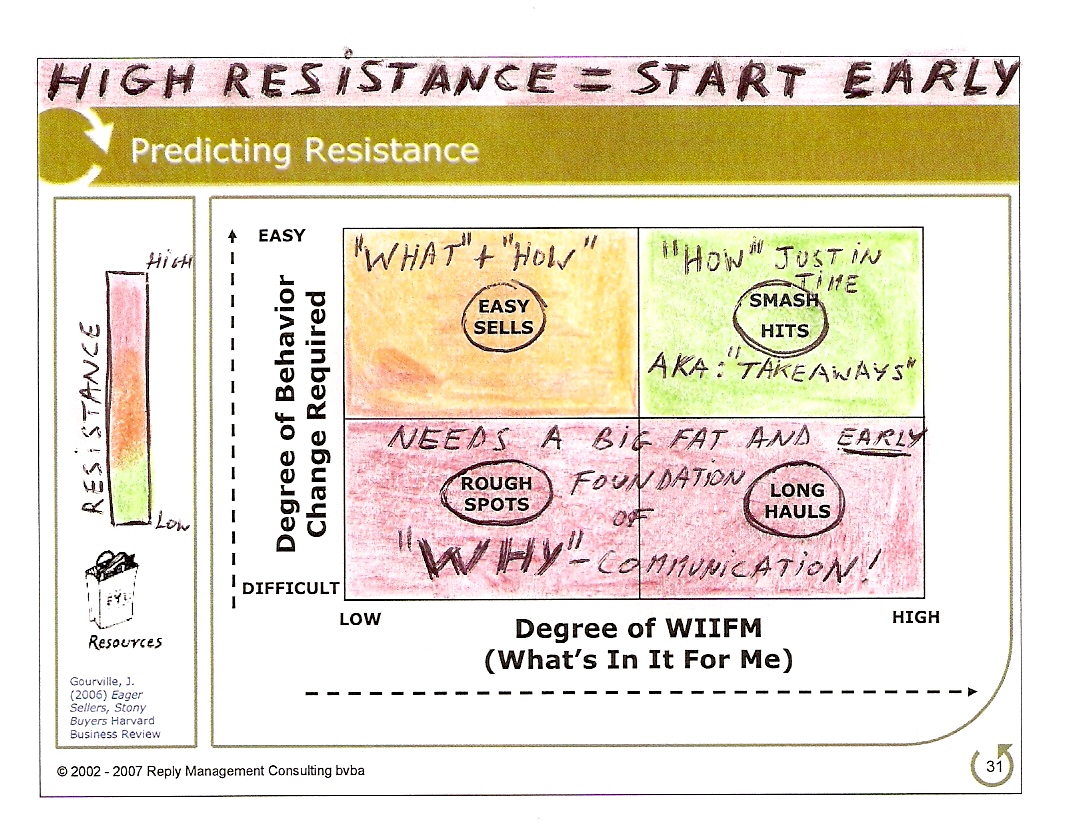
In an earlier article I presented a framework for positioning the changes accoring to two dimensions: degree of behavior change and degree of WIIFM (‘What’s In It For Me’). I borrowed it from John Gourville (Harvard Business Review 2006). However, since this week I have a bit more clarity on how to use it.

As a starting point I make a big inventory of changes. There is no structured approach to doing that apart from keeping your ears open and being there when people start to worry about the future. This inventory always comes to the surface when ‘old’ meets ‘new’. Mostly a bunch of consultants and a bunch of dedicated business people work together in blueprinting sessions and design workshops. That is when these conversations happen and that is exactly when you should have your notebook ready. Soon you will have an inventory of changes.

Next, it is time to plot them on the Gourville matrix. As a consultant, you should resist the temptation to do this task by yourself. As part of the exercise you should ask the stakeholders (mostly SAP key users or process owners) to map the changes on this matrix. This is what Edgar Schein calls a ‘diagnostic intervention’. In other words: you are surveying the stakeholders but the dignosis itself is an intervention that triggers a change process: people are forced to start thinking about the changes in terms of ‘will we resist or not?’.

Finally, when all changes are plotted you are ready to prioritize the communication in terms of timing. ‘Rough spots’ and ‘Long Hauls’ will need a lot of context (i.e. why-communication) to settle in – and this takes time. The reason is simple: you are introducing a foreign element that will shake up the way things are.

So this is what I will be kicking off next week: harvest the inventory of changes. Having them plotted on the Gourville matrix and then get to the rough spots as soon as I can. People need the time to resist, to say ‘over my dead body’, to bargain and to come to terms with the new reality. Wish me good luck!

What’s In It For Me?

Sunday, January 28th, 2007

Selling something that people didn’t ask for

In my opinion, marketers know more about how to cope with a changing environment than any other people inside an organization. In fact, the survival of the majority of organizations depends on their marketers’ ability torespond to the “more-better-faster-now” changes in customer environment.Changing is what marketers are good at, and that is why their insights are valuable when making change happen inside a company.
So – hang on – here comes some marketing stuff applied on the inside of an organization…
I would like to focus on the insight of John Gourville (2006), who says we need to pay attention to the psychological costs when new products force consumers to change their behavior. When we apply this marketing logic in the world of organizational change, we can refine the value proposition for the stakeholders. Stakeholders overvalue the existing benefits of their current way of working by a factor of three, and executives and change project team members overvalue thenew benefits of their innovation by a factor of three. The product of this clash of irrational estimates is a mismatch of nine to one between what the organizational change team thinks stakeholders want and what stakeholders really want.How can you overcome this disconnect? Gourville says the first step is to ask what kind of change we are asking of users. As the chart shows, we need to figure out where the changes for the users fall in a matrix with four categories:
  • Easy Sells
  • Rough Spots
  • Long Hauls
  • Smash Hits
Each has a different ratio of WIIFM (What’s in it for me) versus behavior change required from the user. As a result of the mapping of the chart, you will be able to estimate the resistance for each change. Accordingly, you will know which topics need more time for conversation or in which order you want to communicate them (we recommend communicating the bad news first).To make things a bit more concrete I have added some typical examples one can encounter during SAP implementations.


Rough Spots Limited WIIFM and significant behavior changes. These changes typically refer to transactions that require more clicking and data entry than before with no visible result for the user. An example is the situation of production workers who need to put in production data in a timely fashion. Most often, this is an essential action for the process on the whole, but another burden on top of their workload. If the communication of such a topic is restricted to the know-how and know-what (i. e., the instructions and the procedure), these users (and their supervisors) may quit on data accuracy and timing. If you want users to commit to these rough spots, it is going to require a lot of context (know-why) and a thorough monitoring of the supervisors as agents of change.
 
 
Long Hauls Significant WIIFM and significant behavior changes. These are typically the transactions that require a complete different way of thinking, a considerable number of clicks and screens, and many parameters to look after at the same time. For example, the local procurement of materials that had a paper flow of approvals and signatures is replaced by a paperless procurement workflow with automated approvals linking to a corporate and centralized catalogue. In the beginning, this will be a tremendous change for the users, and only after a while they will start to see the benefits of this automated and centralized approach. We really want people to persist in this long period of learning how to work in a totally different way. This will only succeed when we communicate regularly the know-hows (refreshers course, quick reference cards, coaching on-the-job, etc.), the know-whats (e. g., feedback about the KPIs to all the procurement users) and the know-whys (the context of why we are doing this).
 
 
Easy Sells Limited WIIFM and limited behavior changes. These are the very small changes in very basic actions. Examples include the printing of transport documents and any other transaction that requires no different logic than the one that users had to apply previously. For these changes, sticking to the know-how and the know-what may work out fine, although we recommendthat you take every opportunity you get to reinforce and link back to the know-why.
 
 
Smash Hits Significant WIIFM and limited behavior changes. These are the time savers and visible process improvements compared to the old situation. Examples may include a better overview of stock levels, or better search functionality. Most of the times, these are kind of features that users themselves are keen on telling their colleagues about, although initiating them yourself can do no harm to your relationship with the users and the trust they put in you.
__________
Source: Gourville, J.: Eager Sellers, Stony Buyers, Harvard Business Review, June 2006.