
Archive for the ‘Jeff Jarvis’ Category

Love & Work (Part 5) – What Motivates Us?

Monday, September 6th, 2010

From the previous generations there is no evidence that building more autonomy and purpose into our work environments may lead to happier and more productive people. Luckily times are changing and leaders have to get out of the way for their organizations to survive in the knowledge economy.
Behavioral science shows that we want to be self-directive. But the truth is that we are climbing out of the industrial revolution and simply don’t know how to redesign our workplaces for more autonomy. It is still tempting to believe that the best way to motivate people is with external rewards like money.

According to Daniel Pink that is a mistake. In his latest book Drive: The Surprising Truth About What Motivates Us, he builds on more than 40 years of research on motivation to prove that there are flaws in this thinking. But it is only now – when we can no longer deny the end of the industrial revolution and failing of ‘if-then motivation technology’ – that these insights are starting to make sense.

Carrots and Sticks

To understand why the carrot-and-stick logic is failing more and more we need to have a look at what drives people. Human beings are stimulated by a mix of drives: biological drives (we do things because we are hungry, thirsty, horny, etc.); a reward and punishment drive (the external reward to which we do respond very well) and a contribution drive (doing things because they are interesting and because they give us a feeling of belonging).

Over the past decades, ‘work’ as we know it since the industrial revolution has changed. In our knowledge economy, work is no longer repetitive, straightforward, well defined and rules-based. Yet, this is what all of the past generations in the world of work have been doing for a living and for a very long time.

Today’s work is increasingly non-routine. It requires a greater degree of creativity in order to solve the more complex challenges. The bad news is that carrot-and-stick motivators – which are very good when you need to follow a repetitive set of instructions – are no longer effective in this new context. According to Pink, this requires a different ‘technology for motivating people to do it’.

Pink also found that external rewards sometimes demotivate people. He calls them ‘if-then’ motivators. This means that they are very good at focusing our minds and directing our attention in a tight way. This is great to achieve specific and well defined goals. But when performing creative and conceptual tasks they are less effective. As Pink puts it: ‘this defies the laws of behavioral physics.’

Internal or External Rewards?

To cut this one short: you have to pay people enough. Frederick Herzberg’s Two Factor Theory (1959) is a ‘classic’ that is still proves to be valuable in this context. According to this theory, people are influenced by two factors. First, motivation factors, which help increase satisfaction but have little effect on dissatisfaction. Second, hygiene factors which, if absent or inadequate, cause dissatisfaction, but their presence has little effect on long-term satisfaction.

The external reward of money is a hygiene factor; if you are not paying people enough, there will be no motivation. You have to pay people enough to get the issue of money off the table. If people are paid enough they can focus on the work. That is when you can switch to what Frederick Herzberg called the ‘motivators’: the factors which help increase performance.

But then, which rewards leads to enduring performance? To Dan Pink, the answer is pretty clear:
1. Autonomy: need to direct our own lives;
2. Mastery: the desire to learn and create new things;
3. Purpose: being in service of something that is larger than oneself

Note: these are all internal rewards and they call for managers and leader to replace control with trust; in other words: to get out of the way. The Atlassian example in the video above is an example of radical autonomy that reduces if-then motivation and infuses autonomy in the workplace.

Autonomy allows people to make progress and animates what people are doing with a greater sense of purpose. Instead of engineering elaborate incentive schemes, managers should recognize progress and shine a light on progress. In their book Switch: How to Change Things When Change Is Hard, Chip and Dan Heath refer to this as finding the ‘bright spots’ and using them actively for shaping the path.

It’s Not About Rewards, It’s About Progress!

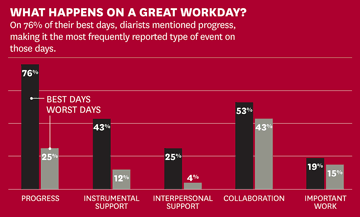
And there is more. The biggest surprise in this debate comes from the research findings that suggest that rewarding is not the issue at all. What really motivates people is the sense of making progress!

In a recent article of Harvard Business Review, Teresa Amabile and Steven Kramer present the astonishing results of a multiyear study tracking the day-to-day activities, emotions, and motivation levels of hundreds of knowledge workers.

A close analysis of nearly 12,000 diary entries, together with the writers’ daily ratings of their motivation and emotions, shows that making progress in one’s work—even incremental progress—is more frequently associated with positive emotions and high motivation than any other workday event.

The authors conclude that managers have powerful influence over events that facilitate or undermine progress. They can provide meaningful goals, resources, and encouragement, and they can protect their people from irrelevant demands. Again, the great catchphrases of Jeff Jarvis – the Google evangelist – resonate here: First, be a platform; then, get out of the way!

Oh, The Places You’ll Go!

Tuesday, July 6th, 2010

“If things start happening, don’t worry, don’t stew, just go right along and you’ll start happening too.”
— Dr. Seuss
As the Organizational Change Practitioner’s group on LinkedIn is about to reach 10.000 members, it’s time for me to look back and wonder how on earth the group got this big so fast? Sure enough, it is tempting to think that it’s all about me. But ego-centered games usually don’t last so long and don’t get so big.

Digital Natives and Digital Immigrants

I am sure you have come across these terms already. They are used to describe the division between generations who are connecting digitally and those who don’t. Unfortunately, most us think this is a generational gap. It isn’t. Today I saw a presentation indicating that the gap can even be split according to year of birth: 1980 seems to be the year of birth that indicates the great divide.

But age is irrelevant. Rather than talking about a generation gap, there is another difference: those who create, contribute and communicate digitally and those who don’t. In short: we are all digital natives once we decide to contribute digitally.

Trust Agents

“The stupidest possible creative act is a still a creative act.” says Clay Shirky, the most cited thinker on new media and digital economy. The thresholds for participating digitally have never been so low and not participating is no longer a matter of being too old or not being computer literate. Shirky underscores that the greatest difference between digital natives and digital immigrants is the difference between doing anything and doing nothing at all.

Chris Brogan, another icon of the digital age published a book in 2009, co-authored by Julien Smith, titled Trust Agents: Using the Web to Build Influence, Improve Reputation, and Earn Trust
The authors hand out practical advice for social media etiquette. And they make it all very tangible through the analogy of a cocktail party. They conclude that the internet and all of its tribes and communities is ultimately human because it rewards social behavior and punishes anti-social behavior.

The Bank Account

So the good old metaphor of the emotional bank account that is often used by Stephen Covey in his book The 7 Habits of Highly Effective People still stands. It’s like a financial bank account into which you can make deposits and take withdrawals.

The most important of all deposits into the emotional bank account of trust is empathy – and that is no different in the world of bits than it is in the world of atoms.

Covey defines empathy as: “listening to another person within his or her frame of reference. Empathy tells you what the important deposits are to that person.” And that is even more true on the internet.

The Platform

Of course, there are some principles you need to change in order to make things work in the digital age. That’s where Jeff Jarvis’ advice comes in. In his book What Would Google Do?
Jarvis explains some principles that would even make sense if we would also apply them in the non-digital world.

The first is to be a platform for other people to express their uniqueness instead of a big-hit-final-destination. Second, the insight that you don’t create a community but provide  elegant organization and then the community will let you help them (if you are lucky). You don’t own the community, so getting out of the way is a strength.

The Long Tail

Jarvis’ advice becomes clearer once you have a look at the dynamics and the mechanics underpinning the digital economy. In his book The Long Tail: Why the Future of Business is Selling Less of More, Chris Anderson does a very good job at explaining these dynamics in depth.

In short, there are three forces shaping the digital economy and they are bullwhipping the most fundamental laws of economics:
1. The means of production are available to anyone in the digital economy;
2. Transaction costs and shelf-space costs are close to 0 in this digital economy;
3. “Wisdom of crowds“: your brand is no longer a logo or a slogan: it is the story your customers tell about your product.

This means we need to review our basic understanding of transaction costs, distribution, shelf space and (above all) scarcity.

Is the Internet Making us Stupid?

The next question is the dumb-and-dumber question: is the internet sucking every bit of intelligence, education and sociability out of us? Again, looking at the generation Y’s and how they are most of the time behind a computer screen or any other device, it is tempting to say they are dumb and anti-social.

Think again, because what they are tapping into is way more intelligent, social and human than you can imagine. Here are three reasons why I think the internet is making us MORE INTELLIGENT:

1. Multiple Intelligence

First, in 2000 (!) John Seely Brown noted that the internet is the first medium to honor multiple intelligences. He invites us to have another look at literacy. In our narrow view of the world literacy involves only text, but there is also image and screen literacy. The ability to “read” multimedia texts and to feel comfortable with new, multiple-media genres is important.

According to Seely Brown, the new literacy, beyond text and image, is one of information navigation. My ability to watch TV does not exclude my reading abilities, just as my ability to tweet does not exclude my ability to have a decent conversation at the dinner table. They are all new layers of literacy that add up in out multiple intelligence. No need to be afraid of unlearning any skill.

As Seely Brown concludes: “Navigation” may well be the main form of literacy for the 21st century. In my humble opinion, this ‘navigation literacy‘ is being topped by  a new literacy: Collaboration Literacy.

2. The Medium Shapes the Message

Socrates worried about how writing affected the way ideas would be conveyed as opposed to speaking and conversation. Nietsche worried about how a typewriter would affect how his ideas would be conveyed as opposed to handwriting. A 2008 article of The Atlantic explains that the same is true for the internet:

“Never has a communications system played so many roles in our lives—or exerted such broad influence over our thoughts—as the Internet does today. Yet, for all that’s been written about the Net, there’s been little consideration of how, exactly, it’s reprogramming us.”

The internet as a medium shapes the message differently than offline. That much is true. But it does not make the connection poorer, nor does it make the participants dumber. The medium merely opened another can of possibilities.

3. Cognitive Surplus

In the below TED talk Clay Shirky takes the example of the platform Ushahidi to explain what he calls Cognitive surplus. In short: “Cognitive surplus = human generosity + digital tools”

Since the post-election violence in Kenya in 2008 the Ushahidi Platform has grown into a large open-source project impacting a number of communities around the world. It was deployed in the DR Congo to monitor unrest; Al Jazeera used it to track violence in Gaza; It was used to help monitor the 2009 Indian Elections; And to help gather reports globally about the recent Swine Flu outbreak.

Anybody can contribute information. Whether itʼs a simple text message from a SMS-capable phone, a photo or video from a smartphone, or a report submitted online, Ushahidi can gather information from any device with a digital data connection.

To me this platform proves that the internet can really make us more intelligent, because intelligence is the ability to interact and make new understanding. A platform that can do the powerful math of “1+1=3″ is a social platform.

The Places You’ll Go

“Online” is a different literacy and even puts an extra layer on off-line communications. I became aware of this when I discovered some new things about friends and family by interacting with them via Facebook (which I restrict to family and friends). Some of them I know for more than 20 years and still I discover things I would otherwise not have known about them.

Is that a sign of bad communication during my pre-internet years? No. Now we just have more than one channel to resonate and each channel shapes a different aspect of my friends and family.

And there is so much more to discover… Oh, the Places You’ll Go!

“You’ll get mixed up, of course, as you already know. You’ll get mixed up with many strange birds as you go. So be sure when you step. Step with care and great tact and remember that Life’s a Great Balancing Act. Just never forget to be dexterous and deft. And never mix up your right foot with your left.”
— Dr. Seuss

Music and Leadership (part 4)

Tuesday, June 1st, 2010

It is not the first time I got carried away by music into insights and aha’s on leadership. Last week I was fortunate enough to sneak into another rehearsal of the B’Rock orchestra. A strange thought crossed my mind: ‘What Would Google Do?’
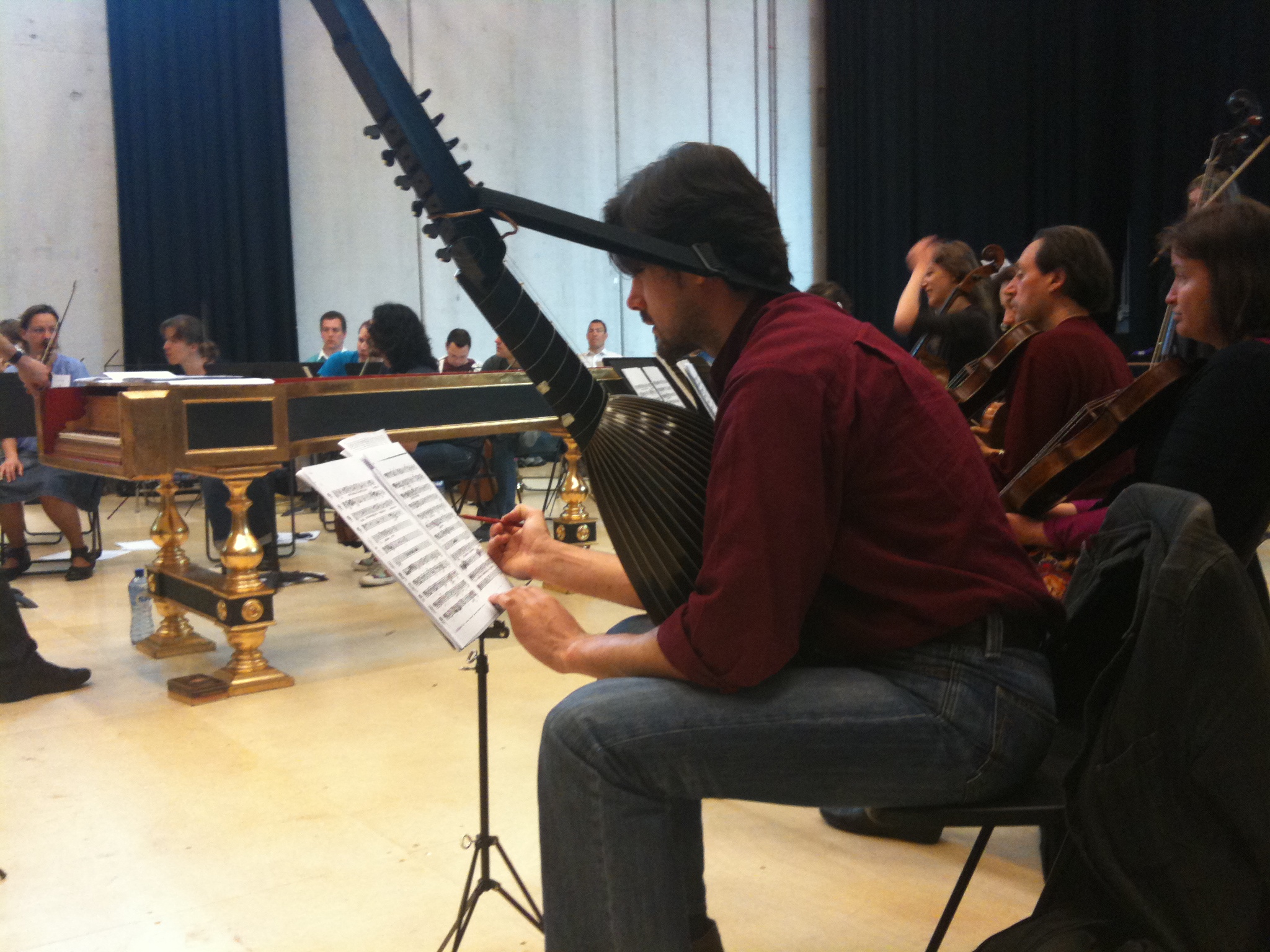
B’Rock is a project based ensemble that is organized in a particular way.

Like my previous visit to the B’Rock rehearsal, this was another immersion into music as a metaphor of leadership.  Like last time I was scouting learning methods in this exclusive and (until now) closed setting. A bizar experience … that’s why it is called BizzArts.

The way the B’Rock ensemble is organized is a great source of inspiration for anyone with a knack for management and leadership. B’Rock is a ‘democratic’ orchestra. And this has far reaching consequences on how each of B’Rock’s projects are organized.

If Google Were a Baroque Orchestra

With his 2009 bestseller What Would Google Do? Jeff Jarvis described a turning point in our economy by explaining in great detail how the internet is totally changing the rules of the game in our economy. Jarvis describes the disruptions on all levels of management when ‘online-real-time’ and ‘access to information by default’ enter the stage. The factory model of the industrial revolution has brought us prosperity and wealth, but in this information economy the command-and-control management needs to make place for new dynamics.

Let’s not get hooked on what the internet and baroque music have in common (because the answer is plain and simple: ‘nothing’). The point is that this orchestra incorporates a leadership style beyond command-and-control.

First: Draw a Line

Frank Agsteribbe – the leader of B’Rock – does not like to be addressed as the conductor. Rather, he sees himself as the ‘musical leader’. You may think this is just a small difference, but it shapes all of his decisions and actions as a leader.

‘Democratic’ does not mean ‘anarchy’, because there area few non-negotiables where the musical leader draws the line: choosing the program, setting the calendar and shaping the context. In an organization this is comparable to defining the strategy, defining the projects and communicating the vision. Frank makes it clear that this is the task of the leader and unlike sloppy organizations he takes full responsibility of these aspects.

He marks the playing field before the games begin. Do you put yourself on the line to mark the playing field before you kick off the game?

Second: Be a Platform

Unlike other orchestras who see themselves as a destination (and attract mostly mediocre musicians who are in search for a safe place to hide) B’Rock functions as a beehive: musicians are attracted and form a project based team.

The form of the beehive stays the same (the playing field), but the project at hand determines the pattern that the bees will follow and the dance they will perform.

B’Rock is the platform for awesome musical projects such as ‘On the Road to Mozarts Harem‘ or ‘Adieu to the Pleasures‘, thereby attracting better than average musicians.

Google is a platform, and if it were an orchestra it would be a project-based beehive. How about your organization? What are you being a platform for?

Third: Get Out Of The Way

This is where we got to observe that the musical leader walks his talk. As he explained right before the rehearsal: “I only have one pair of eyes and one pair of ears and when I focus on a singer or an instrument my attention is distracted from other elements. In that case it is good to have other musicians pointing out to me those other elements. By allowing them to do so, I widen the scope of what I can hear and what I can see.”

The problem with most orchestra’s is that of the dominant leader, the conductor who gets tempted to think that he is the centre of the orchestra (a moral that I mentioned in the previous post on music and leadership).

Agsteribbe continues: “Dominant leaders miss out on a lot of opportunities to improve because most musicians with a simple or creative idea will not bother to stand up and suggest it to the conductor.”

Right. They don’t want to get in trouble.

Although what looks like a chaotic organization at first, is actually an organic organization: in each section of the orchestra there is a spokesperson and often this role is a rotating role.

Actually, these are the lead players of each section who set the milestones and accents. In the beginning of each project they even have separate ‘leaders rehearsals’. This is an interesting concept.

When did you have a leader rehearsal prior to kicking off another million dollar project?

Unleash the Red Monkey (A Twitter Tale)

Monday, May 17th, 2010

‘Every truth passes through three stages before it is recognized. In the first it is ridiculed, in the second it is opposed, in the third it is regarded as self-evident.’
Arthur Schopenhauer

As I am writing this the second Twitter Brainstorm of OCPractitioners has just closed. I never thought it would be a confrontational idea for the 150+ followers. But somehow I have the feeling we have not quite crossed the chasm.
Red Monkeys

Cool friend Jef Staes is using the red monkey metaphor since 2007 to denote confrontational innovative ideas. Through the lense of this metaphor you can easily see how you should (and should not) appraoch the introduction of your red monkey (i.e. your idea) in your own forest (i.e. your organization). For example: you can determine where and when to drop your monkey if you want it to have best chances for survival (the answer: at the edge of your rainforest; NEVER in the middle). Another example: you can start to recognize red monkey hunters and diagnose their weapons.

EOI Café – Straight Talk

Last week I was fortunate enough to participate to the first Engine Of Innovation Café – another initiative from Jef Staes. There, I gave the below stand-up talk on my own red monkey: launching a brainstorm on Twitter for the community of Organizational Change Practitioners – a group of more than 9.000 members on Linkedin.

“A Twitter What??”

Although some learning takes place and good conversations are going on, my gut feeling tells me that we can do more with that community. So I created the Twitter Account @ocpractitioner.

It is a very awkward feeling to do something without any prior example. Putting my reputation on the line in front of 9000+ peers is not something I do every day… But I see it as my responsibility to make the community explore new territory. So I had sweaty hands and nothing more than a gut feeling that it might just work.I guess failing forward is part of the game :-)

What Inspired Me?

I figured that even if you take the Wikipedia 1% rule this would mean that a core group of 90 contributors could find one another in an intense cooperation. Sparked by seeing a growing number of people hooking up on the @ocpractitioner Twitter account I drafted the announcement for the first brainstorm.

I always wanted to test how we can brainstorm using new media – thereby learning its strengths and weaknesses. At the same timeI wanted to tap into the wisdom of the crowd of Organizational Change Practitioners in a dialogue mode (as opposed to the forum-mode we are familiar with on LinkedIn).

But there are also considerations on the long run:

  • First, Organizational Change Practitioners may be the largest network in the area of organizational change. But at present it is just a group, not a tribe. People do not (yet) pride themselves of being part of it.
  • Second, I believe that a platform of 9000+ people that gathered around the topic of organizational change is big enough to start crowd sourcing and learning from one another. To me, having this number of people gathered around this very topic is a tremendous opportunity.
  • Third, we have a message: Organizational Change Management should be center stage in any organization. We are on a mission and clarifying this mission is what will make this group into a tribe: organizational change management and a focus on the people side of change is vital for any organization. In that sense this is not ‘just another group to add to your profile’. Therefore I grab just about every opportunity to strengthen this network.

The Internet and the Zero-Cost

The internet has given us all the things we need at our fingertips and a smart use of the LinkedIn and Twitter platforms allow us to progress at zero cost. That is: zero cost for setup, subscription, maintenance or travel. We are seamlessly blending free tools that would otherwise be costing us a fortune a decade ago:

  • internet (that may be the only part you are paying for),
  • email (free Gmail),
  • an online forum (LinkedIn),
  • a one-to-many chat system (Twitter),
  • an online reporting system (Tweetchat and WhatTheHashtag).

So the zero-cost of transaction and the way we can integrate it seamlessly nowadays is a big accelerator. There are no costs in this investment.

Red Monkey Hunters

On a personal level this initiative takes a bit of courage to fight a certain amount of self doubt. You can imagine the voices in my head spinning around when the first reactions on the announcement were rolling in. They were not exactly ‘positive’. Rather sarcastic to be honest.

Then it is a matter of getting out of the way and not letting your ego take over. As a community manager I had to resist the urge to post victim reactions, revenge notes or rescue actions. At those moments you need to get out of the way and let the community to the work. And eventually it did. Trusting the community to self regulate and preparing to accept the course the community will take as a reaction to your prototype is a big thing.

Some Lessons Learned

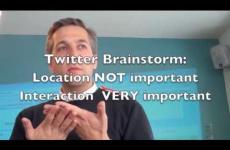
I have found that the human interaction ‘rules of the game’ are as valid online as they are face-to face. The real value of brainstorming clearly remains: people at the same time in the same (virtual) room. Interaction is key for ideas to come out. It seems like the brainstorm mode is something that is restricted in time and triggered by peers.

This was exemplified by the reaction of a participant early in the brainstorm who tweeted: “Hey is this brainstorm over? Am I alone here?It makes no sense to have a brain eruption when no one is watching.

Another example is that of participants whose timezone did not match and who contributed later. They read through the tweets; retweeted some and reacted to others. But the dynamic was gone. Looking at a board full of post-its from a brainstorm is nice and can be energizing. You can even add yours but when you notice that you are the only one in the room, the enthousiasm soon fades away.

The 140 Character Advantage

Twitter is not a replacement of Linkedin discussions. Rather, it is a layer of interaction that comes on top of it. The medium restricts you to 140 characters which is an advantage because you really need to craft your reaction before your post it by asking: ‘what is it exactly that I want to say?’

Another fascinating thing is new measurements that automatically come with the platform. ALthough we still need to figure out what they mean and if they are meaningful at all! For example:

  • Number of participants: it is important to have every participant tweet at least his  presence so the others know they are not alone in the room and that their brain eruptions will not go unnoticed. Somehow spectators need to be able to aknowledge they are watching;
  • Number of tweets: like the number of post-its it is only indicating the volume and not the quality of the discussion;
  • Number of RT’s (ReTweets) this is something we will need to educate the participants for: If you like an idea you should RT it. That is a virtual way to vote for an idea. This will allow certain ideas to gain further attention.
  • Number of reactions: this is reacting to a tweet of another participant. This may tell us something about the level of listening that occurs among the tweeters.Is it just noise or are we really trying to understand what is being said?
  • The timeslot: like a face-to-face brainstorm I have noted that the first 40 minutes are the best and then it seems like the brains have been emptied. However, from the second brainstorm we could experience people retuning to the discussion board the next morning and continue the discussion.
  • Follow-the-sun: Never before have I discussed an idea with an Aussie and an LA person while all being at home (this is: early morning, late noon and middle of the night). People log on when it suits them most.

Of course these are findings of one single brainstorm so we need to find out if they remain valid throughout the next storms.

Now What?

My guess is that there were some people participating and a lot of people watching the brainstorm as it unfolded like watching a wrestling game in the ring.

That is OK for the first time, but from now on I would like to take this exceptional first time and craft it into a habit for our community so that one day any member in need for ideas can call out to the community and request a brainstorm.

I hope one day this will become the second nature of our community members. And that’s where Twitter brainstorming really will start to add value to our community.

Tips for First Timers

Finally, for first-timers, here are a few hints:

  • Create a Twitter account and start playing around with it; follow some people, Tweet, Retweet
  • Twitter is free and if you don’t like it you can simply close down your account
  • Don’t know how to tweet? Ask your kids and experience reverse-coaching firsthand!
  • Read What Would Google Do? In this 2009 book of Jeff Jarvis you will learn basic principles that you need to embody whenever you manage such a community or a brainstorm. Principles like: ‘Give up all control’, ‘Do what you do best & link to the rest’, ‘Get out of the way’ and ‘Web 1.0 was about ‘look at me’, whereas Web 2.0 is about ‘look at you’,…  are key to understanding the dynamics of communities.

Glossary, Related Articles and Links