
Archive for the ‘Jef Staes’ Category

Welcome to my Bell-Shaped World

Tuesday, August 31st, 2010

Take a seat on the other side of my eyeballs. You will discover that I look at the world through a pair of bell-curve-shaped lenses. I keep tinkering until they make sense. So there you go: Ten Tinkered Bells!

It all started in 1809, when Carl Friedrich Gauss published the monograph  “Theoria motus corporum coelestium in sectionibus conicis solem ambientium” (now repeat that one more time with your eyes closed…) where among other things he introduced the normal distribution. This is a bell-shaped curve where most values cluster around a mean, while outliers can be found above and below the mean.

For example, human height often follows a bell  curve, with outliers who are unusually short and tall and the bulk of people being concentrated around a mean height, such as 70 inches (178 centimeters) for American men. When data which follows a normal distribution pattern is graphed, the graph often resembles a bell in cross section, explaining the term “bell  curve.”

These Normal or Gaussian distributions can be found in a wide variety of contexts, and if you ask me: they are everywhere! As you go through these 10 bell-shaped thoughts you will note that I am recycling some stuff I have published over the past three years. Also, I am mixing in some new elements. Old wine in new bottles if you will – but for me it does the trick.

1. The Diffusion of Innovations

What is it?


For starters, in a 1962 book called The Diffusion of Innovations, Everett Rogers stated that adopters of any new innovation or idea could be categorized on a classic bell-shaped curve as described here:

  • Innovators (2.5 %) Venturesome, educated, multiple information sources, greater propensity to take risk;
  • Early Adopters (13.5%) Social leaders, popular, educated;
  • Early Majority (34%) Deliberate, many informal social contacts;
  • Late Majority (34%) Skeptical, traditional, lower socio-economic status;
  • Laggards (16%) Neighbors and friends are main information sources, fear of debt.

Why is it important?

If you are about to introduce and organizational change you will find the exact same diffusion of crowds inside organizations.

How do I use it?

In short: I use it as a compass. Rogers found out that this diffusion – and these proportions form a reliable pattern. Therefore, this chart gives me patience and reassurance in difficult moments.

Imagine you have just kicked off an organizational change program and you get nothing but very bad reactions. Of course there is some feedback in there, but chances are that you just landed your change vehicle in the middle of the laggards’ nest. So stay positive and keep looking for the other slices of the curve!

2. The Chasm

What is it?


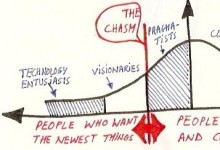
Building further on Rogers’ observations, Geoffrey Moore’s key insight is that the groups adopt innovations for different reasons. According to Moore, early adopters are technology enthusiasts looking for a radical shift, while the early majority wants a productivity improvement. Both groups are divided by a chasm. According to Moore:

  • Technology Enthusiasts (Innovators) are explorers;
  • Visionaries (Early Adopters) are more geared towards exploitation. They are not especially bothered by the fact that the product doesn’t work. They are willing to make it work;
  • Pragmatists (Early Majority) want a product that works. They want a 100% solution to their business problem. If they get the 80 % that delighted the visionary, they feel cheated, and they tell their pragmatist friends;
  • Conservatives (Late Majority) buy products because they really have no choice. They are not reassured by having books about the product, because the existence of books implies the product isn’t simple enough to use. Conservatives will not tolerate complexity;
  • Skeptics (Laggards) are not going to buy, though they may talk other people out of buying.

Why is it important?

Now that we know that different crowds come to the surface each time you introduce a change, Moore’s observations tell us where the real challenge lies: crossing the chasm; i.e.: winning the hearts and minds of the 85% who want solutions and convenience. The problem in crossing the chasm is that the visionaries aren’t good references for the pragmatists. They provide tales of heroics. Pragmatists want references from other pragmatists.

How do I use it?

In short: I use it to keep my head out of the clouds and to get my feet on the shop floor. It is obvious that the innovators and the early adopters will never oppose or object the changes you are implementing. Another word for the left hand side of the chasm is a project cocoon: a safe group of like-minded people. On the right hand side of the chasm you will find people who want solutions and convenience. And they represent 85% of your target population!

The challenge of organizational change management is to get your ass to the other side of the chasm. And it takes a great deal of emotional intelligence to cross the chasm. The interactions you have at the other side increase the quality of the solution you are building – to the same extent as they are grinding your nerves. Just remember: the best work is done with the heart breaking or overflowing.

3. The Tipping Point

What is it?


In his book The Tipping Point: How Little Things Can Make a Big Difference, Malcolm Gladwell investigated what determines the moment of critical mass, the threshold, or even the boiling point of a marketing effort.

Wikipedia describes it even better: “the levels at which the momentum for change becomes unstoppable.”

Why is it important?

Once you hit a tipping point all the dynamics change. All of a sudden your product, idea or trend you have been pushing starts spreading like a virus. What once seemed impossible now all of a sudden has become unstoppable. Inexperienced project managers are often taken by surprise when the tipping point pulls them into an ugly acceleration.

In times of ugly acceleration hanging on to control will kill you. Experienced project managers know that ‘control’ is the way to the tipping point, but they also know that they need to switch to coordination and trust once their project becomes unstoppable.

How do I use it?

In short: managing expectations. I integrate the expectation of “ugly acceleration” into my approach. Tipping points are points of no return – the very times when procrastination ends. From here on it’s action, so one should keep it simple and make sure to be on the same page.

Each project – big or small – has a tipping point, and it occurs when your deliverables hit solid ground: usability testing, user training, physical changes on the shop floor, etc.
That is when you meet the pragmatists face-to-face. They want solutions and convenience. You no longer need to tell WHY the program exists. Instead, you are prompted to explain in detail HOW it is going to work. They won’t let up until it makes sense to them.

Wanna know another lesson learned? Don’t over-promise. It is painful to be applauded for announcing or demonstrating a feature only to discover it won’t be part of the solution. Trust me: on large scale projects this happens all the time.

4. Broken Windows Theory

What is it?


The broken windows theory is a notion that comes from the same book by Gladwell. Consider a building with a few broken windows. If the windows are not repaired, the tendency is for vandals to break a few more windows. Scientists in the field of criminology found that disorder invites even more disorder and that a small deviation from the norm can set into motion a cascade of vandalism and criminality.

Why is it important?

Litter encourages more litter. A broken window is a crack that allows negative behavior to slip in. And human beings are herding animals: we resonate to the influences nearest at hand.

As Gladwell notes: “Why was the Transit Authority so intent on removing graffiti from every car and cracking down on the people who leaped over turnstiles without paying? Because those two trivial problems were thought to be tipping points-broken windows-that invited far more serious crimes“.

How do I use it?

People who work with me know that I’m a neurotic when it comes to broken windows. When I see a crack, I want to repair it instantly. Right now. An unpleased customer, a deliverable missing a beat, a target group we forgot to involve, or resistance brewing underground (mostly you pick that up accidentally standing by the coffee machine).

Attention here: fixing a broken window is not the same as denying it. Saying it ain’t so won’t solve the tension; neither does jumping to conclusions. Fixing the broken windows of dissatisfaction is done with respect instead of judgement. The broken windows theory reminds me to be sensitive for cynicism and indifference and to provide platform for these emotions to turn into contributions.

Final note: the strange thing about change management broken windows is that they are best fixed by the inhabitants. Your role is to spot them and to provide the means, the time and the space to do so.

5. The Red Monkey

What is it?


Jef Staes introduced the concept of a red monkey. According to the latest insights in biodiversity, new species do not start in the middle of a forest but at the edge. At the edge! – where different species from different ecosystems ‘meet’. That’s when Jef created a metaphor of a brown monkey from the jungle who meets a red fish from the sea (an adjacent ecosystem). Through their conversation a new confrontational idea is born: a red monkey.

Why is it important?

What would happen if that confrontational idea would be dropped in the middle of the jungle? It would be killed immediately. Jef notes that the same thing happens with confrontational ideas that are ‘dropped’ in the middle of an organization … they get killed as well. Innovation ‘never’ starts in the middle of an organization but on the edge, where ecosystems meet.

By default your red monkey disturbs the balance in people, teams and organizations. It tilts the stability of an ecosystem, and therefore it will get killed if there is no critical mass to protect it in order to survive and mature.

How do I use it?

Think of red monkeys as your next innovation project. And think of yourself as the one responsible for its survival. It takes a serious amount of conflict handling skills to coax a red monkey to the right hand side of the chasm. This is a step-by-step process and it requires a different view on resistance. One thing is sure: you should start at the edge and move gradually to the middle.

When I look at my job that way, I tend to see it as a vocation and myself as a linchpin instead of a cog. And this – in its turn – radically influences my persistence and the quality of my work.

6. The Elephant Dilemma

What is it?


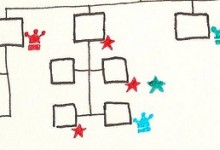
Just like Jef Staes constructs theories involving monkeys, I do the same thing with elephants. It started when I was attending a phone conference that lasted too long. I started drawing randomly and without knowing it uncovered an elephant out of my favorite bell-shaped curve.

Why is it important?

In all organizational change programs there is a moment when the work ahead looks so massive that you don’t know where and how to start. Those moments are paralyzing and you feel pretty small. Project managers refer to this situation as the ‘how to eat the elephant dilemma’. The elephant is hidden in the target population and the chunks of the elephant are the audiences that you encounter while introducing a new product or initiative.

The secret?  On the drawing above you go tail first: making sure that the innovators and the early adopters (most of the times this is your own core team and the sponsor of your program) get through that change cycle first. Once you have won their minds and hearts they will help you to attack the next big chunk: the pragmatists (these may be key users or testers of whatever you are implementing) and so on.

How do I use it?

The elephant reminds me that I can shape the path of the project just by channeling the emotions and the energy towards the main deliverables. If you think people will whine or be angry you should make sure that they ‘whine forward’ or ‘complain forward’ People make sense of the change as they react to the prototype of your deliverables.

The solution is to provide a series of deliverables that people can shoot at, nicely ordered in the same direction: forward. Not only will this improve the quality and the accuracy of the deliverables, it will also get their minds in motion and their noses pointed in the direction of the program.

7. Warcraft Wisdom

What is it?


In the chapter “On The Beach” of his 1993 book Accidental Empires, Robert Cringely talks about the three distinct groups of people that define the lifetime of a company: Commandos, Infantry, and Police.In my opinion these forces all represent the management styme that is needed as you progress through the lifecycle of an innovation.

For instance, the destructive (literally: ‘ground-breaking’) work of commandos who prepare territory for the infantry is described by Robert Cringely as follows: “Commandos parachute behind enemy lines or quietly crawl ashore at night. Their job is to do lots of damage with surprise and teamwork, establishing a beachhead before the enemy is even aware that they exist.”

This is exactly how difficult and large change projects kick-off: they have been planned and budgeted for long before they officially kick-off. Once the path is cleared, changing can start. Now you will need an infantry of agents to get the job done: blueprinting, designing, testing, training, collecting and cleansing data, etc.

Finally, the new structures are in place, you will find that there is still the need for a military presence by means of local coaching (often referred to as ‘hypercare’). These are the UN peacekeeping troops, a remainder of the infantry (note: you will find nothing about UN peace keeping troops in Cringely’s book – please allow me to stretch the concept). Their only purpose is to stabilize the new order and eventually to hand over to the local peacekeepers: the police.

Why is it important?

You need a commando style in order to create the circumstances for change.  Whether it is to obtain commitment for blueprinting, design, testing, training or go-live, without the commando actions the efforts will be ignored as long as there is no pressure or hard evidence that things will change.

For the infantry the most important thing here is to take on a structured approach. In the words of Cringely: “While the commandos make success possible, it’s the infantry that makes success happen.”

How do I use it?

The one thing to remember is that it takes different team styles: the commandos are the agents that make success possible, the infantry make success happen and UN peace keepers and police are needed to refreeze the new structures and habits like a stabilizing force.

8. Mapping the Added Value

What is it?


After reading Seth Godin’s Purple Cow, blogger Thomas Baekdal wrote a wonderful piece on what you should plan, do and support. He calls for a strategy with 4 layers: plan and prepare for the future, work in the present, support what you did yesterday, and ignore out-of-date ideas. To illustrate this, he tops the bell-shaped curve with a value curve.

Why is it important?

The value curve illustrates where you should focus your energy and resources. If you want to be successful, then most of your time must be spent on what Baekdal calls ‘the next thing,’ and the rest should be maintained and automated to the best of your abilities.

How do I use it?

This is what your project plan should look like from a time management perspective:

  1. Actively devote attention to your future plans and test out new ideas
  2. Spend most of your time making sure that your deliverables cross the chasm and get picked up at the other side.
  3. Continue to support the project phases that you launched ‘yesterday,’ even if they are no longer an active part of your dashboard. As Baekdal puts it: “Answer people’s questions, provide tips and gently push them towards your new ideas.”
  4. Finally, you need to unhook your attention from the laggards (usually they are experts at sucking up your precious time for futile details that add no value what-so-ever.)

9. The Long Tail

What is it?


The long tail refers to the statistical property that a larger share of population rests within the tail of a probability distribution than observed under a Gaussian distribution. The term has gained popularity in recent times because it identifies the digital economy and the effects of the internet on business as we know it.

In his book The Long Tail, Chris Anderson does a very good job at explaining these dynamics in depth. According to Anderson, the internet flips some basic economic theories of Adam Smith, Vilfredo Pareto, Karl Marx and very basic concepts such as transaction costs, distribution, shelf space and (above all) scarcity.

Why is it important?

The long tail of normal distributions has changed since the internet mainly through three dynamics:

  1. The means of production are available to anyone in the digital economy;
  2. Transaction costs and shelf-space costs are close to 0 in this digital economy;
  3. “Wisdom of crowds”: your brand is no longer a logo or a slogan: it is the story your customers tell about your product.

The point is not that you should no longer try to get into the top position of big hits. Since the internet the niches have become the new big. But in order to survive in the niches you should be a platform for these niches instead of a final big hit destination.

How do I use it?

Being platform  (aka: ‘crowdsourcing‘)instead of a know-it-all destination is a good thing. Rather than seeking uniformity, and the full control of one single ‘hit’ destination, the long tail tells us it is better to be a platform for a crowd of alternative solutions.

10. The Three Strategies

What is it?


Building further NYU professor Clay Shirky’s statement that ‘Institutions will try to preserve the problem to which they are the solution.’ More specifically, Shirky refers to how the media industry is incapable of changing because they are solving the wrong problem.

Let’s face it: newspapers are the solution to the problem of … news gathering and news distribution. AND THAT PROBLEM NO LONGER EXISTS. That inspired me to identify three strategies to cope with the reversed dynamics of the digital economy: No Problem, Extrapolating the Problem, and Reinventing the Problem from Scratch.

Why is it important?

Let’s take my favorite example: the dying newspaper industry. Nowadays if we all want news we simply go to Google to get it.  Who published it isn’t nearly as important to readers any more.  Nor is the packaging. There are 3 strategies for newspapers to react to the downturn in their business:

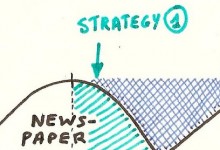
  • NO PROBLEM: This is where most newspapers and magazines are today: Do nothing unless the competition forces you to. Paper is the main business and the internet, well… because we have to.
  • EXTRAPOLATING THE PROBLEM: these companies know that printing will be out of business some day, so they just make the technical switch to a new medium (the internet and e-readers). However, they have fallen in love with the problem that no longer exists: they still view themselves as gatherers and distributors of news (and what sucks even more: they still package the news on these e-readers in ‘pages’ and ‘issues’ – a constraint that was due to the printing press!)
    Note on the drawing:  be careful here because this area splits in half:
    - The left part is EXTRAPOLATING the problem that no longer exists.
    - The right part is what one could call the LONG TAIL
  • REINVENTING THE PROBLEM FROM SCRATCH: Today’s problem is an abundance of news and a need to make sense of it all. So the future is to be a platform for sense-making. This will require the newspapers business to let go of their attachment to the producer-consumer model. Only then will they be able to search for new revenues and growth.

How do I use it?

To me these three strategies are a razorsharp analysis tool to separate wanna-be innovations from real innovations. The three strategies open my eyes to the fact that each product and each project has a lifecycle and that you have the choice to:

  • Do nothing and – to you own amazement – die at the end of the lifecycle;
  • Try out a new lifecycle but with both feet firmly anchored in your current world-view: you will never be a leader in your segment;
  • Take a risk; jump; and invent your own game.

11. What’s In a Bell?

As I was writing this article it became obvious that there is more to my bell-shaped world than this. Have a look at the following dilemma’s which somehow- will fit in a bell-shaped world, but I still need to map them on a chart to discover what is holding us back.

  • Money as an exchange mechanism versus the revival of the gift economy. Let’s face it: money has not been there since the beginning of business and trade. And in the beginning it came into being rather as a side-effect of some smart traders.
  • Fossil fuel versus renewable energy sources. How and when will we switch? Someone pointed out that this is a classical example of the prisoner’s dilemma. The prisoner’s dilemma is a fundamental problem in game theory that demonstrates why two people might not cooperate even if it is in both their best interests to do so.

Fascinating … to be continued!

(but I think it’s enough for now…)

Newspapers are Solving the Wrong Problem

Monday, August 9th, 2010

We are all quite good at creating and sustaining comfort-zones, because this is what makes life predictable. But when we do that at as a group or an organization, disasters can happen. Newspapers are next on this list.

Many project teams isolate themselves in their own cocoons, having little contact as possible with what is, for them, outer space. In the past I have called this project cocooning. Recently I have come to think of it as shop floor fear.

The truth is that any sign of skepticism puts competent teams at the edge of their comfort zone. The resistance they meet is mostly countered with … resistance. By virtue of their ‘shared values’ project teams counter feedback with arrogance. That is why large scale projects fail even when all of the measurements, indicators and dashboards in the green zone.

Group-Think

When Irving Janis discovered this mechanism he defined it as group-think. It occurs “when the members’ strivings for unanimity override their motivation to realistically appraise alternative courses of action.”

Group-think has led to disasters such as failure to anticipate the Japanese attack on Pearl Harbor (1941); the Bay of Pigs fiasco (1961) when the US administration sought to overthrow Cuban Government of Fidel Castro; and the prosecution of the Vietnam War (1964-67) by President Lyndon Johnson. Lend me your ears and I can top this list with some juicy stories of failed large scale projects.

Testing Group-Think

Group cohesion is the comfort zone at stake because that is the value that seems to be more important thanb common sense. To make groupthink testable, Janis devised eight symptoms indicative of groupthink:

1. Illusions of invulnerability creating excessive optimism and encouraging risk taking.
2. Rationalizing warnings that might challenge the group’s assumptions.
3. Unquestioned belief in the group’s morality and ignoring the consequences of their actions.
4. Stereotyping those who are opposed to the group as weak, evil, biased, spiteful, stupid, etc.
5. Direct pressure to conform placed on members who question the group, in terms of ‘disloyalty’.
6. Self censorship of ideas that deviate from the apparent group consensus.
7. Illusions of unanimity among group members, silence is viewed as agreement.
8. Mind guards — self-appointed members who shield the group from dissenting information.

When we test the Newspaper industry against these criteria, they score very high, so we may be looking at a disaster waiting to happen.

Preserving the Problem

NYU professor Clay Shirky has a clear view on why group-think exists. According to him, complex solutions (like a company, or an industry) can become so dedicated to the problem they are the solution to, that often they inadvertently perpetuate the problem: ‘Institutions will try to preserve the problem to which they are the solution.

Shirky refers to how the media industry is incapable of changing because they are solving the wrong problem. Let’s face it: newspapers are the solution to the problem of … news gathering and news distribution. AND THAT PROBLEM NO LONGER EXISTS.

Distribution is the Wrong Pot to Piss In

In an earlier sketch with Seth Godin I have argued that it’s about content, not printing or distribution. The Shirky Principle, which results from the mechanics of group-think seems to confirm my analysis.

Nowadays if we all want news we simply go to Google to get it.  Who published it isn’t nearly as important to readers any more.  Nor is the packaging. There are 3 strategies for newspapers to react to the downturn in their business:

NO PROBLEM: This is where most newspapers and magazines are today: Do nothing unless the competition forces you to. Paper is the main business and the internet, well… because we have to.

EXTRAPOLATING THE PROBLEM: these companies know that printing will be out of business some day, so they just make the technical switch to a new medium (the internet and e-readers). However, they have fallen in love with the problem that no longer exists: they still view themselves as gatherers and distributers of news (and what sucks even more: they still package the news on these e-readers in ‘pages’ and ‘issues’ – a constraint that was due to the printing press!)

REINVENTING THE PROBLEM FROM SCRATCH: Today’s problem is an abundance of news and a need to make sense of it all. So the future is to be a platform for sense-making. This will require the newspapers business to let go of their attachment to the producer-consumer model. Only then will they be able to search for new revenues and growth.

PS: Have a look at another sketch with Jef Staes to see how Belgian Media (and to be honest: the complete Belgian Economic and political landscape) are a good example of the mechanics of group-think.

Unleash the Red Monkey (A Twitter Tale)

Monday, May 17th, 2010

‘Every truth passes through three stages before it is recognized. In the first it is ridiculed, in the second it is opposed, in the third it is regarded as self-evident.’
Arthur Schopenhauer

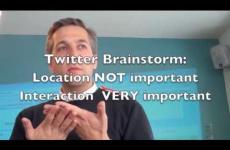
As I am writing this the second Twitter Brainstorm of OCPractitioners has just closed. I never thought it would be a confrontational idea for the 150+ followers. But somehow I have the feeling we have not quite crossed the chasm.

Red Monkeys

Cool friend Jef Staes is using the red monkey metaphor since 2007 to denote confrontational innovative ideas. Through the lense of this metaphor you can easily see how you should (and should not) appraoch the introduction of your red monkey (i.e. your idea) in your own forest (i.e. your organization). For example: you can determine where and when to drop your monkey if you want it to have best chances for survival (the answer: at the edge of your rainforest; NEVER in the middle). Another example: you can start to recognize red monkey hunters and diagnose their weapons.

EOI Café – Straight Talk

Last week I was fortunate enough to participate to the first Engine Of Innovation Café – another initiative from Jef Staes. There, I gave the below stand-up talk on my own red monkey: launching a brainstorm on Twitter for the community of Organizational Change Practitioners – a group of more than 9.000 members on Linkedin.

“A Twitter What??”

Although some learning takes place and good conversations are going on, my gut feeling tells me that we can do more with that community. So I created the Twitter Account @ocpractitioner.

It is a very awkward feeling to do something without any prior example. Putting my reputation on the line in front of 9000+ peers is not something I do every day… But I see it as my responsibility to make the community explore new territory. So I had sweaty hands and nothing more than a gut feeling that it might just work.I guess failing forward is part of the game :-)

What Inspired Me?

I figured that even if you take the Wikipedia 1% rule this would mean that a core group of 90 contributors could find one another in an intense cooperation. Sparked by seeing a growing number of people hooking up on the @ocpractitioner Twitter account I drafted the announcement for the first brainstorm.

I always wanted to test how we can brainstorm using new media – thereby learning its strengths and weaknesses. At the same timeI wanted to tap into the wisdom of the crowd of Organizational Change Practitioners in a dialogue mode (as opposed to the forum-mode we are familiar with on LinkedIn).

But there are also considerations on the long run:

  • First, Organizational Change Practitioners may be the largest network in the area of organizational change. But at present it is just a group, not a tribe. People do not (yet) pride themselves of being part of it.
  • Second, I believe that a platform of 9000+ people that gathered around the topic of organizational change is big enough to start crowd sourcing and learning from one another. To me, having this number of people gathered around this very topic is a tremendous opportunity.
  • Third, we have a message: Organizational Change Management should be center stage in any organization. We are on a mission and clarifying this mission is what will make this group into a tribe: organizational change management and a focus on the people side of change is vital for any organization. In that sense this is not ‘just another group to add to your profile’. Therefore I grab just about every opportunity to strengthen this network.

The Internet and the Zero-Cost

The internet has given us all the things we need at our fingertips and a smart use of the LinkedIn and Twitter platforms allow us to progress at zero cost. That is: zero cost for setup, subscription, maintenance or travel. We are seamlessly blending free tools that would otherwise be costing us a fortune a decade ago:

  • internet (that may be the only part you are paying for),
  • email (free Gmail),
  • an online forum (LinkedIn),
  • a one-to-many chat system (Twitter),
  • an online reporting system (Tweetchat and WhatTheHashtag).

So the zero-cost of transaction and the way we can integrate it seamlessly nowadays is a big accelerator. There are no costs in this investment.

Red Monkey Hunters

On a personal level this initiative takes a bit of courage to fight a certain amount of self doubt. You can imagine the voices in my head spinning around when the first reactions on the announcement were rolling in. They were not exactly ‘positive’. Rather sarcastic to be honest.

Then it is a matter of getting out of the way and not letting your ego take over. As a community manager I had to resist the urge to post victim reactions, revenge notes or rescue actions. At those moments you need to get out of the way and let the community to the work. And eventually it did. Trusting the community to self regulate and preparing to accept the course the community will take as a reaction to your prototype is a big thing.

Some Lessons Learned

I have found that the human interaction ‘rules of the game’ are as valid online as they are face-to face. The real value of brainstorming clearly remains: people at the same time in the same (virtual) room. Interaction is key for ideas to come out. It seems like the brainstorm mode is something that is restricted in time and triggered by peers.

This was exemplified by the reaction of a participant early in the brainstorm who tweeted: “Hey is this brainstorm over? Am I alone here?It makes no sense to have a brain eruption when no one is watching.

Another example is that of participants whose timezone did not match and who contributed later. They read through the tweets; retweeted some and reacted to others. But the dynamic was gone. Looking at a board full of post-its from a brainstorm is nice and can be energizing. You can even add yours but when you notice that you are the only one in the room, the enthousiasm soon fades away.

The 140 Character Advantage

Twitter is not a replacement of Linkedin discussions. Rather, it is a layer of interaction that comes on top of it. The medium restricts you to 140 characters which is an advantage because you really need to craft your reaction before your post it by asking: ‘what is it exactly that I want to say?’

Another fascinating thing is new measurements that automatically come with the platform. ALthough we still need to figure out what they mean and if they are meaningful at all! For example:

  • Number of participants: it is important to have every participant tweet at least his  presence so the others know they are not alone in the room and that their brain eruptions will not go unnoticed. Somehow spectators need to be able to aknowledge they are watching;
  • Number of tweets: like the number of post-its it is only indicating the volume and not the quality of the discussion;
  • Number of RT’s (ReTweets) this is something we will need to educate the participants for: If you like an idea you should RT it. That is a virtual way to vote for an idea. This will allow certain ideas to gain further attention.
  • Number of reactions: this is reacting to a tweet of another participant. This may tell us something about the level of listening that occurs among the tweeters.Is it just noise or are we really trying to understand what is being said?
  • The timeslot: like a face-to-face brainstorm I have noted that the first 40 minutes are the best and then it seems like the brains have been emptied. However, from the second brainstorm we could experience people retuning to the discussion board the next morning and continue the discussion.
  • Follow-the-sun: Never before have I discussed an idea with an Aussie and an LA person while all being at home (this is: early morning, late noon and middle of the night). People log on when it suits them most.

Of course these are findings of one single brainstorm so we need to find out if they remain valid throughout the next storms.

Now What?

My guess is that there were some people participating and a lot of people watching the brainstorm as it unfolded like watching a wrestling game in the ring.

That is OK for the first time, but from now on I would like to take this exceptional first time and craft it into a habit for our community so that one day any member in need for ideas can call out to the community and request a brainstorm.

I hope one day this will become the second nature of our community members. And that’s where Twitter brainstorming really will start to add value to our community.

Tips for First Timers

Finally, for first-timers, here are a few hints:

  • Create a Twitter account and start playing around with it; follow some people, Tweet, Retweet
  • Twitter is free and if you don’t like it you can simply close down your account
  • Don’t know how to tweet? Ask your kids and experience reverse-coaching firsthand!
  • Read What Would Google Do? In this 2009 book of Jeff Jarvis you will learn basic principles that you need to embody whenever you manage such a community or a brainstorm. Principles like: ‘Give up all control’, ‘Do what you do best & link to the rest’, ‘Get out of the way’ and ‘Web 1.0 was about ‘look at me’, whereas Web 2.0 is about ‘look at you’,…  are key to understanding the dynamics of communities.

Glossary, Related Articles and Links

Organisations in Search of a New Balance – Part 2: The Sheep Drama (by Jef Staes)

Saturday, March 20th, 2010

Organizations don’t fall by threats they noticed in time but by threats they didn’t see coming. The low innovative power of organizations is caused by 2D-managers and 2D-HRM who didn’t or wouldn’t see the harmful impact of job descriptions and competence management on creative entrepreneurship. Unconsciously they were successful in changing a whole generation of talented people into sheep.

Job Descriptions: Sheep are Born

If we look at 2D-management we see a manager who manages his team by tasks or job descriptions. Job descriptions and the related competence management are the best practice examples of today’s 2D-management generation.

However, something doesn’t feel right with these best practices. Take away all the window dressing and the only thing remaining is a list of tasks of what a team member has to do. We always try to find the right person for a job but still, there will always remain tasks in his job description for which he doesn’t have the talent or passion. In 2D-management thinking it is generally accepted that it is impossible to organize work in such a way that everyone has a job with only tasks for which he has the passion and the talents. Everyone is expected to take up tasks one doesn’t like to do.

Job descriptions and departments have become tangible fences that box in people in their 2D-organizations. People are required to stay within these fences, to perform tasks that do not fully meet their passions and talents, and undergo training that attempts to make them do better what they do not like to do in the first place. The latter is the result of the much praised 2D-competence management.

To me it’s pretty clear: put a fence around people and they become sheep … and that is the reason why creative entrepreneurship in our regions has almost ‘totally’ disappeared. We have built organizations that turn people into sheep rather than developing and using what makes us unique as human beings: passion and talent.

From Jobs to Roles: Ending the Sheep Drama

In the fast-moving 3D-era, it is impossible to survive if we do not better manage and use the natural talent and passion of people. We need creative and entrepreneurial team players. In order to succeed we must replace ‘job descriptions’ with ‘role descriptions’.

This seems to be a simple operation, but the consequences are huge. A 3D-manager breaks with job descriptions and competence management. He makes a cast list with all the necessary roles needed to move in the direction of his vision and then he begins the search for passionate talents that fill in the roles.

In a 3D-organization HR becomes a switchboard for casting passion and talents. The throughput of people working for various managers, business units, and even organizations will be the success indicator for the switch from jobs to roles.

This proposal, however, is a tragedy for 2D-managers who cannot imagine how they need to prepare for this. For 2D-HRM services is blasphemy because they have so much invested in static 2D-job descriptions and competence management that they can’t admit having invested in the wrong processes.

For 2D-trade unions this is hell because the entire job classification system and “working for one employer” belongs to the past.

For 3D-managers, -workers and -trade unions on the other hand, this movement is an opportunity because it will enable creative entrepreneurship by deploying the right talents in the right place.

So what do you want? Sheep or creative entrepreneurs? It is not a question of money, but one of courage. The courage to change.

Houston we have a SMART problem

Monday, February 8th, 2010

I always associated SMART goals with positive things, such as sound corporate governance. Never in my life I would have thought that SMART would be threat to the people I work with. But things have changed and they continue to change.

When my team has to reach a certain goal, I chunk that goal into manageable parts and plans. Next, individuals commit to the plan. Eventually – if I want them to perform well against the plan – I assign them SMART goals.

SMART is one of those management acronyms that are taken for granted by everyone. It stands for:
S   – Specific, meaning: unambiguous, clear goals
M   – Measurable, meaning: ’if you can’t measure it, you can’t manage it’
A   – Attainable, meaning: a little stretch is OK
R   – Relevant, meaning: ’important to me’
T   – Traceable by setting a journey of interim goals

Table Soccer

That is what managers and consultants learn at business schools and it is what I have been proclaiming ever since graduating. No need to shoot holes in a concept that works, is there? Everyone understands it, shepherds love it and sheep flock eagerly on SMART meadows.

Hmmm… and that’s exactly where the problem is: rather than fueling or accelerating their performance, SMART goals are numbing very bit of initiative and creativity out of people. Rather than empowering people, with SMART goals I am putting a fence around them. I’m domesticating them with function descriptions and herding them within the fences of the status quo. As you can guess: that fence an illusion of security that makes people stop thinking.

A few weeks ago Jef Staes told me that it is better to start looking at SMART goals as the worst symptom of atrophy. Once you consistently need SMART goals for your organization to perform this means that your people have lost all of their self-propelling capacity. People have become sheep and the organization has lost all of its agility. You are playing table soccer with your people.

Houston

Why are SMART top-down controlled organizations with diligent employees in trouble? They’ve worked splendid in an environment where the amount of information was fixed. The manager receives the information, interprets and processes it and then hands out the instructions. In fact, this has been the secret of growth in our economy over the past decades.

But now a shift is happening: the amount of information is overwhelming and most people, teams and companies are paralyzed by the flood of information. Information has become the new element. We are overwhelmed by something we can’t get enough of. The result for SMART corporate decision-making is painstaking: as a central commander you need to process even more information faster. No matter how hard you try, you will always be too late in this new information-driven economy.

Go Dumb or stay Numb?

If you are a leader, the key to staying on top is to stop trying to stay on top. That’s right, the advice for decision makers is to get dumber by empowering their people. That way they stop being the single information processing bottleneck. By the way, isn’t it a coincidence that the bottleneck is always at the top of the bottle?

Getting dumber will reduce the bottleneck in two ways:

1. Distributing the intelligence across their organization; turning the sheep into passionate knowledge hunters. And it’s still Ok to stay on top of decision-making. But continuing to be the single information-processing hub is paralyzing your organization.

2. Redefining intelligence. In reality intelligence is the social skill to work together in a network of experts. Joseph Chilton Pearce defines intelligence as the ability to interact. Knowledge is a social thing. Take the people away and you end up on ground zero.

The New SMART

In the old days looking forward was a good way to plan ahead. There was no ambiguous fog of information. Now the challenge is to look through the information clutter, visualizing a goal that is not yet visible. Some call it intuition, others call it gut-feeling. I call it the single most needed competence of today’s leaders: the skill to get out of their minds and into their senses.

For employees the transformation from a sheep to knowledge hunters will come as an electro-shock. After all, empowerment means taking responsibility above and beyond any fence that has been set up by them or their boss.

There are no fences. And soccer is no longer a table game.

Belgian Media Grinding to a Halt? Big Time.

Saturday, December 5th, 2009

A few weeks ago I purchased a Kindle, an e-reader for books, newspapers and blogs. I was quite amazed by the usability of my new gadget: I can read tons of books and subscribe to lots of newspapers… except Belgian newspapers. What once was an asset turns out to be a liability.

Pinch

I pinched myself in the arm and checked the calendar: Why is my favorite newspaper De Standaard not available on Kindle in December 2009?

In an automated answer, they were kind enough to share a recent article explaining their point of view. Upon reading it I had to pinch myself a second time: “Corelio is waiting for e-readers that are easy to use and that can download the newspaper wireless.

Duh… looks like I am holding one of those in my hands, allowing me to subscribe wireless…

Here is a company whose unavoidable future I am holding in my hands, in a size as thin as most magazines and a weight lighter than a paperback book. The problem: Belgian newspapers are missing, unlike the French, German or UK newspapers (and even tabloids).

Switch

For several years Jef Staes has been pointing at the element ‘information’ as a competitive advantage. He calls it Switch 2D-3D. The moral of his story: ‘You can’t solve today’s problems with the tools and mindsets of yesterday’. Below you will find a one-minute interview with Jef Staes that was recorded during the bi-annual VOV-beurs for training & development. In 60 seconds he makes an intriguing point on how the Belgian economy is grinding to a halt: a complacent attitude towards information as a resource.

In the Middle of Crisis Lies Opportunity

Those who look at information as a resource will be the ones to compete on the edge. This is December 2009. In any organization – regardless of the sector – people struggle to make sense of information. Smart companies know that and seize the opportunity.

Unfortunately, things are not looking OK for Corelio. I don’t know much about the media landscape, but I know one thing: information should be their core business.

Not so when you open Corelio’s website. The one thing hitting you in the eye is the sentence “Printing is one of Corelio’s core activities“.

WTF? Since when? And for how long? Until they get rescued by the government? Time has come to understand that “Established 1914“ is no longer important. Instead, it has become a liability.

___________

Related Articles:

- Organisations in Search of a New Balance – Part 1 – November 12th, 2009
-
A conflict isn’t always a bad thing – Part 5 – January 12th, 2009
- My Inconvenient Truth – part 1 – May 18th, 2008

Organisations in Search of a New Balance – Part 1 (by Jef Staes)

Thursday, November 12th, 2009

Suppose I challenge you with following question: “How do you make your organisation capable of innovating in a very fast and much cheaper way?” What would be your answer as a CEO, business unit manager or HR director?

I’ve learned that, although we have been investing millions in management courses, today a lot of CEO’s and other decision makers are still struggling with making innovation happen. It sounds frightening but maybe we have been investing in old fashioned management models which do not take into account the world of today. This is the same as what happened in the car industry, they also ‘forgot’ to invest in new, energy-efficient models.

This sequence of 6 articles will help you in understanding what’s wrong with today’s “management-thinking” and will challenge you to reflect on possible alternatives. It will become a search for a new balance. A switch from 2D to 3D.

The Information Crisis

In 1978 I graduated as an industrial engineer in telecommunication, but as the years went by I became more and more fascinated by organisational development instead of software development. This resulted in an exciting professional rebirth. My passion for organisational development drove my eagerness to learn. During this learning process I experienced the evolution of the Internet firsthand.  Thanks to the internet’s speed increase, the availability of worldwide information sources and the massive introduction of video and social networks, I was able to learn informally and very fast. I still don’t have any formal degree in organizational development.

Because of this enormous access to free and valuable information we are experiencing an “information crisis”. We are facing a crisis in which 2 groups are opposing each other.  On one hand there are the passionate and talented people who will use these new sources of information to learn informally and extremely fast. And on the other hand there are those who have lost their passion and eagerness to learn and are stuck in the past. They still have formal degrees but are threatened by people without a formal degree but with more knowledge.

Switch 3D
 
While writing my book “My Organisation is a Jungle”, I recalled my early school time and my fascination about a colorful historical timeline hanging above the blackboard in the classroom. On this timeline, each period was given a name which was typical for a specific period, for instance the Stone Age, the Bronze Age and the Iron Age. This classification enabled us, not only to describe our evolution but also to see the different crisis’s during the transition from one period to another.  During the beginning of every transition a large group of people saw the new period as a treat and a minority saw the same period as an opportunity. This can easily be compared with what’s happening today. Today it is not about stone, bronze or iron, it is about the element ‘information’.

Those companies or organisations who are able to use information very effective and efficient will win the competition. Information leads to creativity, creativity leads to entrepreneurship and entrepreneurship leads to innovation. The biggest challenge for CEO’s and other decision makers is therefore the transformation of their slow moving 2D-organisations to 3D-organisations built to learn and innovate. 2D-organisations  aren’t built for passionate people eager to develop and use their talents. 2D-managers in 2D-organisations just don’t have the right competences to develop and handle people that are smarter than they are. 2D-managers are using old fashioned management models.

The chaotic period in which we are living and working today is the fascinating but dramatic transformation zone during which we are switching from the 2D-Age to the 3D-Age.  The flat 2D-Age, which is characterized by classroom-teaching, predictable routine and continuous improvement, is slowly making way for the 3D-Age.  This is the age in which more and more passionate talents will cause tidal waves of new information and innovation.  An age in which regions will compete and collaborate thanks to continuous, fast and durable innovation.

What’s next?
The answer depends on your attitude towards the growing availability of the element “information”.  Are you perceiving this as a threat and do you feel aversion towards this new 3D-World? Or do you look at it as an opportunity and does it itch to shape the 3D-World?

The following 5 articles will go deeper into the various transformation dramas and opportunities which are taking place today.  You will get acquainted with the battle between the new management concepts and the old ones. 

Step by step it will all get clear to you.

A conflict isn’t always a bad thing – Part 5

Monday, January 12th, 2009

Unexpected – like innovation itself – another perspective that I’d like to add to this series: the newest insights on biodiversity. Some time ago, Jef Staes introduced the concept of a red monkey. According to Jef, the concept started to develop during his seminars when participants asked him where to start with very confrontational change projects.

At that moment, he just learned about the origin of the rich biodiversity in a rain forest. According to the latest insights in biodiversity, new species do not start in the middle of a forest but at the edge. At the edge! – where different species from different ecosystems ‘meet’. That’s when Jef created a metaphor of a brown monkey from the jungle who meets a red fish from the sea (an adjacent ecosystem). Through their conversation a new confrontational idea is born: a red monkey.

What would happen if that confrontational idea would be dropped in the middle of the jungle? It would be killed immediately. Jef notes that the same happens with confrontational ideas that are ‘dropped’ in the middle of an organization … they get killed as well. Innovation ‘never’ starts in the middle of an organization but on the edge, where ecosystems meet. In the below video you can see Jef explaining the concept.

In the long run, red monkeys are key if organizations are to survive.  A red monkey disturbs the balance in people, teams and organisations – it tilts the stability of an ecosystem, and therefore it will get killed if there is no ‘critical mass big enough to survive.

Innovation is the result of a red monkey that has managed to survive the initial conflict between these two opposing points of view. And that is why we need all that stuff about organizational change management: to get from the edge to the middle!  No need to mention that Jef is passionate about the subject; he even designed a bumper sticker:

For those of you who wonder how this red monkey metaphor relates to the previous articles in this small “conflict” series have a look at where I pasted the bumper sticker.

You will immediately note that it will take a serious amount of conflict before you can introduce the red monkey on the right hand side of that chasm. As I have written earlier: this is a step-by-step process and it requires a different view on resistance. Thanks to Jef it is now crystal clear that you should start at the edge and move to the middle – gradually as you implement all the stuff I’ve been blogging about over the past 2 years.

Bonus material for Dutch-speaking readers: Jef Staes talking about the next generation of young employees on a symposium about leadership in education organizations. You will note that Jef’s ideas have a lot in common with John Seely Brown when talking about the social life of information (aka: knowledge Management) and the gap / conflict / clash (whatever you want to name it) between generations.

Click here for part 1 of “Jongeren zijn anders”
Click here for part 2 of “Jongeren zijn anders”