
Archive for the ‘HR’ Category

Organisations in Search of a New Balance – Part 2: The Sheep Drama (by Jef Staes)

Saturday, March 20th, 2010

Organizations don’t fall by threats they noticed in time but by threats they didn’t see coming. The low innovative power of organizations is caused by 2D-managers and 2D-HRM who didn’t or wouldn’t see the harmful impact of job descriptions and competence management on creative entrepreneurship. Unconsciously they were successful in changing a whole generation of talented people into sheep.

Job Descriptions: Sheep are Born

If we look at 2D-management we see a manager who manages his team by tasks or job descriptions. Job descriptions and the related competence management are the best practice examples of today’s 2D-management generation.

However, something doesn’t feel right with these best practices. Take away all the window dressing and the only thing remaining is a list of tasks of what a team member has to do. We always try to find the right person for a job but still, there will always remain tasks in his job description for which he doesn’t have the talent or passion. In 2D-management thinking it is generally accepted that it is impossible to organize work in such a way that everyone has a job with only tasks for which he has the passion and the talents. Everyone is expected to take up tasks one doesn’t like to do.

Job descriptions and departments have become tangible fences that box in people in their 2D-organizations. People are required to stay within these fences, to perform tasks that do not fully meet their passions and talents, and undergo training that attempts to make them do better what they do not like to do in the first place. The latter is the result of the much praised 2D-competence management.

To me it’s pretty clear: put a fence around people and they become sheep … and that is the reason why creative entrepreneurship in our regions has almost ‘totally’ disappeared. We have built organizations that turn people into sheep rather than developing and using what makes us unique as human beings: passion and talent.

From Jobs to Roles: Ending the Sheep Drama

In the fast-moving 3D-era, it is impossible to survive if we do not better manage and use the natural talent and passion of people. We need creative and entrepreneurial team players. In order to succeed we must replace ‘job descriptions’ with ‘role descriptions’.

This seems to be a simple operation, but the consequences are huge. A 3D-manager breaks with job descriptions and competence management. He makes a cast list with all the necessary roles needed to move in the direction of his vision and then he begins the search for passionate talents that fill in the roles.

In a 3D-organization HR becomes a switchboard for casting passion and talents. The throughput of people working for various managers, business units, and even organizations will be the success indicator for the switch from jobs to roles.

This proposal, however, is a tragedy for 2D-managers who cannot imagine how they need to prepare for this. For 2D-HRM services is blasphemy because they have so much invested in static 2D-job descriptions and competence management that they can’t admit having invested in the wrong processes.

For 2D-trade unions this is hell because the entire job classification system and “working for one employer” belongs to the past.

For 3D-managers, -workers and -trade unions on the other hand, this movement is an opportunity because it will enable creative entrepreneurship by deploying the right talents in the right place.

So what do you want? Sheep or creative entrepreneurs? It is not a question of money, but one of courage. The courage to change.

How do you recruit?

Sunday, June 7th, 2009

I was just wondering how the hell I can be sure that the person I am interviewing is the right man/woman for the position. Sure, making a clear description of the skills, knowledge and attitudes we need in order to get the job done is a must; and so is the selection of CV’s that come your way.

But once I’ve taken those steps, I have found that the predictive validity of my interviewing skills and the list of smart and astute questions I ask is not that reassuring. Being aware of all that psychometric stuff like the halo effect, STAR questions and all that did not make the job any easier. It just left me feeling a bit more guilty (‘I should have known’)

I have come across candidates that I hired just because "we need somebody yesterday", zero confidence that they could get the job done, etc… and they turn out to be the best performers! On the other hand – and admittedly more frequent – I have recruited people with high expectations, a bright CV, outstanding answers, etc. and they turn out to be complete zero’s. On other occasions I have recruited people whilst heavily investing in a headhunter and a recruiter, just to see the new hire leave after 6 months and tons of education (note: I live in Belgium, where you are in no way insured against that phenomenon). As a result I feel a bit more guilty (‘I should have managed better’).

Though the years I’ve built up a set of fundamental question marks, such as:
- Which are the interview blind spots I am missing?;
- Am I setting the wrong expectations?
- Am I mismanaging by sticking to my own wrong expectations?
- Who am I being that their eyes aren’t shining?
- Etc.

So I was wondering ‘How do other people recruit?’. Until one day I met Eddy, the owner of a homecare nursery that employs about 30 nurses. As you may guess, nursing is a profession that requires quite some professional vocation. The jobs is tough, the pay is low, the working schedules are irregular, time pressure is high and not all patients are friendly people. In short: if you’re not made for this job, you’re not gonna make it through a working week.

Eddy told me that he had a particular way of recruiting. In fact, he was not even like recruiting at all – it was confessing.  Each time he would invite the candidates based on the same criteria as I did: a selection of the CV’s according to the job description. So far so good. The next thing he did is inviting the candidate and then he started to talk…for more than one hour long… about his passion for nursing and about where he thinks the heart and soul of good nursing lies. About the results of their work, rather than the list of tasks. About the quality he is entitled to as a patient when he gets old and helpless. He asks zero questions. Then he invites the candidate for a second conversation a few days later. A lot of people call their office before the second conversation in order to cancel the second meeting.

Those that do show up are committed and perform above expectations. Note that Eddy is an extremely empowering manager, trusting people to an extreme extent. And it pays, as they are known for being the ‘home care nurses that care more’.

Wow… passion and excellence woven into what I would call ‘viral interviewing’.

Not HR’s Best Friend

Saturday, October 18th, 2008

That’s me; I am about one inch away from being a persona non grata in the HR community. Primarily this was because I radically contradicted "the" Dave Ulrich when I stated "you are not an agent of change".  Last year, the people of HR Expert online were kind enough to publish this point of view in the article "An Organization that Is Serious about Processes Is Serious about HR".

But now there is a second reason for HR people to despise of my blunt opions on HR. In the October 2008 issue of HR Expert I now examine what it takes for HR to become a business partner. In short, the article covers a concrete three-step approach for HR to become a reliable business partner. The biggest takeaway for HR managers is an understanding about the importance of HR processes and how an ERP implementation should be used to support an HR strategy. Next to that we also outline some opportunities for managing expectations of HR.

 HR expert online logo

Both articles are based on my observations as an organizational change manager on large scale ERP implementations. During those implementations one is involved in the trenches in a weird way; offering people new roles and responsibilities; focusing on processes as a new way of working and … sharing their frustration as HR is never involved and most of the times completely ignoring the changes at hand.

More Evidence on the HR-Gap

Sunday, August 31st, 2008

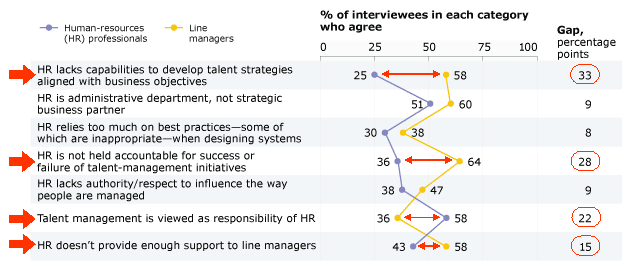
In this week’s article I’d like to address evidence of McKinsey to prove the point I made in one of my latest posts on HR (As you know: if a tiny consultant from Belgium tells you so, you can forget about it. But when ‘the’ McKinsey proves his point with worldwide survey results, well…) The chart below uncovers the declining influence of the human-resources function. According to McKinsey, only HR can translate a company’s business strategy into a detailed talent strategy. As they continue: "HR professionals should assert their influence and provide credible and proactive business counsel and support for individual business units." Well said McKinsey, and thanks for supporting my point! (Click on the chart to enlarge)  The HR Gap The bottom line of this chart is that HR has a major problem with regards to managing the expectations of both the business and themselves. Mind you: ‘Talent Management’ is just the new word for anything that was previously known as ‘competence management’. Same thing – different package. However, changing the name will not improve the conditions for HR. The so-called ‘talent management’ is nothing more than ’step 2′ of the approach that I presented earlier on. And regular readers of this blog know that it is now time for HR to cut the crap and start to be serious about their own processes before ‘talent management’ can become a reality. Just my humble opinion of course – a bit more convincing this time thanks to McKinsey :-) _________________ Source: The McKinsey Quarterly Chart Focus Newsletter, August 2008

Monday Morning Mandate for HR VP’s

Sunday, August 24th, 2008

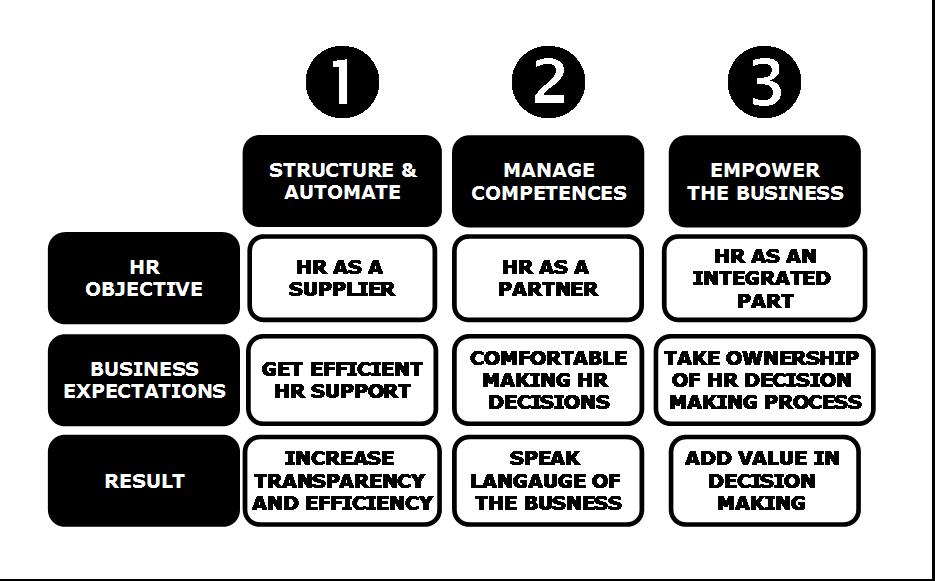
In previous articles I have made my point on why HR is not an agent of change and the miserable state HR is in nowadays. In this article I want to focus on what HR should be doing in order to get out of this isolation and into the value chain (*). More precisely, there are 3 steps to take for HR in order to become a business partner.

The first step consists of structuring and automating the basic HR processes. This requires documenting the procedures, drawing the HR processes and streamlining them, and most of all: holding HR people accountable for them. As such, the first milestone to achieve is to become a reliable supplier to the business.

The second step consists of managing the competences. This implies diving into the business and spending at least 30% of your time out of the office and into the business. Competence, performance, career and succession are empty words if there are no activities in a value chain to put them against. Putting the right person on the right place requires some knowledge of that person’s role in the value chain of the organization.

The third step for HR is empowering the business by outsourcing the core part of their activities … to the business. Whereas step 1 may include the outsourcing of administrative tasks to a shared service center, this step will require a handover of activities to the business. That way, HR processes get managed where they live and exist: on the shop floor among the people.

As the diagram above indicates the business expectations change as HR follows this step-by-step approach. These business expectations indicate the value HR should be creating for each step on the way. From this diagram it is clear that one should not try to empower the business in HR decision making from the very first step. Instead you should get the basics right first and get to know the business in the second place before you even know which decisions you can outsource to the business.

In the beginning of this three step process most of the attention will be spent ‘below the bottom line’: automating the basic and repetitive stuff. However, as you move along, automation and outsourcing of the basic personnel administration will free up time.

It is my contention that HR should be spending every minute of extra time as a result of automation in going (physically) to the business; even if that means joining their sales force on the road or getting their hands dirty on the shop floor. The point is that during step 2, HR will be building solutions (systems, procedures, structures, trainings, etc.) that are tailored to the business and then aligning them with the firm backbone that was established in step 1.

Finally, the third step is to shift a part of the HR responsibilities to the business. This only works with a firm backbone of basic HR processes (step 1) and HR solutions that are tailored to the business (step 2). This is where business people really start to use the HR tools at their hand in order to drive business decisions. In other words, at this point HR has shifted from a cost center to a value driver for the business.

It is a myth that HR needs a seat at the executive table in order to practice strategic HRM. Strategic HRM is a matter of reclaiming your place in the value chain in three steps: get the basics right, get into the business and shift the ownership to the business. As controversial as it may seem, giving away parts of the personnel administration to outsourcing entities and giving away parts of the HR decision making to the business makes HR more powerful as a business partner.
_________________
(*) The value chain was first described by Michael Porter in his 1985 book, Competitive Advantage. The value chain categorizes the generic value-adding activities of an organization. The "primary activities" include: inbound logistics, operations, outbound logistics, marketing and sales, and services. The "support activities" include: administrative infrastructure management, human resource management, information technology, and procurement. The value chain is a powerful analysis tool for strategic planning. Its ultimate goal is to maximize value creation while minimizing costs.

HR Blues

Thursday, March 20th, 2008

In this article I make an inventory of my observations on HR. Although most of my points of view and arguments are a bit sharp, I cannot avoid concluding that HR can’t get any worse than it is today. But hey, when you’re at the bottom, at least you know which way is up. I am convinced that HR can do better than this, hence the title of this article.
“Not an Agent of Change”: One Year Later

About one year ago I had my five minutes of fame when I was all of a sudden on the frontpage of Workforce.com. All I had to do was saying that Dave Ulrich (*) chose the wrong pot to piss in by declaring HR as a change agent. In short, I argued that HR does not posses the skills that are required to manage change initiatives. Instead, HR’s strength is that of a ‘Continuity Agent’.

The only HR actions that have a positive impact take place at the beginning and at the end of a change program life cycle. This leads me to conclude that continuity, not change, is HR’s core business. Even when an organization is affected during the transition, HR should help you out in minimizing the disruption of continuity.

I did receive some reactions and some HR managers turned their backs on me, but until now nobody proved me wrong. That is: zero evidence on the fact that HR is an agent of change.

The Pitfall of Strategic HRM

And there is more. The second thing that causes severe headaches is the constant whining of HR managers that they should get a seat at the executive table. Let me cut this one short: HR managers should stop desiring a seat at the table of the executive committee because they will be raped and abused.

On top of that, as they get out of that room, HR will have lost all credibility as a fallback or buffer between workforce and management. The first thing people will ask as HR is still recovering from their C-suite domination is “whose side are you on anyway?”

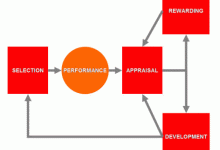
The good news? You don’t need a seat at the table in order to practice strategic HRM. In case you would not have noticed, strategic HRM is a matter of anchoring and tying your actions to the Michigan model. Besides the fact that 1982 is an excellent wine year, it is also the year that Tichy et al. published the well known ‘Michigan model’(*). Unlike good wine years, nothing exciting happened ever since on the level of qualitative HRM theory.
N-o-t-h-i-n-g.


The Michigan Model (1982)

Strategic HRM is quite simple, but it requires focus and discipline. Forget the hypes like ‘competence management’, ‘talent management’ and don’t even think about ‘organizational change management’. Instead, focus on ‘selection’, ‘performance’, ‘appraisal’, ‘rewarding’ and ‘development’ and foremost the processes that tie them together.

Look Around You: Everybody hates HR, Quality and IT

And it gets even worse than that. Did you ever wonder why HR, Quality and IT are the favorite scapegoats in almost all organizations, regardless of the sector and regardless of the country they are in? The reason is not that they are not included in the so-called ‘value-chain’. The real reason is that they don’t have a clue about what a value chain is.

As a result they are perceived as not adding value to the product or service that an organization produces. So all these supporting functions find themselves in a defensive position before they even had a fair chance to demonstrate their added value. And when you act from that position, you simply have no focus on productive stuff, you avoid responsibility and you forget what you were there for in the first place.

Getting Out of Your Box: Some Tips & Tricks

Instead of defending their position, HR directors would be better off creating an internal market for their services, aka: “what is your question to my answers?” Some IT managers are doing this already. So in order to get out of this disorder I would advise HR directors to have a look at the service oriented frameworks of service that IT departments are building (ITIL, CMM, etc.).

Second, it is about time that HR learns about proces thinking. HR processes: talk about them, design them, draw them, eat them, live them, measure them and improve them. Why? They visualize how HR adds value to the business.

As a third step towards becoming responsive and service oriented, HR directors should consider outsourcing in two directions:

A. Automation of basic HR processes (payroll, employee self service, manager self service)

B. Outsourcing of the business partner function to … the business itself. This brings about a different dynamic and a shared responsibility and focus on what really matters to the business.

Indeed, time has come for HR with balls, and like you I have been waiting for years for this transition to happen. Seems like it’s easier said than done. So here’s to all HR managers who run away from their own mess by saying they are change agents:
1. Please bring facts to the table that prove me wrong.
2. Wake up, get your act together and focus on HR processes
3. Get rid of the distractions: outsource the repetitive stuff and spend your time dealing with HR processes.
4. You are not a change agent. Live with it.

__________________
(*) In his 1997 book Human Resource Champions: The Next Agenda for Adding Value & Delivering Results (Harvard Business School Press, ISBN: 0875847196) Dave Ulrich challenges Human Resource professionals to define the value they create for the business. By doing so he distills these roles for Human Resources careers: strategic partner, administrative expert, employee champion and change agent.
(**) Tichy, Noel M., Fombrun, Charels J. & Devanna Mary A. (1982) Strategic Human Resource Management. Sloan Management Review, 23(2), 47-61.

Stop it – seriously – STOP IT!

Wednesday, June 6th, 2007

No to the Non-sense of Measuring Culture!
Every now and then I meet HR managers who are keen on measuring culture and who claim to be working on the essential layer of their organization, the source-code so to speak. To those managers I would like to say: you missed the point. In this article I have summarized why we should stop pretending that we can measure culture and propose an alternative instead.
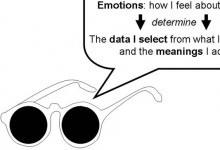
Culture as a Pair of Glasses
We see the world as we are, not as it is. Another way of putting it is by saying ‘perception is reality’. As the drawing shows, culture is a sense making mechanism that works like a pair of glasses you are wearing. Pink-lensed glasses will make you feel happier than black-lensed glasses; that much is certain. What is less obvious, though, is that glasses of a certain color will make you see certain things more clearly and completely ignore other things; in other words, they determine the data you select.

So, as a starting point: culture is a sense making mechanism that determines our perception; culture IS the glasses. By the way, since taking off these glasses is not an option, none of us human beings is capable of looking at the glasses, investigating and analyzing the components or comparing one pair to another.

Deceiving Belly Button Measurements
Then, what are we actually looking at when we measure culture with long and complex surveys? The answer is: we are staring at our belly button. The model which we choose for looking at the reality is already distorted by our perception to begin with. Based on this model we will distill dimensions which we assume are important to measure. Then these get translated to survey questions which supposedly reflect and measure these dimensions. As you can see there are a lot of bridges to cross and the distortions increase each time. Finally, in the majority of the organizations these surveys get distributed with a minimum of communication.

As for the responses – they only get returned by a group of people who are willing to fill out and return the survey – again another filter on the population. All of these filters are unintentional, but they do occur. Now, let’s have a look at what this amounts to.

Cultural surveys are interruptions that confuse the hell out of people. How would you react when a survey comes falling out of the sky that basically says: please fill out this awkward questionnaire and we will push you in a stereotype category and tell your management about it. Feel safer now? It gets people out of their comfort zone, that’s for sure, but what’s the benefit and will people respond truthfully – swear to God – what they feel and think?

We simplify the world into the dimensions of the survey (that part is OK – it’s called ‘focus’) and we desperately try to make cause-and-effect relationships with these dimensions (this is the not-OK part – it’s called ’stereotyping’). Not only will you be restricted to measure what you want to measure, you will also push the organization into the forced ranking of your statements and purge any other cause-and-effect relationship.

OK Smartass, What’s the Alternative?
Organizational change teams should ask themselves whether they are really that low on trust that they need a survey to justify an organizational change program? Or would they rather start from a vision and a strategy? Surprisingly, the mechanism behind implementing a strategy is exactly the same, but the intent is different. A strategy also molds reality into "We see the world as we are", but by implementing a strategy we co-create the future state instead of manipulating people into categories.

Second, managing organizational change is about getting people out of their comfort zone, but never ever without providing them a platform of psychological safety. And there’s a million ways to do that – although the best way is to do nothing, i.e. to shut up, listen and acknowledge receipt of what people tell you. Feeding them back what you have understood is an essential part of providing psychological safety. The next part is called integrity, i.e. acting on their feedback (and letting them know that you are). And then – only then will people be ready to get on board (that is: because they want to, not because they have to).

There Is No Outside
Another awkward thing is that organizations who want to do cultural surveys use a lot of ‘they’, ‘them’, ‘those people’ and ‘over there’ words when referring to their own organization. Karl Marx referred to this as alienation, and I would add that this is a behavior and not a circumstance. Also Heidegger described this phenomenon quite precise when he referred to ‘Das Man’ (‘The They‘). My most favourite way of countering this is by telling that there is no outside (N° 10 of Senge’s Laws of Systems Thinking).

The point I’m trying to make here is that our inability to measure culture does not prevent us from creating one. And it’s really simple: first, as Ghandi said, be the change you want to see in the world; second, shut up, listen and acknowledge feedback, third, walk your talk. Deceivingly simple? Yes. Darn difficult? Indeed, because you’re gonna get naked, vulnerable and hurt.

Don’t Count on HR to drive the change!

Thursday, January 18th, 2007


Forget what Dave Ulrich (*) says!
Whenever the human side is involved, organizational change projects tend either to ignore it or to completely outsource it to the human resources (HR) department. Hopes, dreams, wishes, and expectations are never taken into account,and training, communication and coaching are restricted to the minimum. The attitude in most projects is exemplified by this statement: “We’ll take care of the process reengineering and the technical stuff; HR will do the soft stuff.”
However, there are two fundamental reasons why you should not count on HR to drive a change.


1. HR is Not a Change Agent
HR safeguards continuity in the organization. Let’s face it: By their very nature, the fundamental HR processes are aimed at safeguarding stability. But when you ask HR managers about the core competencies of their departments, they will tell you that the management of organizational change is on the forefront. They are wrong. The basic processes of HR and their accompanying goals are the following:

  • Recruiting and Selection => Goal: Employment Continuity
  • Training and Development => Goal: Knowledge and Skills Continuity
  • Performance Management and Appraisal => Goal: Performance Continuity
  • Compensation and Benefits => Goal: Stability in Personnel Costs
  • Work organization and Communication Systems => Goal: Social Stability

Therefore, HR should be approached as you would any other function in the organization,and they should be the first target of your change-management efforts.But there is more.

2. HR is an Agent of Continuity
As a support function, HR will be impacted indirectly by a reengineering effort and will most likely resist at first hand. Does that disqualify them from having any stake in the organizational change? Not at all.

Change always happens in three phases: Unfreezing, Changing, and Refreezing. As the key strength of HR is to stabilize the human side of an organization during and after a transition, it is their role to lead the Refreezing stage. In order for the change to stick onto the organization, you are going to use the HR department’s tools and methods.

Therefore, HR is one of the first targets to work with. The faster you can enlist them into becoming a continuity agent, the better. Just don’t expect them to be on the same page from day one, as they—like everybody else—will resist the change in the beginning.

Conclusion: HR as a Co-Pilot in Long-Term Planning
From my experience, the only HR actions that have a positive impact take place at the beginning and at the end of a change program lifecycle. This leads me to conclude that continuity and not change is HR’s core business. Even when the organization is affected during the transition, HR should help you out in minimizing the disruption of continuity.

As an example, program staffing of key people is a task that needs to be conducted in close alignment with HR as it should involve career perspectives and long-term accountability. Gradually, as the program comes to a close, HR needs to become the owner of the deliverables regarding learning, performance, organization, and communication.

The role of HR in this case is one of sustaining the change and integrating it into its standards and procedures. In other words: safeguarding stability and continuity of the new organization.

—————————-
(*) In his 1997 book Human Resource Champions: The Next Agenda for Adding Value & Delivering Results (Harvard Business School Press, ISBN: 0875847196) Dave Ulrich challenges Human Resource professionals to define the value they create for the business. By doing so he distills these roles for Human Resources careers: strategic partner, administrative expert, employee champion and change agent.