
Archive for the ‘Frederick Herzberg’ Category

Mindset, Membership and the Matthew Effect

Monday, July 19th, 2010

I have grown up with the firm belief that in order to achieve something in life you need to have a degree. Although I resent that statement with all of my heart I have come to a point that I no longer can deny it.

There are three ‘M’s involved in explaining why I capitulate to the non-sense of the way things are. They are: Matthew Effect, Membership and Mindset.

Matthew Effect

For to all those who have, more will be given, and they will have an abundance; but from those who have nothing, even what they have will be taken away.
—Matthew 25:29

Those who have shall be given – and if you happen to be on the other side: bad luck. But it’s more subtle than one may think at first sight. In his book Outliers: The Story of Success, Malcolm Gladwell compares the misfortune of the genius Chris Langan to the successful achievements of another genius: Robert Oppenheimer.

Both men were equally gifted, so the Matthew effect is not applicable on first sight. However, Gladwell states that – while both men were comparable in terms of intelligence – it is their sense of entitlement that has shaped the opportunity (or lack thereof) to grow and have a successful career.

Being talented, good-looking, intelligent, etc. may be the entry criterion for the achievement contest we call life; eventually it is the access to opportunities that will determine the outcome.

Membership

When researching the main causes of hunger and poverty in Third World countries, 1998 Nobel Prize winner Amartya Sen discovered that hunger is not caused by a lack of food, but by a lack of entitlement.

In the book Poverty and Famines: An Essay on Entitlement and Deprivation he demonstrates that famine occurs not only from a lack of food, but from inequalities built into mechanisms for distributing food.

At the age of nine, Sen witnessed the Bengal famine of 1943. Later he concluded that the loss of 3 million lives was unnecessary. He presents data that there was an adequate food supply in Bengal at the time, but particular groups of people including rural landless laborers and urban service providers like haircutters did not have the monetary means to acquire food.

Mindset

Back to the importance of degrees and the perversity of entitlement. Although entitlement was described by Sen as a matter of having the opportunity to influence your own mortality, I recently came to think of it as an illusion. It seems to me that entitlement to the fruits of a degree is mostly felt by those on the lower side of the glass ceiling.

I also think that the ignorance of how little a degree is worth once you crossed that fence, makes people blind to the real gravitational forces of the Matthew effect. That is: it pulls people down, not up.

A degree is a hygiene factor in terms of Herzberg’s two-factor theory: it is necessary, but not sufficient to succeed. It doesn’t push you up, but lacking it can pull you down.

Tragedy

The tragedy of it all is that it is the degree-less people with the most outspoken talents who suffer the most from this downward spiral of I-am-not-worthy-ness. They carry the lack of entitlement as a burden every day.

They are the victims of a ‘false negative‘ or simply a stupid coincidence.  As a consequence, this world not only suffers an inflation of stock markets. Most of all, it suffers an inflation of degrees.

Hope

Ken Robinson, who recently published ‘The Element: How Finding Your Passion Changes Everything‘ became popular after his 2006 TED talk titled “Do Schools Kill Creativity?” In this talk he makes the case for a radical shift from standardized schools to personalized learning.

Robinson claims our education has dislocated us from our natural talents. Most talents are like real natural resources: they are buried deep. And education as we know it is designed to flatten out the individuality of our talent.
However, we are blocked by the tyranny of common sense as paraphrased by Abraham Lincoln: ‘The dogmas of the quiet past are inadequate to the stormy present. The occasion is piled high with difficulty, and we must rise WITH the occasion. As our case is new, so we must think anew and act anew.’

Conformity

Many of our ideas have been formed not to meet the circumstances of this century but to cope with the circumstances of previous centuries. However, our minds are still hypnotised by them. In other words: college degrees – just like CV’s – are a form of entitlement that made sense in the previous centuries but not anymore. Yet, they continue to rule our lives.

Robinson goes on to talk about the root cause: conformity and a longing for the ‘future quo’. We have built our education systems on the models of fast food: everything is standardized instead of customized to local circumstances. In turn, this is impoverishing our spirits and our energies in the same way that fast food is downgrading our physical bodies.

Passion

He concludes that passion and not conformity is needed to cope with today’s challenges. Doing stuff that feeds your spirit. The kind of thing you are doing when time seems to fly. Like Seth Godin in his book Linchpin: Are You Indispensable?, Ken Robinson links the search for passion to the end of the industrial revolution.

We need to get out of our industrial model of education, which is based on linearity and conformity to an organic model. And with it we need to abandon our attachment to the entitlement of a degree.

Gardening

The one thing we need to understand is that learning and education are organic instead of manufacture-like.  As Peter Senge is often quoted: “We keep bringing in mechanics–when what we need are gardeners. We keep trying to drive change–when what we need to do is cultivate change.”

The only difference between a mechanic and a gardener is the entitlement of their degree and time has come to recalibrate these degrees to the challenges of today’s world.

Fine as North Dakota Wine

Sunday, July 6th, 2008

In his 2007 book Mindless Eating, Cornell Professor Brian Wansink reports that changing the label on a wine changes diners’ opinions of their wine, opinions of their meal, and their complete dining experience that night.

Forty-one diners at the Spice Box restaurant in Urbana, Illinois were given a free glass of Cabernet Sauvignon to accompany a $24 prix-fix French meal. Half the bottles claimed to be from Noah’s Winery in California. The labels on the other half claimed to be from Noah’s Winery in North Dakota. In both cases, the wine was an inexpensive Charles Shaw wine.

Those drinking what they thought was California wine, rated the wine and food as tasting better, and ate 11% more of their food. They were also more likely to make return reservations.

Accoring to Wansink it comes down to expectations and his findings are aligned with another set of studies that were conducted about 36 years ago. These studies have consistently shown that people’s impressions are based far more upon how information is conveyed rather than the content itself. For instance, the study by Mehrabian in 1972 shows that the impact of a communication is only for 7% purely the content, for 55% body language, colors, layout, smiles and visual stuff, and for 38% how we speak, language, vocabulary, tone of voice etc.

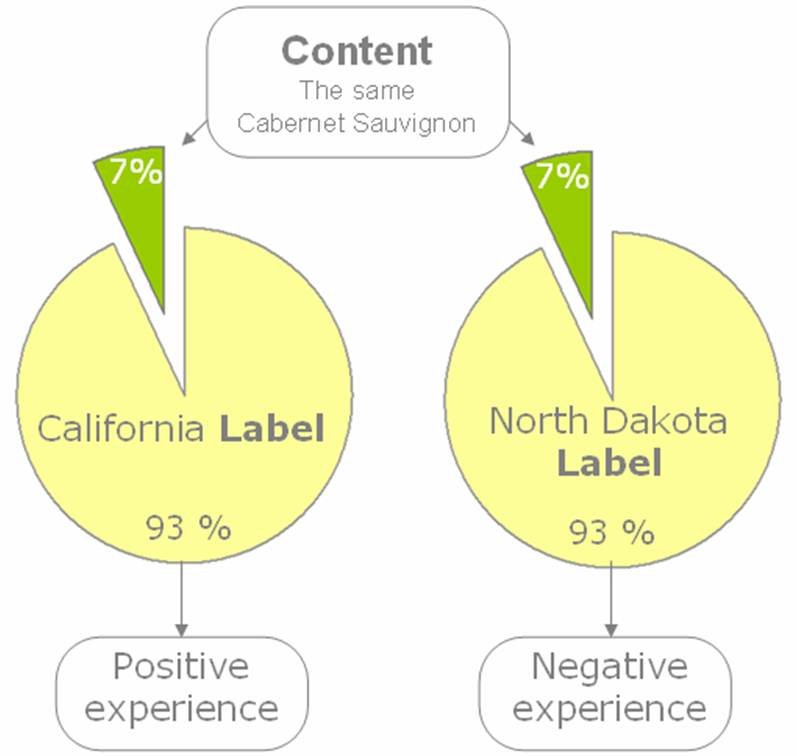
This means that our perception accounts for 93% of the impact (provided that the 7% content is to the point and correct). In terms of Wansink’s dining experiment: the content of his bottles impacted only 7 % of the perception. In the drawing below I have blended both insights to depict the impact of the wine label on the dining experience.

The impact of a wine label versus bottle content 

As Wansink asserts: Once they were given a free glass of "California" wine, they said to themselves: “This is going to be good." Once they concluded it was going to be good, their experience lined up to confirm their expectations. They no longer had to stop and think about whether the food and wine were really as good as they thought. They had already decided. This mechanism is also known as ‘cognitive dissonance’ or ‘overjustification’ and it is hard-coded into the human mind.

Of course I would not be writing about these findings if I wouldn’t attach my own ‘far fetched’ analysis on organizational change management. Well, here it is and it comes with a big disclaimer: In the same way as the label of a wine bottle can impact the dining experience, to the same extent – that is approximately 93% – your change management efforts can influence the experience of your systems implementation (be it SAP or any other ERP platform) or reengineering effort. This is depicted in the drawing below: the impact of change management on the experience of your target audience.


The impact of change management efforts on perception

The disclaimer – of course – resides in the fact that good change management does not compensate a bad implementation or bugged ERP software. The content has got to be right, although it will only positively impact the user experience for 7%.

Conversely, if the content is not good (corked wine or a bugged ERP software for that matter) there is no way a nice label or good change management practices can make up for it. In this respect, good ERP software is a hygiene factor and change management is a motivation factor.

As I stated in an earlier article, it’s all a matter of managing the attention we give to the one and (not: "or") the other.

______________
Sources:
– Albert Mehrabian “Nonverbal Communication” Walter De Gruyter;  1972
– Brian Wansink "Mindless Eating: Why We Eat More Than We Think", Bantam, 2007

Attention – The Forgotten Resource

Sunday, December 16th, 2007

Management is not a science like mathematics or quantum physics, but nevertheless some truths come to the forefront like laws of nature. One of those is the basic need for attention. Translated into workplace mumbo-jumbo this means that people (starting with you and me) have a basic need to be proud of what they are being and doing.

Pretty obvious, not? Unfortunately we don’t seem to be able to respond to this basic need in terms of management. In other words, we don’t seem to recognize attention as a resource – to the same extent as we value time, money and manpower. For the latter three resources we have plenty of systems and methods to plan (and look ahead), organize, command, co-ordinate and control (feedback and inspect) them. (the words that I underlined actually define ‘management’)

Too bad we are clueless when it comes to ‘managing’ attention … because there’s quite some evidence that this would be a wise thing to do. 

Attention is the Common Denominator

In the domain of motivation theory some gurus have summarized and visualized the motivation laws of gravity and other major truths even before I was born. When we have a closer look, there is one thing that all of them have in common: attention as the driving force. Let’s have a look at my three favorites:

1. Abraham Maslow’s Hierarchy of Needs (1943)

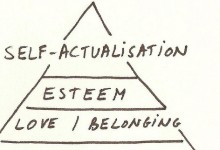
Maslow’s hierarchy of needs is often depicted as a pyramid consisting of five levels. Like in a computer game we only worry about the needs of certain level if the needs of all the lower levels are met.
 

Fulfilling the needs of a certain level is nothing more than managing the attention on that level. 

2. William Reilly’s Balance of ‘Wants’ (1957)

Quite an old book in which he describes the 4 basic ‘wants’. Way less popular than Maslow, not the most requested article from the Harvard Business Review like Herzberg – but to the same extent pretty much to the point when it comes to describing what we really want.
 

All of the things we want so much are actually a form of expressing attention, the currency of attention so to speak. (thanks to Michael Neill for pointing me to this reference). 

3. Frederick Herzberg’s Two Factor Theory (1959)

According to his theory, people are influenced by two factors. First, motivation factors, which help increase satisfaction but have little effect on dissatisfaction. Second, hygiene factors which, if absent or inadequate, cause dissatisfaction, but their presence has little effect on long-term satisfaction.

In other words: motivators are the factors that add value if you pay attention to them (note the management term: ‘paying’ attention, as if it were a resource like money, time and manpower). Hygiene factors on the other hand are those things that are damaging if we don’t pay attention to them. 

Attention Management

Those of you who regularly scan through the ‘question & answer’ section of LinkedIn may have noted that there is one question that keeps coming back: ‘what is the difference between managing and leading?’. A lot of interesting responses pop up, some more practical than others. In the light of this post, I could offer an additional answer to that question:
Managing = taking care of the resources Time, Money and Manpower. Leading = adding the resource ‘Attention’ to that list.

If there is one thing that I want to continue blogging about in 2008, it is attention management. Take my word for it: it’s my new year’s resolution.