
Archive for the ‘Evrett Rogers’ Category

A conflict isn’t always a bad thing – Part 5

Monday, January 12th, 2009

Unexpected – like innovation itself – another perspective that I’d like to add to this series: the newest insights on biodiversity. Some time ago, Jef Staes introduced the concept of a red monkey. According to Jef, the concept started to develop during his seminars when participants asked him where to start with very confrontational change projects.

At that moment, he just learned about the origin of the rich biodiversity in a rain forest. According to the latest insights in biodiversity, new species do not start in the middle of a forest but at the edge. At the edge! – where different species from different ecosystems ‘meet’. That’s when Jef created a metaphor of a brown monkey from the jungle who meets a red fish from the sea (an adjacent ecosystem). Through their conversation a new confrontational idea is born: a red monkey.

What would happen if that confrontational idea would be dropped in the middle of the jungle? It would be killed immediately. Jef notes that the same happens with confrontational ideas that are ‘dropped’ in the middle of an organization … they get killed as well. Innovation ‘never’ starts in the middle of an organization but on the edge, where ecosystems meet. In the below video you can see Jef explaining the concept.

In the long run, red monkeys are key if organizations are to survive.  A red monkey disturbs the balance in people, teams and organisations – it tilts the stability of an ecosystem, and therefore it will get killed if there is no ‘critical mass big enough to survive.

Innovation is the result of a red monkey that has managed to survive the initial conflict between these two opposing points of view. And that is why we need all that stuff about organizational change management: to get from the edge to the middle!  No need to mention that Jef is passionate about the subject; he even designed a bumper sticker:

For those of you who wonder how this red monkey metaphor relates to the previous articles in this small "conflict" series have a look at where I pasted the bumper sticker.

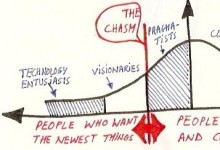
You will immediately note that it will take a serious amount of conflict before you can introduce the red monkey on the right hand side of that chasm. As I have written earlier: this is a step-by-step process and it requires a different view on resistance. Thanks to Jef it is now crystal clear that you should start at the edge and move to the middle – gradually as you implement all the stuff I’ve been blogging about over the past 2 years.

Bonus material for Dutch-speaking readers: Jef Staes talking about the next generation of young employees on a symposium about leadership in education organizations. You will note that Jef’s ideas have a lot in common with John Seely Brown when talking about the social life of information (aka: knowledge Management) and the gap / conflict / clash (whatever you want to name it) between generations.

Click here for part 1 of "Jongeren zijn anders"
Click here for part 2 of "Jongeren zijn anders"

A conflict isn’t always a bad thing – Part 2

Saturday, November 29th, 2008

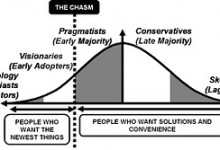
Here comes the demographic point of view. The process of creative destruction is not the only place where conflict proves to be productive in the long run. When we have a closer look at the findings of Everett Rogers in his 1962 book Diffusion of Innovations, we will find that conflict is abundant in any population. Rogers discovered that a target population of an innovation could always be categorized on a classic bell shaped curve divided according to following protagonists: Innovators (2.5%), Early Adopters (13.5%), Early Majority (34%), Late Majority (34%), Laggards (16%).
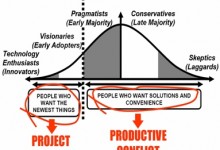
If you are about to introduce and organizational change you will find the exact same diffusion inside of organizations. Building further on Rogers’ observations, Geoffrey Moore’s key insight is that the groups adopt innovations for different reasons. According to Moore:
- Technology Enthusiasts (Innovators) are explorers.
- Visionaries (Early Adopters) are more geared towards exploitation. They are not especially bothered by the fact that the product doesn’t work. They are willing to make it work.
- Pragmatists (Early Majority) want a product that works. They want a 100% solution to their business problem. If they get the 80 % that delighted the visionary, they feel cheated, and they tell their pragmatist friends.
- Conservatives (Late Majority) buy products because they really have no choice. They are not reassured by having books about the product, because the existence of books implies the product isn’t simple enough to use. Conservatives will not tolerate complexity.
- Skeptics (Laggards) are not going to buy, though they may talk other people out of buying.

In terms of project management it is obvious that the innovators and the early adopters will never oppose or object the changes you are implementing. The left hand side of the chasm is also known as the project cocoon: a safe group of like-minded people. On the right hand side of the chasm you will find people who want solutions and convenience. That is where you will find most conflicts – and this also represents 85% of your target population!

There is no way around it: if you are to build a solution for your organization, it will take a great deal of emotional intelligence. To quote Jane Goodall ‘Change happens by listening and then starting a dialogue with the people who are doing something you don’t believe is right.’ No need to mention that these interactions increase the quality and the usability of the solution you are building – to the same extent as they are grinding your nerves. But hey, the best consulting work is done with the heart breaking or overflowing!

The Speed of Change

Tuesday, May 27th, 2008

This is just a reminder of two things we all know but fail to understand when it matters most: simplicity and synchronization. To my opinion these are the factors that determine the speed of change and the moment when they matter most is the delivery phase of your project. In this article I would like to point out why.
Simplicity: Keeping it Simple

One of my favorite quotes in this regard is the one of Bill Jensen: ‘Change all you want, just know that execution happens at the speed of making sense’. This means that people – and that includes you and me – will only do what they understand. At this point we are not even at the level of resistance – comprehension is the issue here!

However, there is a relationship: if you do a good job in sense-making you will be rewarded with less resistance. This implies that you not only tell people what they need to know to make the change happen, but you also listen, involve them and feed-back to them your understanding.

Synchronization: Staying on the Same Page

In the beginning of a project you may not be aware of the need for synchronization. Your project may still be building a prototype and you want to spread the word. In that phase any communication is good communication; whether it is structured or not, prepared or not, accurate or not – anything is better than radio silence (disclaimer: this is not an advice, it is an observed behavior).

But as you are approaching delivery and increasing the contact moments with your target audience people will urge you to get concrete, specific, accurate and fast. That is when your bunch of people (aka: the project team) needs to get disciplined about communication, testing and training (i.e.: the most important contact moments with the target audience).

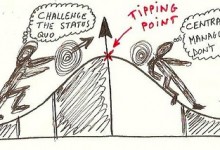
The speed of change

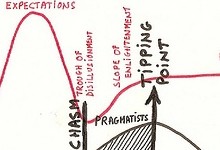
As the drawing above illustrates, during the implementation phase more people become closely involved in the work of the program. You should be aware that this is also the first time that you meet pragmatists that hook into the details of the testing and conservatives who start to wonder what this is going to mean for them.

You will feel as if the big boulder of the project has reached a tipping point and is now rolling downhill. In other words: from now on you will have to pace the majority of pragmatists and conservatives who will be pushing you for concrete details. Therefore, during your communication it is important that you set the right expectations and that you do not over-promise with regards to delivering prototypes and demonstrating solutions. It is painful to be applauded for the demonstration of a certain solution only to find out that you overlooked some important elements because you did not consult the implementation team at large.

Your team is probably a big team by now and you must align solutions internally first before making promises to the organization. Minor and major incidents in this area will make you aware that you will need to centralize communication as you are approaching the delivery.

So if there is one sentence that you should keep telling yourself when your project is in the delivery mode it’s this one: Let’s keep it simple and make sure we’re on the same page’.

Good luck!

______________________
In the illustration I make use of the following specific terms and representations:
1. The bell-shaped graph: Rogers, E.: Diffusion of Innovations, Free Press 1962
2. "The Chasm": Moore, G.A.: Crossing the Chasm: Marketing and Selling High-Tech Products to Mainstream Customers, HarperBusiness 1999
3. "The Tipping Point": Gladwell, M.: The Tipping Point. How Little Things Can Make a Big Difference,Little Brown 2000

Why Marketeers outperform Organizational Change Experts (PART II)

Monday, April 16th, 2007

What’s in a word: Sponsors—Agents—Targets
I always wonder why a glossary is mostly the last part of a document – it just makes no sense. So, let’s not do that and start with the glossary of this very article…
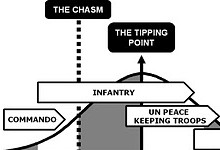
Leading change involves building demand for change by managing three different groups: sponsors, agents, and targets. According to Connor (1992) these groups can be defined as follows

Target
This is an individual or entity that will be required to change behavior and actions. They are the most important people in the change process, because if the they reject change, it will fail. However, the way they are commonly referred to is: ‘not me’, ‘they’, ‘them’, ‘those people’, ‘the users’, ‘it’, etc. Of course people love to be tagged like that!

Sponsor
This is the individual or entity with responsibility for the success of a change initiative, and the necessary authority to commit required resources to the initiative. They possess sufficient organizational power to either initiate resource commitment (Authorizing Sponsor) or reinforce the change at the local level (Reinforcing Sponsor).
Common denominator? ‘They’, ‘them’, ‘it’, ‘the ivory tower’, ‘because they said so’, etc. Of course we make sure they never hear us tagging them as such.

Agent
This person is empowered by the sponsor to carry out specific tasks related to the change initiative. Mostly tagged as: ‘they’, ‘them’, ‘who do they think they are’, ‘the project’, ‘not me’, ‘over my dead body’, ‘those consultants’, etc. Of course, change agents are appointed robots, trained and paid to hear that stuff all day, so they don’t mind.

Warcraft Wisdom
OK – so let’s put the sarcasm aside and get to the point: oddly enough the best knowledge on how to guide an organization through a change comes from the army. As Robert Cringely (**) points out in his book Accidental Empires, the founding of the personal computer industry and the history of Silicon Valley is based on different kinds of people, like the different segments of an army.

As you know by now, I am quite keen on recycling any good marketing insight and applying it on the inside of an organization. When we apply Cingley’s analysis we can formulate a clear advise on how to behave as a change agent during the different stages of an organizational change, i.e.: we come to the conclusion that agents of change projects should adopt different styles according to the phase of the change.

Initially, they take responsibility for breaking the fundamental structures that underpin the current context and beliefs. Robert Cringely compares this destructive work to the job of commandos who prepare territory for the infantry:
“Commandos parachute behind enemy lines or quietly crawl ashore at night. Their job is to do lots of damage with surprise and teamwork, establishing a beachhead before the enemy is even aware that they exist.”

In order to get things started, agents take on a commando style in order to create the circumstances for change. Most of the times, the project leader gets the honor of preparing the territory. Whether it is to obtain commitment for blueprinting, design, testing, training or go-live, without the commando actions the efforts will be ignored by business as long as there is no pressure or hard evidence that things will change.

Once the path is cleared, changing can start. Now you will need an infantry of agents to get the job done: blueprinting, designing, testing, training, collecting and cleansing data, etc. The most important thing here is that an infantry takes on a structured approach. In the words of Robert Cringely:
“While the commandos make success possible, it’s the infantry that makes success happen. These are the people who hit the beach en masse and slog out the early victory, building on the start given them by the commandos. […] Because there are so many more of these soldiers and their duties are so varied, they require an infrastructure of rules and procedures for getting things done.”

Finally, the new structures are in place, and it is time to refreeze the new processes that have been installed by the infantry. This is the fragile process of handing over knowledge from project agents to the target audience. You will find that there is still the need for a military presence by means of local coaching. These are the UN peacekeeping troops, a remainder of the infantry (note: you will find nothing about UN peace keeping troops in Cringely’s book – please allow me to stretch the concept). Their only purpose is to stabilize the new order and eventually to hand over to the local peacekeepers: the police.

As you remember from the previous post on this topic, over time different target segments are reached by pushing the boulder of your project work past the Chasm to the Tipping Point. The insight that Cringely adds to this drawing is that this takes different team styles: the commandos are the change agents that make success possible (unfreezing), the infantry make success happen (changing) and UN peace keepers and police are needed to refreeze the new structures and habits like a stabilizing force. Does this call for a different staffing according to the phase of your project? Ab-so-lu-te-ly!
________________________
(*) Connor, D. :Managing at the Speed of Change, John Wiley and Sons 1992
(**) Cringely, R.: Accidental Empires: How the Boys of Silicon Valley Make Their Millions, Battle Foreign Competition, and Still Can’t Get a Date, HarperCollins 1993

Why Marketeers outperform Organizational Change Experts

Thursday, March 8th, 2007

Because they share basic insights of Evrett Rogers, Goeffrey Moore, Seth Godin and Malcolm Gladwell! So here is my small manifesto for less academic mumbo jumbo and more marketing common sense.


Population Analysis
For starters, in a 1962 book called Diffusion of Innovations, Everett Rogers (*) stated that adopters of any new innovation or idea could be categorized on a classic bell-shaped curve as described here:

  • Innovators (2.5 %) Venturesome, educated, multiple information sources, greater propensity to take risk
  • Early Adopters (13.5%) Social leaders, popular, educated
  • Early Majority (34%) Deliberate, many informal social contacts
  • Late Majority (34%) Skeptical, traditional, lower socio-economic status
  • Laggards (16%) Neighbors and friends are main information sources, fear of debt

Building further on Rogers’ observations, Geoffrey Moore’s (**) key insight is that the groups adopt innovations for different reasons. According to Moore, early adopters are technology enthusiasts looking for a radical shift, while the early majority wants a productivity improvement. Both groups are divided by a chasm.

Moore’s observations come close to what you can expect when introducing a shift inside your organization, be it a new performance evaluation system, new software or simply moving from one building to another. According to Moore:

  • Technology Enthusiasts (Innovators) are explorers.
  • Visionaries (Early Adopters) are more geared towards exploitation. They are not especially bothered by the fact that the product doesn’t work. They are willing to make it work.
  • Pragmatists (Early Majority) want a product that works. They want a 100% solution to their business problem. If they get the 80 % that delighted the visionary, they feel cheated, and they tell their pragmatist friends.
  • Conservatives (Late Majority) buy products because they really have no choice. They are not reassured by having books about the product,because the existence of books implies the product isn’t simple enough to use. Conservatives will not tolerate complexity.
  • Skeptics (Laggards) are not going to buy, though they may talk other people out of buying.

The problem in crossing the chasm is that the visionaries aren’t good references for the pragmatists. They provide tales of heroics. Pragmatists want references from other pragmatists. This brings us to the basic insight that it is going to take strong marketing and employee relationship management (i. e., customer relationship management from the implementation team towards the organization) in order to reach the majority.

Lessons from Customer Relationship Management
Customer relationship management (CRM) is the art of building learning relationships with your target public. In practice we often find a lack of interest when it comes to building a learning relationship between the implementation team and the organization. CRM tells us how to do that if we are willing to replace the “c”of customer with the “e” of employee.

Seth Godin (***), one of the pioneers of CRM, introduced the concept of Permission Marketing in 1999. The list below mentions the six levels of permission that can depict the relationship with a customer, according to Godin.

  • Intravenous Treatment The doctor treating you in the emergency room doesn’t have to sell you very hard on administering a drug.
  • Green Stamps Executives suffer through long layovers to gain frequent-flyer miles. Here, the company rewards customers in currency they care about.
  • Personal Relationships The corner dry cleaner enjoys implicit permission to act in your best interest. A favorite retailer can "upscale” you (recommend something more expensive) without offending you.
  • Branding Given a choice between the known and the unknown, most people choose the known.
  • Situational Selling If you’re in a store and you’re about to make a purchase, you often welcome unsolicited marketing advice.
  • Spam Where most marketers live most of the time: calling a stranger at home, during dinner, without permission. You wouldn’t do it in your personal life. Why do it to potential customers?

Pushing and Pulling
The six levels of permission can help us to get more clarity about our position in relationship with the organization. It becomes even more interesting when we start weaving in the insights of Malcolm Gladwell (****), who investigated what determines the moment of critical mass, the threshold, or even the boiling point of a marketing effort. He calls it the Tipping Point.

From an organizational change point of view, the combination of Gladwell’s and Godin’s observations is illustrated in below:Starting an organizational change program may at times resemble pushing a boulder up a hill. You seem to be making an 80 % selling effort for barely a 20 % response. Your learning relationship with the organization hinges on the lower levels of permission, as you are in the beginning of a relationship. You will soon find out that as the permission level evolves, you will get the buy-in from pragmatists and conservatives.

Before you know it, the boulder starts rolling as a result of the people going through the change cycle. Instead of you pushing a boulder alone, the organization is now pulling at your sleeves to move it forward. From now on, you will have to pace the majority of pragmatists and conservatives,who will be pressing you for concrete details.

Therefore, during your communication it is important that you set the right expectations and that you do not over-promise with regard to delivering prototypes and demonstrating solutions. It is painful to be applauded for the demonstration of a certain solution only to find out that you overlooked some important elements because you did not consult the implementation team at large. You must align solutions internally first before making promises to the organization. Minor and major incidents in this area will make you aware that you will need to centralize communication as you are approaching the date of delivery.

___________________
(*) Rogers, E.: Diffusion of Innovations, Free Press 1962
(**) Moore, G.A.: Crossing the Chasm: Marketing and Selling High-Tech Products to Mainstream Customers, HarperBusiness 1999
(***) Godin, S.: Permission Marketing. Simon & Schuster 1999
(****) Gladwell, M.: The Tipping Point. How Little Things Can Make a Big Difference,Little Brown 2000