


Archive for the ‘Emotions’ Category

Grumpy Boss and Burnout?

Sunday, August 17th, 2008

Some time ago I posted an article on burnout and just recently I shared my view on the causes and effects of grumpy bosses. Until now I only vaguely realized that both were related with each other, but since I used the car – engine – driver comparison as a metaphor the relationship is getting pretty obvious. As I stated before job control (as opposed to ‘job demands’) or ‘autonomy’ is the bottom line when it comes to employee burnout. When people are supported by the right level of autonomy, context, framework, tools etc. in order to cope with the job demands then the job is stimulating rather than exhausting. If not:… well … quite the opposite. The research of Professor Barsade points out that autonomy can act as a buffer on stress – and actually decrease job burnout. That same research points out that a lack of respect accelerates burnout when the autonomy is low. Now, picture this: the grumpy manager that I introduced some weeks ago, with his powerful people-engine wants to control everything – so he shifts the gears into Neutral and he starts pushing the car himself. Every initiative of a project member to bring the project forward is scrutinized, reworked and criticized until it is completely according to the flavor of the boss. People stop using their brains as pro-active initiatives are discouraged by micromanagement. The engine is not ‘empowered’ because of fear of it getting out of control.


If the engine is not empowered: that is a lack of autonomy. If that boss is pushing the pedal to the metal – with the gear shifted in Neutral - it only makes a lot of noise and smoke: that is the lack of respect. So there you go: the car driver’s guide to employee burnout: – The powerful engine: skilled people – The grumpy driver: grumpy boss – The pedal to the metal: high job demands – The gear shifted in Neutral with the engine on: low autonomy (job control) – The damage to the engine: employee burnout By the way, if you type in ‘burnout’ on youtube, you get all kinds of movies that illustrate this comparison in terms of cars. Do I need to paint a picture?

Dying Before Going Into Battle

Friday, August 1st, 2008

This is the title of the fourth chapter of the 1996 book ‘The Last Word on Power’ by Tracy Goss. In this chapter, Goss draws our attention to the Japanese Samurai warriors who, in reminding themselves of the inevitability of loss, used the phrase “Die before going into battle.” This practice allowed a warrior to enter an episode of combat without fear of death. He had brought himself through an experience of the acceptance of death ahead of time. His death was a plausible outcome. In this way the warrior was able to fully give himself to his mission without concern for survival. Such freedom made all the difference between defeat and victory.

A few weeks ago I advised a good friend to apply that exact same technique. His "battle" was an interview where the stakes were very high for the rest of his career. Instead of providing him with tips and tricks on the level of action ("doing") I advised him to change his position on the level of "being". As Goss argues, freeing yourself from the illusion that you can control life so that it turns out the way it ’should’ means that you accept defeat as a plausible outcome. Along the lines of Goss’ advice I gave to my friend the assignment to free himself from the illusion that he could control the outcome of the interview so it would turn out the way he wanted.

At first he was a bit puzzled by the advice because he expected me to give him tasks, assignments, stuff to read, issues to analyze and research, MBTI style surveys to fill out and lots of homework. Not. What I asked him to do is to shut all his plans, one-liners and prepared scenarios for the interview down, to go to a quiet place and to really imagine himself getting it all wrong and picking up life after failing the interview. Then I asked him to accept that scenario as a plausible outcome.

As you can guess I would not be writing about this event if it weren’t successful for my friend. A few days later I got a phone call in which he explained: "Before I got in for the interview I was convinced that the game was over and I accepted that outcome. As a result I was so relaxed that I forgot about scenario A or strategy B that I would apply during the interview – because it did not matter anymore – and I could engage fully in the interview without any distraction." This sudden ‘liberty’ and ‘letting go of the urge to be in control’ is something I have written about before (The Rattle Snake exercise): the more you prepare for a conversation, the more you will get stuck because your preparation takes over from the real source of a fruitful conversation: yourself.

To my opinion this is a practice we should apply more often in our lives – be it private or professional. As Goss explains: "You cannot control the outcome of your life. In the end, the outcome will be the same. One day you will die. Someone with a shovel will throw dirt over your face. You will be, at that time, as satisfied or unsatisfied as you will be. In the meantime, life won’t follow the pattern of the controls you are trying to put in place. Your life will not turn out as you hope it will. There is no hope of life ‘turning out as it should.’ Life turns out as it does."

The Time Factor

Friday, February 8th, 2008

As I am writing this we are about to shake up a traditional organization by means of an SAP implementation. Most of the times this is regarded as a pure software implementation: design the system, configure the system, test the system and roll it out. That is how most software engineers look at it and that is what traditional managers expect of it.

Only, with SAP it’s slightly different: since the software is supposed to administer the way you get your work done inside your organization it is quite instructive as to which standards, timings, methods and data you should manage from then on. Very soon you will find that it pretty much dictates your way of working – that is – if you want to get things done you better align to the ‘way of the system’.

I’ve facilitated about five SAP implementations before from the change management side and as I am embarking upon my sixth one I am starting to see the importance of the factor time. SAP brings with it a number of changes like: different working methods, different documents, a change in an organizational structure, a change in a procedure or a dramatic change of existing SLA’s (Service Level Agreements). Some of these changes are pretty easy to sell, but others a bit tougher.

In an earlier article I presented a framework for positioning the changes accoring to two dimensions: degree of behavior change and degree of WIIFM (‘What’s In It For Me’). I borrowed it from John Gourville (Harvard Business Review 2006). However, since this week I have a bit more clarity on how to use it.

As a starting point I make a big inventory of changes. There is no structured approach to doing that apart from keeping your ears open and being there when people start to worry about the future. This inventory always comes to the surface when ‘old’ meets ‘new’. Mostly a bunch of consultants and a bunch of dedicated business people work together in blueprinting sessions and design workshops. That is when these conversations happen and that is exactly when you should have your notebook ready. Soon you will have an inventory of changes.

Next, it is time to plot them on the Gourville matrix. As a consultant, you should resist the temptation to do this task by yourself. As part of the exercise you should ask the stakeholders (mostly SAP key users or process owners) to map the changes on this matrix. This is what Edgar Schein calls a ‘diagnostic intervention’. In other words: you are surveying the stakeholders but the dignosis itself is an intervention that triggers a change process: people are forced to start thinking about the changes in terms of ‘will we resist or not?’.

Finally, when all changes are plotted you are ready to prioritize the communication in terms of timing. ‘Rough spots’ and ‘Long Hauls’ will need a lot of context (i.e. why-communication) to settle in – and this takes time. The reason is simple: you are introducing a foreign element that will shake up the way things are.

So this is what I will be kicking off next week: harvest the inventory of changes. Having them plotted on the Gourville matrix and then get to the rough spots as soon as I can. People need the time to resist, to say ‘over my dead body’, to bargain and to come to terms with the new reality. Wish me good luck!

Useful Insights from Employee Burnout

Thursday, January 17th, 2008

Research suggests that the level of autonomy or job-control determines the level of stress and burnout to a larger extent than job-demand or complexity. For managers there is a lesson in there: Respect.

I was on the 5:50 pm train with Nancy. She works for the social security administration on a department I would simplify as ‘accounts receivable’. She talked to me about how puzzled she was by the high turnover in the team of datamanagers – a team that is fundamental in managing the accounts of about 6 million inhabitants (as you can guess: Flanders).

On the other had she was very surprised by the stabilty of the claims department. Not only do they have the straining job of hunting citizens to pay social security, they also need to take care of the complaints, excuses, arguments and plain threats. Because of that stress, she would have expected to witness a high turnover the latter team instead of the former.

The Insights

As an outsider who is keen on organizational behavior I immediately thought of the reseach on burnout. Two specific researches came to my mind:

1. The 1979 Karasek model (*) which is also known as the ‘job-demand-control model’. It illustrates that high job demands do not necessarily lead to burnout. The point here is not job demand but the ability to control the job at hand! In other words: are people supported by the right level of autonomy, context, framework, tools etc. in order to cope with the job demands? If yes: then the job is stimulating rather than exhausting. If no:… well … quite the opposite.

2. The 2006 research on Employee Burnout by by Lakshmi Ramarajan and Professor Sigal Barsade from Wharton suggests the same as Karasek: job control is the bottom line. In their research, Ramajaran and Barsade have elaborated this dimension a bit further. First, they found that respect (indeed: R-E-S-P-E-C-T) influences burnout above and beyond the effects of job demands. In their own words: “The impact of organizational respect on burnout is felt most strongly when job autonomy is low.” Autonomy (i.e. ‘Job Control’), the researchers note, can act as a buffer on stress - and actually decrease job burnout.

The Real Bottomline: Respect

And there is more. According to Ramajaran and Barsade, the extent to which others are treated can influence an individual’s own perceptions of respect. For example, when team members see someone else on the team being treated unfairly, they alter their own perceptions of the fairness of the team. In case you would not have a clue what Ramajaran and Barsade are referring to, have a look at this video of Tom Peters explaining the correlation between R-E-S-P-E-C-T and excellence in leadership: my gut feeling says it must be around 99,9%.

Of course, as an outsider I could be terribly wrong in my analysis but blogging about this topic was a good reminder of what really matters in the workplace. Thanks Nancy, for sparking these ideas!
______________
(*) Source: Karasek, R. (1979). Job demands, job decision latitude and mental strain: Implications for job redesign. Administrative Science Quarterly, 24, pp. 285-306.

More Evidence on the Good Nature of Resistance

Sunday, January 13th, 2008

This week I came across an article by Alain Vas, professor at the Louvain School of Management in La Libre Entreprise (i.e. the business section of a Belgian newspaper published in French). Professor Vas – like most professors – starts off by analyzing the origins of the word ‘resistance’.

Apparently the original Latin word ‘resistere’ signifies ‘to stop’ or ‘to oppose against’. When we look at what it means in physics, resistance refers to the force that opposes motion. On the other hand, the resistance of a material against an external influence, the resistance of a human body against a disease, and even the resistance in the Second World War are uses of the term that describe quality, health and guts; three terms that I would label as positive.

Then why is it that resistance in the context of an organizational change program is negative? As I have stated before, a common misunderstanding about resistance is that it is a phenomenon that gets in the way, something to avoid, something to prevent, etc. The belief that resistance is a bad thing is caused by the fact that the emotion is interpreted as negative and the energy is mostly directed against the change (at least: that is what we think!).

The truth is that resistance against an organizational change is an authentic reaction of people that communicates: "I CARE ABOUT THIS AND THEREFORE I REACT". In the above drawing I have demonstrated what I mean with ‘authentic’. The vertical axis describes the intention we have inside of us and horizontal axis describes the behavior that we demonstrate on the outside. Resistance – like commitment – is an energy source because the outside behavior is in sync with the intent inside of us. For a more detailed explanation of the drawing I would like to refer to the following related articles:

As for the meaning of resistance in the context of organizational change, let’s agree we give it the connotation that it deserves from now on, shall we?

Always Remember Rule Number 6!

Thursday, December 6th, 2007

The following story is quoted from  Ben and Rosamund Zander’s book ‘The Art of Possibility: Transforming Professional and Personal Life

Two prime ministers are sitting in a room discussing affairs of state. Suddenly a man bursts in, apoplectic with fury, shouting and stamping and banging his fist on the desk. The resident prime minister admonishes him: "Peter," he says, "kindly remember Rule Number 6," whereupon Peter is instantly restored to complete calm, apologizes, and withdraws.

The politicians return to their conversation, only to be interupted yet again twenty minutes later by an hysterical woman gesticulating wildly, her hair flying. Again the intruder is greeted with the words: "Marie, please remember Rule Number 6." Complete calm descends once more, and she too withdraws with a bow and an apology.

When the scene is repeated for a third time, the visiting prime minister addresses his colleague: "My dear friend, I’ve seen many things in my life, but never anything as remarkable as this. Would you be willing to share with me the secret of Rule Number 6?" "Very simple," replies the resident prime minister. "Rule Number 6 is ‘Don’t take yourself so damn seriously."

"Ah," says his visitor, "that is a fine rule." After a moment of pondering, he inquires, "And what, may I ask, are the other rules?"

"There aren’t any."

Some Mails are Better Never Sent

Thursday, November 29th, 2007

I tend to believe that the best consulting work is done with the heart breaking or overflowing. Sometimes people tell me not to get so emotionally involved and to adopt a rational outsider perspective.

To tell you the truth: I can’t. As a consequence I travel a bumpy road and from time to time I feel like sending mails like the one below.

Would you have sent it?
I didn’t.
But writing it made me feel so much better!

Change Cycle Illusions

Saturday, September 15th, 2007

The Shortest Distance Between Two Points is NOT a Straight Line

The dotted line in the drawing below shows the expectation that people might have with regard to a transition from a current state to a future one. The fact that we perceive this transition in this way is caused by the fact that we look at organizational changes purely as a mathematical exercise (the shortest distance between two points is a straight line). Change Cycle Illusions
However, it is a false expectation and when reality settles in, we are puzzled by the emotional responses to the change and terrified by the delays and the drops in performance. But we are only witnessing nature having its way.

Ignore the Emotional Side at Your own Peril

Emotional and psychological factors ultimately decide the duration and success of the organizational change. Whenever people are involved, performance will drop and resistance will come. Either we ignore it until the last minute or we accept it as a given and incorporate it in our approach.

Impatient Executives

The members of executive team that decided to deploy the organizational change are the first to wrestle with their incompetence to shape a crystal clear future state. However, by the time they have, they are on the top right hand point of the drawing and they have difficulties understanding why it takes so long for all the others to get there. Executives tend to dismiss the time it took for them to get there from their memory.

Next in line is the project team responsible for the implementation of the change. They will go through exactly the same cycle when they find out they are supposed to become ambassadors by the time they go live with something they hardly know about right now.

Stay Cool

It is not an easy thing to go through the dynamic of emotions and at the same time keep a clear perspective. Eventually, change gets personal, and in an organizational context we are not used to this for the following reasons:
- We often don’t know how to deal with strong emotions in our organization. We think they should be over and done with before they started.
- We don’t trust one another to deal with emotions constructively.
- We know something must happen, but we don’t know how.
- We are afraid of our own emotions because we are insecure in ourselves.

The Only Way Out is Through

By the time your target group is confronted with the end of the world as they know it, it may look like the whole organization is on fire (execs are impatient, project team is half way through the cycle and the target population is going down at a fast pace). That is fine, as long as you are prepared for it and incorporated a good dose of common sense and participation in your approach.

The bottom line is that we need to go through the rollercoaster of leading ourselves through our own changes in order to have the respect and authority to lead others through the organizational change.


Managing Moments of Truth

Tuesday, May 1st, 2007

Another Must-Know Insight from Marketing
Time and again I have underscored that organizational change management experts can learn heaps from the marketing department next door. If only we are willing enough to discover the parallels between a marketer and his customer segments one the one hand and an organizational change program manager and his stakeholders on the other hand. No need to reinvent the wheel… here comes another one that you can apply to your organizational change program; provided that you are willing to give it a little twist: the Moments of Truth in Customer Interactions.

What is a Moment of Truth?
The insight was well described in 2006 in the McKinsey Quarterly (*): companies should focus on the interactions that are important to customers — and on the way frontline employees handle those interactions. Clearly, the authors refer to the spark between the customer and frontline staff members — the spark that helps transform wary or skeptical people into strong and committed brand followers. According to the authors:
"That spark and the emotionally driven behavior that creates it explain how great customer service companies earn trust and loyalty during "moments of truth": those few interactions (for instance, a lost credit card, a canceled flight, a damaged piece of clothing, or investment advice) when customers invest a high amount of emotional energy in the outcome. Superb handling of these moments requires an instinctive frontline response that puts the customer’s emotional needs ahead of the company’s and the employee’s agendas."
 
Although the authors of the McKinsey Quarterly make superb linkages to the work of Daniel Goleman (the author of Emotional Intelligence), they forget to mention that they borrow the notion of “moments of truth” from Richard Normann (**), who argues that a service company’s overall performance is the sum of countless interactions between customers and employees that either help to retain a customer or send him to the competition.
 
Emotions as a Value Driver
The added value of this concept in terms of revenue increase or cost savings lies in improved interactions and more profitable relationships with customers and stakeholders. Building further on Goleman’s insights, you should know that managing moments of truth requires your attention to be split over 4 dimensions:
1 – Get meaning into people’s work: Make sure that your agents can address the ‘why’ of your initiative on the level of their thoughts, feelings, values, beliefs, and emotional needs. Efforts to help employees in this are more successful when the material is presented as simply as possible. Employees are unlikely to react spontaneously — or in an emotionally intelligent way—if they feel the weight of a lengthy and detailed rule book.
 
2 – Use learning through experience: Improving the capabilities of employees so that they acquire the right emotional skills. People learn emotionally intelligent behavior when they become aware of their own inhibiting mind-sets. No need to mention that this is a learning experience that is based in practice.
 
3 – Align structures, systems, and processes: Putting structures, reward systems, and processes in place to back up these changes. Employees respond positively only if structures and systems consistently reinforce the message. Again, as a guiding principle, simplifying frontline processes is a key priority, because it reinforces the vital sense of empowerment. Employees often resist change because new initiatives come on top of their existing responsibilities and overwhelm them;
 
4 – Enlist frontline leaders and mentors: Enlisting frontline leaders to serve as role models and to teach emotionally intelligent behavior. As the McKinsey authors state: children watch their parents; employees watch their leaders and adopt what seems to work and what they perceive to be acceptable to the company.
 
The Little Twist: It’s about Learning Relationships!
To the domain of organizational change, this insight comes as a blessing, first of all because it draws our attention to stakeholder interactions. Secondly, it draws our attention to the fact that the relationship with a stakeholder – like a customer relationship – is a learning relationship. As such, you should synchronize the stakeholder’s learning phases with your program lifecycle and highlight your program’s moments of truth (i. e., critical success factors).
Participation is the key element here. It determines stakeholder buy-in. Training, user acceptance testing, breakout sessions with key users, department meetings, steering committees, data-cleansing workshops and numerous customer visits are vital moments of truth and should be pacing elements of your program. In this context, moments of truth are contacts between the implementation team and the stakeholders of the program on occasions that are emotionally important for the stakeholder. They provide you with the necessary feedback to keep you on track and will prevent you from project cocooning (***).
But also at the core of the team there should be a learning moment of truth. Competent implementation teams like being competent. They are not interested in moments of truth based on interactions because every sign of skepticism puts most of them at the edge of their comfort zones.
 
 
Nail Them Down in SLA’s
In order to make the learning relationship within the organization a lasting one, you could specify the moments of truth into a bi-directional Service Level Agreement (SLA). The SLA describes the level of service that both parties have to provide to each other. It allows formal follow-up of what the program delivers to the organization, but it also avoids stakeholders constantly deviating the original scope that was agreed at the outset.
So here’s the question to think about: instead of copying the most recent and dull template of a Service Level Agreement (SLA), why not starting it from scratch and let moments of truth of your stakeholder(s) be the foundation?
In short: organizational change is about managing differences – so it makes sense to focus on moments when you can make a difference for your stakeholders: emotionally charged moments of truth.
—————–
(*) Marc Beaujean, Jonathan Davidson, and Stacey Madge (2006) The ‘moment of truth’ in customer service, The McKinsey Quarterly, 2006, Number 1.
(**) Richard Normann (2001) Service Management: Strategy and Leadership in Service Businesses, John Wiley.
(***) Many teams isolate themselves in their own cocoons, having little contact as possible with what is — for them — outer space. It’s a remarkable phenomenon, let’s discuss that in one of the next articles.

Four Basic Emotions

Friday, February 2nd, 2007

Mad – Sad – Glad – Scared
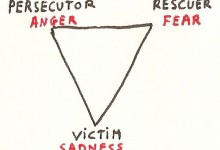
You need to know that there are four basic emotions at hand; i.e, four basic fuels that contain the energy we need in order to move from one state toanother. Fear, anger, sadness, and happiness are the four basic emotions that can be experienced by every person in any culture. Just like the four basictastes: bitter, sweet, sour, and salty.

Fear, anger, and sadness are not necessarily negative. Like salty, bitter, and sour they can be quite good. Whether we like the taste of something is anentirely subjective matter. It depends on our experiences, our education, and the company that we’re in. Likewise, whether we experience change in apositive or negative manner also depends on our experiences, our education, and the company that we’re in. This is a very valuable insight, because itproves that emotions follow perception (and not the other way around).

Some Clarity

Now hang on, because this is where it gets interesting. There are three things you should know about emotions.

1. Perception is a choice. As a result, whatever feelings we experience are not an outside event but the result of our personal choice on how we perceive an outside event.It is the basic insight that is underlying one of the keypoints of the bestseller Fish!(*): Choose Your Attitude – Each day you choose how you are going to act or which "side of the bed" you wake up on. The choice is yours and, the way you act, affects others.

2. Emotions are fuel. Emotions provide the basic energy that is necessary to get anywhere from your current state.

3. Emotions are data. Once you are able to disconnect the emotion and read the valuable information that is hiding behind it, you will soon find out that there is a positive useof these emotions.

In the following paragraphs, let’s have a closer look at what this means for the feelings that trouble us most.

Anger—Clarity

When we are angry, we are often very aware of what we want or don’t want. This leads us to clarity about our objective and the objective of our team. Anger helps us to take decisions, to stay alert, and to stop confusion. There is a thin line between destructive anger and a vision that fuels achange. They both build on the same emotion but with a different sense of responsibility. When you allow frustrated people to find expression for theiranger and you genuinely receive their communication, ask them what you could do to improve.

Fear—Courage

When we are afraid, this means we are approaching unknown territory. New opportunities arise when we have the courage to take that direction. Fear often works as an indicator towards dangers, but also towards new opportunities. Often, the most frightened people are the closest to building the courage to deal with the unknown. Courage builds on the same emotion that can freak us out. Surprisingly, when you allow frightened people to put their anxiety into words, they tend to make room for courage to meet the challenges they are facing.

Sadness—Contact

The essence of each relationship is contact. The measure in which we are in contact depends on the empathy and the self-confidence that we have.Cynicism, for instance, is a hidden form of sadness. Cynical people often are very good at sensing which relations are being left behind in a change project. Again, there is thin line between cynical reactions and emotional intelligence. The underlying emotion is the same. Although cynical people aretough, they also know exactly who is left out. When they see the purpose behind the change, they may even be the best relationship builders.
_____________________________________________
(*) Fish! A Remarkable Way to Boost Morale and Improve Results by Stephen C. Lundin, Harry Paul, John Christensen. ISBN: 0786866020