

Archive for the ‘Emotions’ Category

Creativity as a Resistance Buster

Tuesday, July 27th, 2010

The way I approach resistance is influenced by the way I look at organizational change management. I see resistance as a crucial ingredient that is needed to make a change happen. Resistance fuels change. Without it, there is no change.

I get very suspicious whenever I see advertisements for consulting companies or training courses claiming they will help you to reduce or avoid resistance. They create the false expectation that organizational change is a mathematical exercise.

Emotions are the Only Way Out

They avoid to make sense of the emotional responses. Instead of seeing them for the fuel and energy they provide, they mistake them for a failure. Then, they move in the opposite direction, as if they were reading a road sign upside down.

Here is what that road sign says: resistance is emotion; and emotion is the ‘motion’ that is needed to move through the dip of change. Of course it is a bumpy road, but it is the only way through.

Lateral Thinking as an Example

One example to go forward is by looking at these reactions like Edward De Bono approaches creativity. De Bono discovered that logical, linear and critical thinking has limitations. It is primarily concerned with judging and seeking errors. He calls this black hat thinking. The problem is that it scares us so much that we want to move away from it. But the opposite it true.

De Bono’s approach is to appreciate the value of this negative thinking, instead of avoiding it. Next, he stimulates the other thinking hats to come to the surface. As a result of respecting the negative thinking and going through, one ends up with a rich palate fueling a solution for the situation at hand:

  • Negative judgment (black hat) – logic applied to identifying flaws or barriers, seeking mismatch
  • Neutrality (white hat) – considering purely what information is available, what are the facts?
  • Feeling (red hat) – instinctive gut reaction or statements of emotional feeling (without justification)
  • Positive Judgment (yellow hat) – logic applied to identifying benefits, seeking harmony
  • Creative thinking (green hat) – provocation and investigation, seeing where a thought goes
  • Process control (blue hat) – thinking about thinking

The bottom line is that we need to go through the roller-coaster of our own emotions in order to have the respect and authority to lead others through the organizational change.

The Math Versus The Path

The mathematical or linear approach assumes a straight line from the present state to the future state. This line is best described as ‘Analyze – Think – Change’.

Inevitably emotional side tips us and our beliefs into the cycle of change as described by Elisabeth Kübler Ross. Turns out that in times of change motivation is more important than math.

The nature of things is ‘See – Feel – Change’. The feel part, according to Kübler Ross is a rollercoaster taking us through the dip of denial, anger, bargaining, depression and acceptance. Trying to avoid those emotions is like cooking without heat: ingredients won’t fuse.

Some Mails are Better Never Sent (Part 2)

Monday, June 28th, 2010

It was only after I scrolled down in his reply to my own original email that I realized the damage I had done. I am a jerk. And now it’s almost midnight, so calling is not an option.

Bear with me, because ‘Mr. Communication’ is about to reveal a true story and it isn’t a schoolbook example.

Earlier last week I made it clear to Peter (not his real name) that I was not comfortable with the teasers he was sending me regarding our next teambuilding activity. It seemed to me that he was transforming our original plan of visiting a religious sanctuary into a murderer game by asking me to bring mysterious attributes and solving weird questions.

The Panic

Last time I was asked to do weird things like that was during a two year intensive course on transactional analysis involving the deeper levels of group therapy. I was not up for that and this went way beyond our original plan. What was this guy up to? All of my sensors went in red alert.

So I decided to ask him. Or rather: tell him. Because after a night of sleep – during which I could reiterate the panic and wind up some more – I decided to put it all in an email. Yep. An email.

The Solution – Or So I Thought

And it felt better. The panic was out of my system. I could breathe better and the fact that I twisted in some Monday-morning-blues and rush-of-the-workweek didn’t bother me. A bit of slam-poetry can only make things clearer.

I ended the email with the words: “Not with me and not now! And now up to you!“, convinced that he would be as tolerant and feel as light-hearted about it as I did AFTER hitting the Send button.

The Wakeup Mail

Days went by and I even forgot about the email. Until I checked the mailbox one night after coming home late, to find a crushed soul at the other end of the digital line. His response ended with: “Not sure I know what this is all about. But if you want to step out that is OK with me”.

Huh? I didn’t mean to do that! And to justify and rationalize my original intent I scrolled down to read my original email and convince myself. O MY GOD. Did I write that? Like that? I am such a jerk. And now it’s almost midnight, so calling is not an option.

The Best Part

Or: ‘Why this is so embarrassing

In my own trainings (see slideshow) I teach professionals that email is silver and phone calls are golden.

Truly a golden rule. One you should never forget. Thank you Mr. Communication… Now walk your talk!

Eventually I did call Peter and we straightened things out. I had the chance to acknowledge the damage done; to apologize and to get back to my original intent: simply to ask him what this was leading to.

Fortunately Peter is a few generations more mature than me and he was kind enough to course-correct and accept my apologies. He called me ‘over-assertive’; a very polite way of stating the facts.

My Own Private Refresher Course

I remember one other mail in my Inbox with the title ‘Have an Average Day’ – by Michael Neill, a remarkable coach I have been following for quite some years. I also remember thrashing that email with the same rush-of-the-workweek adrenalin that I was going to put into my email to Peter.

Now I know that I should have taken that advice and to take the day off from striving and struggling for success – and have a wonderfully average day instead…

Here is how I could have translated that advice instantly: Exceptional emails are silver, but average phone calls are golden.
______________
Related article: Some Mails are Better Never Sent – November 29th, 2007

The other moral to your same old story

Sunday, September 27th, 2009

I have used the evenings of the month of August to pull together this draft of a business fable. In fact, this fable is my way of coping with the ambiguity of workplace dynamics and games people play.

It helps me to make sense of pressure, tension, stress, indifference and breakup.

Is there another way of going about with pressure and tension?

In my world there is.

In this adventure three fish discover that there is always a choice.


Click on the image to download the document. If that doesn’t work you can always copy-paste this link into the address bar of your browser:
http://www.reply-mc.com/wp-content/uploads/2009/09/the-pond.pdf

And please please please let me know your feedback, as I intend to complete this fable by integrating all the afterthoughts into the line of the story.

Happy reading!

Seagull Management

Monday, August 31st, 2009

Chatting with Vera the other day on all sorts of management styles; we came across one she had never heard of before: Seagull Management. At first she thought I was kidding, but after googling the term we discovered that there are 632.000 results on this entry and that it is even featured on Wikipedia.

And this is all because there is one little sentence in the book The One Minute Manager that describes the term: "Seagull managers fly in, make a lot of noise, dump on everyone, then fly out."

Regular readers of this blog are already familiar with the grumpy boss. Now you know what his birdlike equivalent would look like. What’s more interesting is that this conversation made me take the dust off my copy of the One Minute Manager, so I’ll be blogging on that one pretty soon.

A conflict isn’t always a bad thing – Part 6

Tuesday, August 4th, 2009

Looking at the kind of conversations one can have in a project context.  The ones I have been involved in can be categorized in three groups:

1. Polite discussions: interactions on a level of political correctness. No harm done, but nothing gained either on the level of creativity or relationship.

2. Passionate discussions: Above and beyond the exchange of information and facts. These moments can be filled with joy, sadness, fear, but most of the times they are guided by anger and frustration (Yep: such is life on large scal projects). The point is that there is a counterpart in these conversations acknowledging the feeling you are expressing. Relationship matters. I have learned that when people connect at this level, that they are capable of innovative and very high quality work.

3. Powerplay: ‘Mine is bigger than yours’  and command and control discussions where one party needs to win on the other’s expense. I have learned that these suck the last drop of motivation and commitment out of people in the long run. The result is only as good as the IQ of the winner (which, most of the times resembles Rambo’s instead of Einstein’s).

For the sake of simplifying reality so that it fits into my brain, I have plotted the categories on the chart below:

The moral of the story: you need an optimal level of conflict for a good solution, for conflict is what ensures contact. So don’t be afraid to show some guts from time to time.  Just one big warning sign so you don’t tilt to the complete righthand side: if you loose your vulnerability in the conflict, you loose your dignity and you fall into powerplay mode.

Related articles:
-
A conflict isn’t always a bad thing – Part 5 – January 12th, 2009
- A conflict isn’t always a bad thing – Part 4 – December 14th, 2008
-
A conflict isn’t always a bad thing – Part 3 – December 7th, 2008
-
A conflict isn’t always a bad thing – Part 2 – November 29th, 2008
-
A conflict isn’t always a bad thing – Part 1 – November 22nd, 2008
-
Forming – Storming – Norming – Performing  – September 12th, 2008

Parenting as a Management Skill … Huh? (part 5)

Sunday, May 24th, 2009

In addition to the articles on parenting as a management skill that I posted in February 2009, there is one more insight I’d like to add. I found out that the epicenter of organizational change management is hidden in the simple mechanism of cause-and-effect. And I found out about it by being home between television time and dinner time on an average working day.

When I ask my 3 year old son to stop watching television and to come to the dinner table, I’m most likely to receive a ‘No!’ and when I persist in my plan, tears and other forms of ‘Resistance’ will follow for the next ten minutes or so.

However, when I get involved in his frame of reference, I tell him that the television will be shut down when the clock turns seven or when the episode he is watching ends. I can also tell him he can count to three for me to turn off the television, etc. It’s a game he gladly subscribes to; running to the dinner table – eager to start dinner.

What happened here? In the first situation I would be using my parental authority to reinforce an action. This likely results in ‘Revenge’, ‘Regret’ or ‘Rescue’. In the second scenario I am using a different approach: instead of pushing harder I take one step back – BUT I STICK TO THE OBJECTIVE, i.e. television out and on to the dinner table.

By stepping back I inverse the cause-and-effect relationship: I let him be the cause instead of the effect of the situation. This is more likely to result in a ‘Responsible‘ response: I give him the opportunity or the ‘ability‘ to ‘respond‘ positively to my request.

The same is true for organizational change efforts. The point is that you can achieve most of the goals by underscoring the objectives, stepping back and then leaving people the opportunity to become involved in the solution. Instead of pushing harder straight on to ‘Resistance’ you are stepping back and allowing ‘Relationship’ and ‘Respect’.

I bet one can’t learn that lesson so profoundly and deeply at Harvard or Wharton the way I did between the dinner table and the TV set.

Related articles:
Parenting as a Management Skill … Huh? (part 4) – March 1st, 2009
Parenting as a Management Skill … Huh? (part 3) – February 21st, 2009
Parenting as a Management Skill … Huh? (part 2) – February 16th, 2009
Parenting as a Management Skill … Huh? (part 1) – February 9th, 2009

Resistance, Resentment, Regret, Rescue OR…. RESPECT?

Sunday, May 10th, 2009

A lot of R words with a particular significance on this blog. In a reaction on last week’s post I was requested to define resistance more precisely. Well, I tend to adopt the definition of resistance the way it is described by Karl Weick, that is:

Resistance is the emotion that occurs when our expectations of ‘the way things are’ are interrupted. Two words are important in this definition:
A – Emotion: the essence of resistance is that it creates an emotion. That means: not logical, not rational and most of all: not predictable.
B – Expectation: resistance does not only occur when things change, but when our expectations are interrupted, regardless of whether that makes rational sense.

As one of the commenters on LinkedIn put it:

"Resistance is an indirect expression of fears of loss of control and vulnerability. It REQUIRES "peeling the onion" to uncover the roots of the affective reaction. Rather than being a "bad" thing, I have found that resistance is more often than not a signpost indicating a potential problem or set of problems that if left unattended could derail any initiative."

Another commenter simplified the definition (I like that a lot!) in a way that negative connotations are almost gone:

"It’s often seen as a negative, however, it turns the light on to areas that really need attention. Just like the voice of our GPS saying, "recalculating" "

Yet another commenter continued:

"We struggle to find a place to put ‘resistance’, so that is doesn’t interfere with the ‘work’ or the outcomes. Seems to me that when we stop fighting it and see it for what it is (without judgment) we may understand better how to use it as a tool more effectively." - Embracing resistance (like the statue in picture above)

And that is indeed the whole point: whether or not we categorize a certain behavior such or so; the difference is in the response we give. And the response can be one of Resentment, Regret, Rescue OR…. RESPECT. The whole point is that we choose our responses to the world.

Finally: thank you to all commenters on this blog and on Linkedin for fueling this discussion!

Once upon a time…

Monday, April 13th, 2009

A fairy tale for the suffering in the workplace.

Once upon a time there was a pond with the most exceptional fish one could think of. The man who took care of the pond wanted it to be the best pond of all times, and so did the fish.

The man took care of everything because he didn’t trust a single fish. Instead of feeding them and providing them with oxygen, he hooked them up each day. That way, he knew exactly what they were doing and how they were doing it. Each day he weighed each fish, pushed the food down their throat and told them exactly what they should do before he let them into the water again.

The man was quite proud of the way he controlled it all. Any time of the day anyone could ask how the pond was doing and he would explain in detail with colors, graphics, metrics and key performance indicators. By all measurements, this was the best pond of all times!

In order to control the fish efficiently the man threw out nasty bait: a talking worm telling the fish how bad their work was, how the quality sucked, how they were behind schedule and how it made the man nervous as hell. The man thought this kind of bait would keep the fish sharp. And it did. The bait was simply irresistible.

Below the water surface, Red Fish, Blue Fish and Yellow Fish caught every nasty worm. They were smart fish; strong and bright-colored. Each time the bait was thrown out it was only a matter of seconds before they would catch that nasty worm. Red, Blue and Yellow were the best of breed.

• Red Fish was always the first to swallow the bait; “that’s not true” he said; “I’m going to tell him!” But the rage and the misalignment grew with each catch.
• Blue Fish swallowed the bait differently; with each catch his self doubt grew, for he started to believe the accusations that worm was throwing at him.
• Yellow Fish was smarter than that. He would not fight it like Red Fish, nor feel guilty about it like Blue Fish. His approach was to solve the man’s problem. So he swallowed the bait each time, thinking he could solve the man’s problem.

These smart fish were all different in how they approached the nasty worm – so much is true. But there was one thing they all had in common: they always swallowed the bait by their own instinct and each time they got back into the water they felt sore. They didn’t know why; they were bubbled…

And then one day a duck landed on the pond. He said he had seen these situations in other ponds as well, but the fish didn’t pay attention to the duck; for they were too busy swallowing the bait that was thrown at them. Days went by and from the surface the duck could see the daily ritual the fish went through. These smart fish suffered, but they were too proud to admit it. After all, they were the best of breed and besides a duck is a duck. What could he possibly know about fish?

Until one day the hooks left them aching so hard that they needed some time to recover, so they figured they might as well listen to the duck. “OK duck, let’s hear it” Red Fish said. “Things are not OK down here, so tell us what you think is going on.” Blue Fish said.

It’s fairly simple”, answered the duck; “from up here it is obvious how you are exaggerating on the R-side”. “The R-side; what the hell is that?!” Yellow Fish replied. The duck patiently continued:
You see, there is a pattern in your daily suffering:
• Red Fish is driven by Revenge. That is the first R – and he is left with resentment;
• Blue Fish is driven by Regret. That is the second R, which leaves him feeling guilty;
• And you, Yellow Fish, you get hooked because you try to Rescue the man, and in the end you are scared because it didn’t work out as planned.
There is just one thing you should know about these R’s: they will always get you hooked

But that’s our nature – don’t you understand?” Red Fish said. “This pond is our destiny- there is nothing we can do about it” Blue fish said. Yellow Fish concluded: “The only way out is to change the bait”.

Hang on – there is another way out”, the duck said, “but it will require you to use a different R than you are doing today.
• I’m not asking you to change your nature, Red Fish, but you need to become aware of it;
• I’m not telling you to change for a better pond, Blue Fish, but you can think of yourself as the pond instead of the fish;
• And finally, Yellow Fish, you cannot change the bait that is thrown at you – you just need to know that you can choose not to swallow it.
So the alternative R I am talking about is called Responsibility.

The fish were bubbled…

Just try it – you have nothing to lose. When you approach the bait with Responsibility, you will be able to stop and capture the useful information without getting hooked.” Because the fish had no other alternative they decided to try this crazy idea. Days went by before they could turn off the automatic pilot that hooked them.

Eventually, they did it and they reported back to the duck:
We managed not to get hooked for a few days now.” Red Fish said. “And what were your findings?” the duck replied. “Well, it’s hard.” Blue Fish said, “because it needs all of my attention. But now at least the pain is gone and we continue our work.” Yellow Fish thoughtfully added: “This is almost as difficult as swimming upstream.

Indeed”, said the duck “approaching nasty bait with Responsibility is as hard as swimming upstream. Responsibility means that you can choose how you respond to a situation. And it’s not easy. Just remember that it’s the upstream swimming that makes you stronger!

The man never changed. Neither did the bait. But the fish grew stonger each time they realized that there is always a choice in how they respond to a situation.

Happy Easter!

The Anatomy of an Apology

Saturday, April 4th, 2009

I am currently reading The Manager’s Book of Decencies – How Small Gestures Build Great Companies, by Stephen Harrison. Actually, it is more a field guide than a book, because it’s packed with real-life examples of decencies that result in major business impact, and that you can put to use in your company.

Examples include: Greet coworkers personally. Remember to say thank you. For meetings you convene, be the first to sit down and the last to get up. Welcome visitors by name. Answer your own telephone. Give away recognition when things go well; hoard responsibility when they don’t. Convey bad news in person. When you make a mistake, admit it and apologize.

When it comes to this last one – apologizing – I just finished an interesting chapter that matches last week’s post particularly well: Executive Humility Decencies. In that chapter, Harrison explains that apologies are serious business.

All or Nothing

He even cites a research by Jennifer Robbennolt, Professor of Law and Psychology at the University of Illinois College of Law. In two studies, participants, ages 21 to 70, read a scenario describing a pedestrian-bicycle accident. They were asked to take on the role of the injured person and evaluate a settlement offer from the other party, based on information about the injuries, the other party’s conduct, and each party’s responsibility for causing the accident.

Professor Robbennolt found that when a full apology was given, 73% of the respondents would accept the settlement offer. When no apology was given, 52% would accept, but when a partial apology was given, only 35% would accept. Even when she changed the scenario and made the evidence of fault less clear, a partial apology was still often perceived no different to no apology at all. Results also showed that the severity of the injury mattered: the more severe the injury, the more the need to fully apologize. It seems that a late or a bad apology is WORSE than no apology at all.

The 4 R’s

Not surprisingly, when we dig a little deeper in order to find out more about the anatomy of an effective apology, we end up in the field of medicine. Apparently, a lot of health care providers understand and practice what to do after unexpected outcomes – to apologize (*). Most of them use the 4 "R"s of Apology:

Recognition: knowing when an apology is in order. An apology needs to ensure that the injured party knows that you understand specifically what you did wrong.

Regret: responding empathetically. This is an indication that you accept personal responsibility for the injury. Here it is important to remember that an expression of regret is not an admission of guilt or fault.

Responsibility: owning up to what’s happened. Be accountable for the problem, even if it was unforeseeable. This is the part where most apologies end up being partial expressions of regret, impoverished by exceptions and ‘but’ statements. As the above research of Professor Robbennolt points out, a bad apology is worse than no apology at all.

Remedy: making it right. Explain to what’s being done to correct the problem and express your commitment to not make the same mistake in the future.

Finally, back to Harrison’s book, from which I’d like to quote how he links apologizing and vulnerability to leadership:

"During the course of his or her career, every leader will be tested by adversity, and sometimes the leader will fail. At these times, employees and other stakeholders are watching very carefully. When they see the leader as a fallible person who makes mistakes and has the decency to acknowledge them, take responsibility, and apologize if appropriate, the will not abandon the leader. Followers demand neither flawlessness nor omniscience. (…) In the end, followers demand leaders who are worthy of being followed."
__________
(*) Source: Healing Words: The Power Of Apology In Medicine, by Michael S Woods, Jason Isaac Star, Hilda J Bruckner

Exactly HOW can I be responsible for the communication?

Sunday, March 29th, 2009

Earlier this month I stated that the quality of a communication is determined by the extent to which the receiver feels understood and involved, rather than by the amount or even the quality of information. In other words: it is the relationship, rather than the content which determines the quality of a communication. One week later I continued by saying that the sender of a message has the most possibilities at hand by declaring oneself the context for all the circumstances that occur with regards to the communication ("being the board" as Ben Zander calls it) .

Destination: Relationship

Last week my friend Alex was kind enough to open my eyes to the fact that ‘being the board’ is about being the cause for something to occur, instead of being the outcome of a situation. He said: "If you feel like you’re the victim of a situation, that is because you see yourself as the effect of a situation instead of the cause. But the one thing you should know is that you can control your own reactions and initiatives; and these should be driven by a smarter objective. So have another look at what you would like to create, because you DO create the situation you are in by means of your reactions and initiatives."

So there I was, looking at my own knowing-doing gap; and Alex gave me the "X" on the map that told me "you are here": I’ve been writing about this stuff for quite some time, running workshops on that topic and yet I was stuck like a fish on a hook. Until Alex told me I can choose to be the pond instead of the fish in terms of how I act and react in a situation. Do I want to be a fish? Then I will get hooked every time the bait is thrown out. Do I choose to be the pond? Then I will be the context where both the fish and hook are welcome!

In terms of communication it comes down to this: if I want to be right, it’s the best guarantee for a conflict. On the other hand, when my destination is relationship there are a lot of ways to make others win and at the same time being the cause for this situation to occur. All it takes is a healthy dose of integrity.

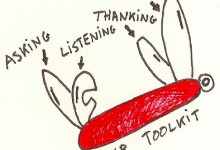
Toolkit: Integrity

So the next question is: exactly "HOW" can I be the cause for relationship to occur?  There are 4 ways to do so and they are universal, i.e.: they are available to anyone, anytime, anywhere. They are:

1. Asking for help: The great Peter Drucker once said: "the leader of the future will be a person who knows how to ask". Asking for help opens doors with honesty and is difficult to resist. It allows your counterpart to have a stake in the solution and to ‘win’ and at the same time you are the cause for this situation to occur.

2. Listening: Attention here – listening is a two-way act, as it involves listening AND acknowledging what you have understood. You need to demonstrate that you are totally engaged. Aknowledging is the part that makes people feel understood and connected.

3. Thanking: Gratitude is a skill we can never display too often. And yet for most people it seems like they need to wait for the perfect moment … but it never comes. It is always the right time to say ‘thank you’. Gratitude is not a limited resource and an overdose is not harmful.

4. Apologizing: Marshall Goldsmith calls this ‘the magic move‘, because an apology is a recognition that mistakes have been made and it contains an intention to change for the better. But most of all, an apology is an emotional contact with the people you care about. It is a closure which lets you move forward.

Bad news for ego

You will note that these four ways have one thing in common: they require you to be humble and to position yourself ‘one down’ with regards to the person you are talking to. You can only access these tools when you let go of your need to win the competition for being right.

In his 2007 bestseller What Got You Here Won’t Get You There, Marshall Goldsmith says: "When you declare your dependence on others, they usually agree to help."  So your only way out is by putting aside ego. It is only when you decide to give up on being right that you will be able to ask for help, to acknowledge feedback, to express gratitude, or to make an apology.