

Archive for the ‘Edward de Bono’ Category

Creativity as a Resistance Buster

Tuesday, July 27th, 2010

The way I approach resistance is influenced by the way I look at organizational change management. I see resistance as a crucial ingredient that is needed to make a change happen. Resistance fuels change. Without it, there is no change.
I get very suspicious whenever I see advertisements for consulting companies or training courses claiming they will help you to reduce or avoid resistance. They create the false expectation that organizational change is a mathematical exercise.

Emotions are the Only Way Out

They avoid to make sense of the emotional responses. Instead of seeing them for the fuel and energy they provide, they mistake them for a failure. Then, they move in the opposite direction, as if they were reading a road sign upside down.

Here is what that road sign says: resistance is emotion; and emotion is the ‘motion’ that is needed to move through the dip of change. Of course it is a bumpy road, but it is the only way through.

Lateral Thinking as an Example

One example to go forward is by looking at these reactions like Edward De Bono approaches creativity. De Bono discovered that logical, linear and critical thinking has limitations. It is primarily concerned with judging and seeking errors. He calls this black hat thinking. The problem is that it scares us so much that we want to move away from it. But the opposite it true.

De Bono’s approach is to appreciate the value of this negative thinking, instead of avoiding it. Next, he stimulates the other thinking hats to come to the surface. As a result of respecting the negative thinking and going through, one ends up with a rich palate fueling a solution for the situation at hand:

  • Negative judgment (black hat) – logic applied to identifying flaws or barriers, seeking mismatch
  • Neutrality (white hat) – considering purely what information is available, what are the facts?
  • Feeling (red hat) – instinctive gut reaction or statements of emotional feeling (without justification)
  • Positive Judgment (yellow hat) – logic applied to identifying benefits, seeking harmony
  • Creative thinking (green hat) – provocation and investigation, seeing where a thought goes
  • Process control (blue hat) – thinking about thinking

The bottom line is that we need to go through the roller-coaster of our own emotions in order to have the respect and authority to lead others through the organizational change.

The Math Versus The Path

The mathematical or linear approach assumes a straight line from the present state to the future state. This line is best described as ‘Analyze – Think – Change’.

Inevitably emotional side tips us and our beliefs into the cycle of change as described by Elisabeth Kübler Ross. Turns out that in times of change motivation is more important than math.

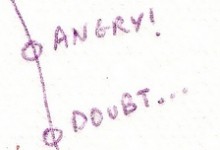
The nature of things is ‘See – Feel – Change’. The feel part, according to Kübler Ross is a rollercoaster taking us through the dip of denial, anger, bargaining, depression and acceptance. Trying to avoid those emotions is like cooking without heat: ingredients won’t fuse.

Web 2.0 includes Invisible Hand

Monday, June 29th, 2009

Over the past week I experienced that the good old brainstorming techniques that are derived from de Bono’s Six Thinking Hats don’t need a nudge in the Web 2.0 age.


6 Thinking Hats

I have used this brainstorming technique in a variety of different settings: to generate ideas, to solve complex problems, etc.  The Six Thinking Hats method provides a way for groups to think together more effectively. ‘Together’ is the absolute key word here: instead of having individuals reacting their own way (as usual), the group agrees to deliberately step into each possible ‘way of thinking’ sequentially. There are 6 different types of thinking or hats one can wear in a discussion:

* Neutrality (white) – considering purely what information is available, what are the facts?
* Feeling (Red) – instinctive gut reaction or statements of emotional feeling (but not any justification)
* Negative judgment (Black) – logic applied to identifying flaws or barriers, seeking mismatch
* Positive Judgment (Yellow) – logic applied to identifying benefits, seeking harmony
* Creative thinking (Green) – statements of provocation and investigation, seeing where a thought goes
* Process control (Blue) – thinking about thinking

In my experience until last week – the Six Thinking Hats was a powerful tool to generate ideas and solve complex problems through parallel thinking. On top of that it creates a greater feeling of momentum in team that otherwise would be cluttered in a ‘being right’ discussion.

6 hats on Web 2.0??

By now most readers of this blog must have noticed that I am making my first babysteps into the Web 2.0 communities. One of them is LinkedIn, where I am lucky enough to manage the Organizational Change Practitioners group (4.722 members subscribed at the time of writing). Recently I decided to have ask the members contribute in which subgroups we would create in this forum.

What I witnessed next was multi-thinking at different dimensions at the same time. One of the most beautiful examples of Six Thinking Hats I have ever witnessed from close by!  At the time of writing, there were over 85 reactions that demonstrated the six thinking styles:

* Neutrality: people responding directly to the question at hand (e.g.:"I suggest to creat a subgroup on human behavior")
* Feeling: people volunteering to become a subgroup manager (e.g.: "Great idea, Luc. If you need help, I would be ready to facilitate/moderate the Web 2.0 group")
* Negative judgement (Black): people opposing to the idea of subgroups (e.g.:"Seems to me the additional structure may add bureaucracy rather than make it easier to navigate and participate.")
* Positive Judgement (Yellow): people supporting the idea (e.g.: "I think having focused discussions would be great so that when dealing with a particular issue, you wouldn’t be all over the place.")
* Creative thinking (Green): people suggesting additional ideas (e.g.:"Maybe a poll would be a good idea to select the final five")
* Process control (Blue): people looking at this process happening (e.g.: "watching and participating in a wonderful new (to me at least) process: asynchronous, large-group virtual conversation and decision making"); one participant even Twittered this discussion thread!

Invisible Hand

The most fascinating observation however, was that the discussion thread almost chronologically went through all of these hats. In the same way as during brainstorming sessions each thinking hat is triggered by one reaction, which sparks a range of reactions that belong to the same thinking type.

Coincidence? Not in a million years. But then, what caused this to happen? How did the group trigger a specific hat, go to a climax of reactions, a decline and then moved on to a next hat? How did the group decide the order of the hats to think by? Honestly – I DON’T KNOW. But I did experience that we were parallel thinking! We simply cannot deny that there is some kind of invisible hand doing some fine work.