
Archive for the ‘Edgar Schein’ Category

Love & Work (Part 1) – Free To Work

Monday, April 26th, 2010

The world of work is changing rapidly and it is difficult to make sense of it all. In search for a subject-matter-expert we bumped into Jan Denys. His latest book offers us more than one perspective on the status of work. A great starting point for this series on Love & Work.

Straight Talk

The book Free To Work is the first book to my knowledge that explains the history, problems, pitfalls and challenges of the Belgian labor market in human language.

The author Jan Denys is one of the few labor market experts in the Belgian and European landscape  who have the authority to say something meaningful about it and the analytic view to dissect it properly.

In Free to Work, Denys carefully explains the challenges for society, government, organizations, employer organizations and trade unions. He puts the finger on the wounds on all levels and he nuances some trends the media have blown-up into unreasonable proportions (such as the threat of globalization, or conversely the false sense of security that arises from jobs-for-life).

One Step Beyond Analysis

And this is where most scholars would have stopped (and would have paralyzed me as a reader with lots of references and academic mumbo-jumbo). But Denys tops the book with two outstanding chapters: Sixty Proposals for an Open And Modern Labor Market (chapter 9), and Your Career (chapter 10). This last chapter zooms in on the individual level.

In the below One-Minute-Interview Jan Denys explains what this means for every single employee who gets ‘trapped’ into the comfort zone of a stable job: Your comfort zone should be coloring red when you find yourself loosing the external focus and ignoring the long-term perspective of your career.

Nowadays, there is no such thing as a lifelong job in one and the same organization. However, in times of economic crisis we see people digging themselves even deeper into the security of their job: comply more, don’t speak up, play-safe-games and even increase the inward focus.

Anchoring Your Career

Denys promotes the career anchors of Edgar Schein to cope with the identity crisis that may occur once an individual stares into the abyss of the labor market: it never hurts to get a clear perspective on who you are and what you want.

Career Anchors match the ‘who you are’ part with the ‘what you do’ part of your daily life. The more these two resonate with each other, the better your chances of finding your way. If you know that most of the people tend to build their career on their very first job, knowing what really matters for you may be worth finding out, for it may not be where you started your career.

Schein distinguishes the following Career Anchors:

  • Technical/Functional competence: You like being good at something and will work to become a guru or expert. You like to be challenged and then use your skill to meet the challenge, doing the job properly and better than almost anyone else.
  • General Managerial competence: Unlike technical/functional people, you want to manage. You like problem-solving and dealing with other people. You thrive on responsibility. To be successful, you will also need emotional competence.
  • Autonomy/Independence: You have a primary need to work under your own rules. You avoid standards and prefer to work alone.
  • Security/Stability: You seek stability and continuity as a primary factor of your live. You avoid risks and you generally prefer a job for life.
  • Entrepreneurial Creativity: You like to invent things, be creative and, most of all, to run your own businesses. You differ from those who seek autonomy in that you will share the workload. You find ownership very important.
  • Service/Dedication to a cause: You are driven by how you can help other people more than using their talents.
  • Pure Challenge: Driven by challenge, you seek constant stimulation and difficult problems that you can tackle. You will change jobs when the current one gets boring.
  • Lifestyle: You look at your whole pattern of living. Flexibility and the integration of life and work is key.

Who Is Driving Your Career?

The one thing you should remember about your job is that job-security is an illusion. Instead, you should be working on a career-strategy; and the best way to start is to see which career anchor resonates best with who you are.

Are you spending your working time in the area of your anchor? Well, then you have nothing to be afraid of; no reason to play safe by ‘fitting into the job’.

Fitting in will no longer safeguard your employment. Instead, build your career-strategy on this anchor, so you can stand-out in your career.

Pay Attention to your Attention

Friday, March 7th, 2008

Sometimes people look at me strange when I mention the importance of psychological safety during organizational change projects. It is a term that I borrowed from the writings of Edgar Schein. Until now I didn’t find a way to explain in plain English what exactly I understand under that term. Strange and expensive words come out of my mouth every time I try to explain and after the upteenth buzzword like "paradigm", "frame of reference" or "change readiness", you can see the blood run from people’s faces. I suck at explaining ‘Psychological Safety’.

So here is another attempt. Consider going to the dentist with children. There are parents who dramatize the event as it approaches and who ‘package’ the situation as dramatic. Most of the times their behavior is driven by their own discomfort with the situation. This tension sucks up all their attention and they transmit this to their kids. Most of the times the result is pretty devastating on the level of fear and tears.

Other parents pay attention to their attention as they know that their own behavior, words AND mindset influences that of their youngsters. I would suggest that their success rate on the level of fear and tears is higher.

The same goes for managers whose organizations are going through organizational changes. They too have a choice between paying attention or not. As their peers and team members are reporting panic, anger or disappointment they can either focus their attention on actions and solutions or focus their attention on persecuting, rescuing or victimizing (aka: dramatizing).

As a manager you need to pay attention to your attention as you are going through an organizational change. If your panic, your people will panic. Why? Because your people look at you in times of uncertainty and they read your behavior all the time. If you’re not paying attention to your words, gestures and mindset, then why should they get a grip on themselves? In times of resistance there is a golden rule: suspect yourself first!

The Time Factor

Friday, February 8th, 2008

As I am writing this we are about to shake up a traditional organization by means of an SAP implementation. Most of the times this is regarded as a pure software implementation: design the system, configure the system, test the system and roll it out. That is how most software engineers look at it and that is what traditional managers expect of it.

Only, with SAP it’s slightly different: since the software is supposed to administer the way you get your work done inside your organization it is quite instructive as to which standards, timings, methods and data you should manage from then on. Very soon you will find that it pretty much dictates your way of working – that is – if you want to get things done you better align to the ‘way of the system’.

I’ve facilitated about five SAP implementations before from the change management side and as I am embarking upon my sixth one I am starting to see the importance of the factor time. SAP brings with it a number of changes like: different working methods, different documents, a change in an organizational structure, a change in a procedure or a dramatic change of existing SLA’s (Service Level Agreements). Some of these changes are pretty easy to sell, but others a bit tougher.

In an earlier article I presented a framework for positioning the changes accoring to two dimensions: degree of behavior change and degree of WIIFM (‘What’s In It For Me’). I borrowed it from John Gourville (Harvard Business Review 2006). However, since this week I have a bit more clarity on how to use it.

As a starting point I make a big inventory of changes. There is no structured approach to doing that apart from keeping your ears open and being there when people start to worry about the future. This inventory always comes to the surface when ‘old’ meets ‘new’. Mostly a bunch of consultants and a bunch of dedicated business people work together in blueprinting sessions and design workshops. That is when these conversations happen and that is exactly when you should have your notebook ready. Soon you will have an inventory of changes.

Next, it is time to plot them on the Gourville matrix. As a consultant, you should resist the temptation to do this task by yourself. As part of the exercise you should ask the stakeholders (mostly SAP key users or process owners) to map the changes on this matrix. This is what Edgar Schein calls a ‘diagnostic intervention’. In other words: you are surveying the stakeholders but the dignosis itself is an intervention that triggers a change process: people are forced to start thinking about the changes in terms of ‘will we resist or not?’.

Finally, when all changes are plotted you are ready to prioritize the communication in terms of timing. ‘Rough spots’ and ‘Long Hauls’ will need a lot of context (i.e. why-communication) to settle in – and this takes time. The reason is simple: you are introducing a foreign element that will shake up the way things are.

So this is what I will be kicking off next week: harvest the inventory of changes. Having them plotted on the Gourville matrix and then get to the rough spots as soon as I can. People need the time to resist, to say ‘over my dead body’, to bargain and to come to terms with the new reality. Wish me good luck!

The Essence of Organizational Change Management is based on … Quantum Theory

Sunday, April 1st, 2007

The observer becomes part of the observed system

To measure the properties of a particle such as an electron, one needs to use a measuring device, usually light or radiation. But the energy in this radiation affects the particle being observed.

The German physicist Werner Heisenberg (1901-1976) received the Nobel Prize in physics in 1932 for his work in nuclear physics and quantum theory. The paper on the uncertainty relation is his most important contribution to physics. The Uncertainty Principle says that the more precisely the position of a particle is determined, the less precisely the momentum is known in this instant, and vice versa. The act of measuring one magnitude of a particle, be it its mass, its velocity, or its position, causes the other magnitudes to blur. This is not due to imprecise measurements. Technology is advanced enough to hypothetically yield correct measurements. The blurring of these magnitudes is a fundamental property of nature. As Heisenberg stated:

"We have to remember that what we observe is not nature herself, but nature exposed to our method of questioning."

The observer is no longer external and neutral, but through the act of measurement he becomes himself a part of observed reality. This marks the end of the neutrality of the experimenter. Does this mean that ultimate truth is unknowable? If in an exact science, such as physics, the outcome of an experiment depends on the view of the observer, then poetry may be more truthful after all.

OK – so what is the connection with organizational change management?
 
Diagnostic Interventions
First, Edgar Schein (*) introduces the concept of Diagnostic Interventions as the best way to involve members of the organization in the change program. By asking them relevant questions about the present state, you not only learn relevant facts about possible resistance to change, but you also begin to influence their thinking and get them involved in the planning. You need to recognize that no matter how neutral and innocent the questions may be, they will influence the thinking of the people in the organization and will, therefore, be an intervention whose consequences must be considered.
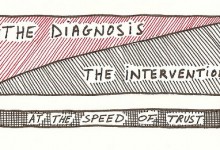
For example, you cannot launch a organization wide survey to decide whether or not to start a change program. Once you are conducting the survey, you have launched the program because you have influenced the thinking and expectations of the people you are surveying. By measuring the temperature, you have blurred the observations because you have set an expectation.
 
The Hawthorne Effect
Second, the Hawthorne effect is another phenomenon that illustrates the Uncertainty Principle: when people are observed in a study, their behavior or performance temporarily changes. People’s behavior and performance change, following any new or increased attention. The term gets its name from a factory called the Hawthorne Works, where a series of experiments on factory workers were carried out between 1924 and 1932.
There were many types of experiments conducted on the employees, but the purpose of the original ones was to study the effect of lighting on workers’ productivity. When researchers found that productivity almost always increased after a change in illumination, no matter what the level of illumination was, a second set of experiments began, supervised by Harvard University professors Elton Mayo, Fritz Roethlisberger and William J. Dickson.
They experimented on other types of changes in the working environment, using a study group of five young women. Again, no matter the change in conditions, the women nearly always produced more. The researchers reported that they had accidentally found a way to increase productivity.
 
You are part of what you observe … whether you want it or not
To summarize, if you are a change agent, the Uncertainty Principle holds a warning for you. You should constantly be aware that any of your questions, actions, non-actions, behaviors, attitudes and opinions have consequences on the stakeholder you approach. As an observer you are part of the observed system.
______________________
(*) Schein, E.: Models and Tools for Stability and Change in Human Systems, Reflections, Volume 4, Number 2, Society for Organizational Learning and the Massachusetts Institute of Technology 2002