
Archive for the ‘Dan Heath’ Category

Elephants! Everywhere I look!

Monday, March 8th, 2010

Forget the cheese and the mice, organizational change management just entered a new era: that of elephants and riders. The Heath brothers published a ground-breaking book on our core business.
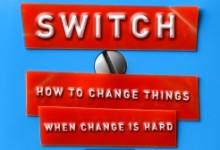
And the expectations were high. First, because their previous book Made to Stick was a great hit for anyone involved in communication.

Second, because I judged ‘how are they going to pull that one off, without a proven track record of publishing in our field of expertise’? Let’s face it: they are not Kotter, Block, Schein, Weick or Blanchard. So I was a little skeptic.

Compelling Style

And they proved me wrong, by every turn of the page. As we could expect, this book is well engineered from a communications point of view. They use strong and compelling stories throughout the book and – like in their previous best seller – they use ‘clinics’ to illustrate the framework they are exposing. So that’s already an A from an educational and storytelling point of view.

What about the content?

So far so good. But what about the content? Before ordering the book I felt like one of the organizational change practitioner’s on LinkedIn paraphrased it: “this book seems like it’s not going to offer me anything better than the proven techniques put out there by experts in change management.” Some other colleagues stated “this book is not transformative“.

Come again? Not transformative? My colleagues refer to the fact that some of the examples cited in the book have been used before in other change literature. Unfortunately they fail to see that the authors present a framework that is clearer than ANY methodology or phase-model I have ever seen in this area.

The authors use the analogy of an elephant and its rider. The rider represents the rational and logical. The Elephant, on the other hand, represents our emotions, our gut response. They are two parts of the human mind and the premise of the book is that change management initiatives need to address both rider and elephant in order to change. The content of the complete book is based on this metaphor:

STEP ONE: DIRECT THE RIDER
- Find the Bright Spots
- Script the Critical Moves
- Point to the Destination

STEP TWO: MOTIVATE THE ELEPHANT
- Find the Feeling
- Shrink the Change
- Grow Your People

STEP THREE: SHAPE THE PATH
- Tweak the Environment
- Build Habits
- Rally the Herd

Elephants … Once you start seeing them

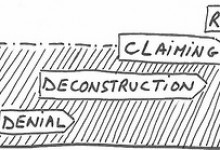
Below is an early note that I scribbled while I was reading the book. On this note I visualize that the rider is analytic and sees a logical straight line from the present state to the future state. This line is best described as ‘Analyze – Think – Change’. The elephant on the other hand – representing the emotional side – tips into the cycle of change as described by Elisabeth Kuebler Ross.

the rider and the elephant in the cycle of change

This is a natural process that all of us go through when we are confronted with any change. The point is that people – or rather their elephants – need time to make sense of the change.

Meanwhile, have a look at the rider anxiously holding on to that straight line. Turns out that in times of change motivation is more important than math.

Transformation: from mice to elephants

The real reason why this book is a gem is because the authors practice what they preach: they point out that you don’t have to be a CEO, a president or a prime minister to bring about effective change. If you look for solutions that are as complex and as big as the problem (which analysts often do) you will get paralyzed. Instead, Chip and Dan Heath advice to shrink the change and adopt the Flylady strategy, fighting chaos with five minute room rescues. (by the way, she defines CHAOS as: Can’t Have Anyone Over Syndrome)

Second, the authors point out that what often looks like a people problem turns out to be a situation problem. On multiple occasions they cite Wansink’s research on Mindless Eating. The point here is that Dinner control starts with plate control. And you often have more tools available than you think: small tweaks to the environment that yield big results.

Third, the Heath brothers take a positive approach and this may be the most groundbreaking point for our field of expertise. Until now our focus has been solely on resistance and how to reduce it. In other words: focusing on the problem and looking at what is withholding change. Instead the focus should be on the bright spots the authors say. Resistance is a symptom and not a cause! Stop looking at the mice. Focus on the elephant!

This book dramatically improves your diagnosis of so-called resistance and puts it in the framework of resilience. And when you change the way you look at things, the things you look at change: from resistance busting to resilience building. And that is why I am convinced that it will transform our profession.

Commander’s Intent: getting to the core

Tuesday, February 16th, 2010

“Communication is not the message sent, but the message received.” You knew that. Because like me, you are smart. Like me, you may have used it to outsmart other people when it comes to criticizing their message. But can you make a better message?


Ehhhmmmm… while the statement “It’s not what you say – it’s what they hear, stupid!” is a direct way to demonstrate the flaws of a communication, coming up with a better alternative requires different ammunition. And that’s exactly the word to cover this article. Did you know that military operations and military field manuals can help us a great deal in achieving better communication?

Uncle Sam

In their 2007 bestseller Made To Stick the Heath brothers (Chip and Dan) are setting a new standard for SUCCESful communication. The SUCCESs acronym is a communication stickiness checklist and stands for: Simple, Unexpected, Concrete, Credible, Emotion, Story. For the first part of the checklist – Simple – they draw heavily on the US Army Combat Maneuver Training Center in order to get to the core of the idea.

Like no other, the US Army knows that the distance between the intent and the operation should be kept as short and as straight as possible. Else they risk inadequate mission accomplishment. The way they do it is through Commander’s Intent.

The commander’s intent describes the desired end state. It is a concise expression of the purpose of the operation and must be understood two echelons below the issuing commander. . . It is the single unifying focus for all subordinate elements. It is not a summary of the concept of the operation. Its purpose is to focus subordinates on the desired end state. Its utility is to focus subordinates on what has to be accomplished in order to achieve success, even when the plan and concept of operations no longer apply, and to discipline their efforts toward that end.

What’s in it for you: Focus

I never thought that Uncle Sam would be of any help for explaining things to my grandmother – which is my ultimate bottom line. Commander’s Intent helps you to achieve focus, because when all plans fail you better not freeze and grind to a halt. In case you’re not convinced, consider the quote of Mike Tyson below:

CI is the military version of “Keep It Simple, Stupid.” Urging their leaders not to make the battlefield planning too complicated because in the heat of battle, innumerable variables will dictate the proper course of action.

The CI technique

The US Army teaches their leaders in all echelons the following technique:

=> Complete the following sentences:

1.)  If we do nothing else during tomorrow’s mission, we must ________________________.
2.) The single, most-important thing that we must do tomorrow is _____________________.

=> By answering these questions, you have basically written your intent.

=> Remember, your intent statement provides a framework for the operation. It does not tell your soldiers what to do. It does give them the overall picture of what you say the company needs to accomplish to be successful.

=> By making your intent a clear, concise, and focused statement, you greatly increase the chances that your soldiers will continue the mission, even when the operation doesn’t go as planned.

Your Mission Statement

Here is a great video by Dan Heath explaining why the US Army had better invaded our business schools and most of the corporate off-site strategy workshops. In this video he explains how to write a mission statement that doesn’t suck. The moral of his story for corporate mission statements:

1. Use concrete language

2. Talk about the WHY

My Granny flies Southwest

Southwest Airlines is a company that discovered the secret behind a Commander’s Intent to get to the core of their success, as their CEO Herb Kelleher asserts:

I can teach you the secret to running this airline in thirty seconds. This is it: We are THE low cost airline. Once you understand that fact, you can make any decision about this company’s future as well as I can.

In short: next time I outwit my colleagues by telling them: ‘If you can’t explain it to your grandmother, forget it’ – I can rely on Uncle Sam to complete the action.