


Archive for the ‘Consulting’ Category

One, Two, Three, Seven?!

Tuesday, April 15th, 2008

Every time I introduce something new into my team, my project or the organization I am working for I am reminded of how well I can count. Let me explain: it’s all about buy-in.

The below text is quoted from Marshall Goldsmith’s book What Got You Here Won’t Get You There. It describes exactly the false illusions, desperations, frustrations and plain trouble I often get myself into.

Has the following ever happened to you? your boss gives you a major assignment to find out what’s going on at a trouble spot within your company. You do what any well-trained MBA would do. You study the situation, identify the problem, report the findings and recommendations to the boss, outline a new approach, and turn it over to the appropriate people to implement the strategy.

A month goes by. Nothing happens. Another month. Still no progress. Six months later, the trouble spot remains unchanged. What did you do wrong? It’s simple: you committed "one, two, three, seven."

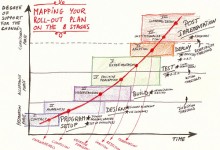
You failed to appreciate that every successful project goes through [the] seven phases [of the schedule below]:one-two-three-seven.jpg

Unfortunately, a lot of people don’t pay close attention to the phases four, five and six – the vital period when you approach your co-workers to secure the all-important political buy-in to your plans. [...]

These three phases are the sine qua non for getting things done. You cannot skip or skim over them. You have to give them as much, if not more, attention as you do in phase one, two, three, and seven. If you don’t, you may as well be working alone in a locked room where no one sees you, hears you, or knows you exist. That’s the guaranteed result of committing one, two, three, seven.

Good Wine Needs No Bush

Monday, February 18th, 2008

This evening I was on the train with Bart. Most of the time we chat about wine but this time we were on to the subject of project management. Several interesting points came out of our discussion.

The consensus of our discussion is that there are too many people who think project management equals project planning in a complicated software tool such as Microsoft Project. Although we applaud the smart guys and girls who are able to produce those graphs and tables, our gut feeling tells that good project managers come to the surface when all of a sudden they need to switch over to plan B.

Good wine at Cabutto(picture taken at Cabutto last year, checking out the 2006 Barolo)

To summarize: you can’t tell the quality of a project manager from grades on his or her resume. "Business School X", "Phd Y", "PMP", "CMMI", "Prince2", "ITIL certified", etc. are sometimes warning signs for ‘overintellectualized’ personalities rather than hands-on project managers.

That being said, a good project manager needs no tag, just like good wine needs no bush!

“Wellness”… My Ass!

Monday, January 28th, 2008

Last week I was a few minutes early on the steering committee of a huge SAP implementation. As we were joking around we came to the subject of ‘change management’. One person mentioned that some consulting companies abbreviate it as ‘CMS’, which alternatively translates as “Chicks Making Slides”. I had no evidence to prove him wrong. So I decided it is time to work on a brave new change management portfolio.

All sorts of examples came to the surface that confirmed the “Nice-to-have” brand that is tattooed on the back of each change management team as they start off. Finally, just before the meeting started, an experienced and seasoned program manager summarized it as ‘wellness’. I gave it the biggest of grins. However, as much as I appreciated the pun, to the same extent I could not provide evidence against it. Painful….

So this one is for all of us who want to endeavor in the domain of change management and take their profession as seriously as I do. If we want to avoid the ‘wellness’ stamp or the ‘nice-to-have’ connotation, we better get our act together!

The ‘act’ to my opinion is composed of four pillars, or ‘containers of work’ as I often call them. In the context of a project or a program these are ’streams’ that last from the startup until the very last phase of a project. Each of these project streams has a benefit that is defined in terms of the project’s return on investment.

They are:

  • The Communication Stream:
    The purpose of this stream is to grow the program during its complete lifecycle. This does not mean project propaganda but a clear answer to the question who are we? And what’s in it for me? The process of communication is one of social construction of a new reality in the hearts and minds of all stakeholders. You manage perceptions of what is going on.
    Major communication activities include:
    -    Segmentation of your target population (yes: you will need a database!);
    -    The mix of communication channels, and
    -    Building platforms and opportunities to interact.
  • The Learning Stream:
    Note that this stream is called ‘Learning‘ and not ‘Training‘, because the activities in this stream go way beyond the classroom. This stream aims to upgrade the skills and knowledge of the organization. Learning deals with three questions at the same time: ‘1. Why should I care?; 2. What is the one thing I need to know?; 3. How should I do it ?’.
    The main outcome is not only the knowledge but most of all how it is used and shared at the right time and to the proper extent.
    Major learning activities include:
    -    Building communities of knowledge;
    -    Making it easy for people to share knowledge, and finally
    -    Training organization.
  • The Organization Stream:
    Essentially, this is the question ‘Who does what?‘ 99% of organizational changes result in a change of responsibilities an accountabilities. The purpose of this stream is to define and implement these new structures, responsibilities and accountabilities. The overall objective is to refreeze a new organization structure that matches the operations to the objectives of the change.
    Therefore the major organization activities include:
    -    Role definition and assigning;
    -    Organization redesign;
    -    Setup of a support structure.
  • The Performance Stream:
    This is where the rubber hits the road. People will ask you: ‘What will this come down to in practice?’. The purpose of this stream is to implement the new ways of working. Also, every reinforcement mechanism that is put in place belongs to this stream.
    Major activities here include:
    -    Physical changes on the workplace;
    -    Simulations of the future state (be it a system or a way of working);
    -    The setup of meaningful measurements.

To me, the above portfolio is a bit different than ‘wellness’. Rather I would summarize it as Michael Hammer once did: ‘The soft stuff is the hard stuff‘. I cross my fingers that change management teams all over the world start realizing that they are working with real budgets and that they need to get their act together. If they do, their large scale organizational change programs will no longer be a foggy substance or a nice to have.

From now on there are 4 goals, 4 teams and 4 containers on your weekly status report. To hell with ‘nice to have’!

Some Mails are Better Never Sent

Thursday, November 29th, 2007

I tend to believe that the best consulting work is done with the heart breaking or overflowing. Sometimes people tell me not to get so emotionally involved and to adopt a rational outsider perspective.

To tell you the truth: I can’t. As a consequence I travel a bumpy road and from time to time I feel like sending mails like the one below.

Would you have sent it?
I didn’t.
But writing it made me feel so much better!

The Duck

Sunday, November 25th, 2007

Always remember: a duck is a duck and a fish is a fish. Fail to see the difference as a consultant and down you go. Sometimes it seems like a farm or a pond captures more of the essence of our profession than a business school.

In an earlier post about consulting (Open letter to my colleagues incl. myself) I wrote that being in service of the customer means coaxing your customer into ownership of the situation and at the same time staying the background as a coach or a play director.

There are two main pitfalls a consultant should be aware of:

1. The Ego Trap: In the flow of the adrenalin and other boosting hormones that is caused by positive feedback on our rhetoric and initiatives we take, we forget that we are there in service of the customer. Instead of being in service, our ego takes over, we become the star of the play, collect the flowers and the compliments, send a big fat invoice and head off to another customer. Climbing on stage yourself and solving the problem may be nice but the customer did not learn anything and he or she is even more dependent on you for further developments. Consultants on stage solving the customers’ problems have missed the point.

2. Change Agent Readiness: Most of the times there is another dynamic at work. In the lifecycle of the project you are delivering, the sponsor of the project may be ready to climb on stage, but the agents – who are supposed to be ambassadors – may not be quite ready to tackle that job. As a result, you take the easy way out: giving the fish instead of teaching them how to fish. Intelligent consultants know that involvement during the project lifecycle is the key point they should focus on.

About a month ago I was thinking how I could make that point clear in front of a large group of key users who are supposed to take ownership of a project by the time it goes live. I kept thinking about the fishing-thing and I came up with a metaphor that allows me to underscore the importance of taking ownership towards my customers.

First, I make it clear that is not my job to sell this project in the field towards their service engineers, technicians, accountants, invoice controllers, truck drivers, team leaders, etc. I do want to be there to support them, but having me explain the project to their peers and colleagues would be the same as a duck explaining to the fish how to swim.

At best a duck can tell the fish in which direction they should be swimming. But in the context of large change projects, the fish need more support than that. They need another fish telling them how to get there. They need someone who knows their context from within. The duck only knows the water from the surface. Moreover – invisible to the duck – duck-credibility in front of the fish equals zero.

Finally, our job as a consultant – be it external or internal (HR business partners, IT account managers, etc…) – is to become aware of the limitations of a duck and agree on the expectations with our agent-fish upfront: a duck is a duck and a fish is a fish. It is a useful distinction if you don’t like ending up like the duck above.

I have used this metaphor several times already and the feedback I receive is that it sticks. If you like it, you could give it a try and let know if it works for you as well – OK?

No Passion, No excellence

Sunday, September 2nd, 2007

A few weeks ago a I had the privilege of being invited by some friends (who are passionate about Italian wines) for a short trip to Piedmont. As you can imagine this was not the ordinary cultural sightseeing trip to Italy but an exciting journey into Italian winemaking and gastronomy.

dsc_0007.jpgNo need to mention that we tasted about 100 wines over the course of 4 days and visited two winemakers, two restaurants and at least one enoteca per day. A fairly acceptable sample to get a sense of excellence in wine making and Piemontese gastronomy.

One of the visits that struck me most was at the restaurant I Bologna, based in the small town of Rocchetta Tanaro. In that particular restaurant you are not welcomed by a particular prepared sketch, a free drink or anything commercial but by the very owner who kindly tells you and shows you what he has to offer today.

His passion for the quality of the ingredients, the wines and the impeccability of the restaurant were overwhelming. I could not tell whether it was through his charisma, his story, the restaurant itself, the professional staff or the freshness of the ingredients, but there it was: the customer experience of excellence.

As a customer, you can clearly recognize excellence when you get immersed in it. Two things stand out for me since our visit to I Bologna:

1. No passion, No Excellence
2. You don’t need an MBA to create excellence. Literacy in any academic form is not a prerequisite – rather a counter indication.

When we entered we did not step into a restaurant but we entered into a story, a firm context where the passion and perfection were abundant. We were not involved in a sales transaction but in a meaningful experience. During that brief visit, we were part of it, and now I consider myself a fan.

If Only I Could…

dsc_0013.jpgStepping back into the context of management consulting, I found a lot of inspiration on Tom Peters’blog. In a recent post he gives another “rambling piece” of advice. After reading his convictions and returning to my workplace I start to wonder: could I love my profession as passionately as the chef of I Bologna? Would my customers have the same kind of experience?
In terms of Organizational change that would mean 200% identification with the customer’s situation and sharing the risk of failure (instead of saying: ‘told you so’ when things don’t work out the way they should).
Fully engaging in the challenge ahead and not stepping out when the going gets tough. Would that make a difference? I think so. Would it be easy? Not a chance. Would I have the lively experience of making a real contribution? Pretty sure about that! Just look at it from the other side: If we don’t achieve that level of excellence in our consulting work, would we not be better of doing something else? Isn’t life a bit too short for mediocrity and playing safe?

Open Letter To My Colleagues (Incl. Myself)

Monday, August 13th, 2007

In my career as a management consultant I have met all kinds of colleagues that I envy and admire for their charisma, their wit, their smartness or their marvelous rhetoric. Nevertheless I recently found out that all the things that make us great consultants, smart and intelligent, fast and proactive, are holding us back from achieving excellence.

It all became clear to me when I witnessed another consultant on my project literally taking over from the customer as the big rescuer. The guy is a fast thinker, a sociable person, a perfect speaker and very loyal to the customer. But this time it felt wrong and it revealed a trait that – until then – has been a blind spot for me: my big rescuer-consultant ego.

Needles to say that consultants are not cheap and that we are engaged in order to get results in a limited amount of time. Second, I have never been hired in a situation where there was no problem. My customer’s problems is how I make a living. So rescuing seems like a good option: getting in, solving the problem, documenting what you have done, transferring your knowledge and getting out. In consultant speak it is called effective use of the customer’s time and money.

The Ego Trap
Now, don’t get me wrong: getting our point across flawlessly is an absolute must-have skill for any consultant. However, most of us crash and burn when it comes to finishing the job. In the flow of the adrenalin and other boosting hormones that is caused by positive feedback on our rethoric and initiatives we take, we forget that we are there in service of the customer. Instead of being in service, our ego takes over, we become the star of the play, collect the flowers and the compliments, send a big fat invoice and head off to another customer.

Until now I would have said “Nothing wrong with that”. But the incident of my colleague made me acknowledge how often we are killing actors on stage. Let me explain. Solving the problem is only half of the work. The hardest part is to make sure that you stay in the background as the director of the movie and the real actor – your customer – is the one on stage solving the problem. Climbing on stage yourself and solving the problem may be nice but the customer did not learn anything and he or she is even more dependent on you for further developments.

Strangely, before I started in this profession, I thought that the stage work and the preparation to get on stage were the most essential part of the job. After some years of experience I know that there is still stage work involved, but that my place is in the chair of the play director. On stage is the customer and any intervention on my behalf in front of his/her peers only makes the customer weaker and my ego stronger (that’s how we end up with such a high percentage of arrogance in our sector).

The Humble Consultant
What happens when the consultant leaves? The customer has a great solution, you’ve been taking the punches and darn right you deserved that money! However, your customer does not ‘own’ the solution as in: being representative for the solution. There can only be one individual representative for the solution. But we are smart and we design our game so subtle that the customer gets more time to spend on day-to-day business, while you as an expert work independently to solve the problem. What’s more, you have talent and experience beyond measures in this specific topic so you offer a solution that could never been achieved by the customer, even if he/she spent the same amount of time as you did.

We all know the saying “Give a man a fish and he will eat for a day. Teach him how to fish and he will eat forever”. I am convinced that the real consulting of this type is the road less traveled. But saying that customers demand to be serviced on a rescuer basis is a bad excuse for assuring our recurring business.

Being in service of the customer really means directing the play in such a way that he/she solves the problem and that you are in the background as a coach or a play director. That, of course, involves consulting skills of a higher level: knowing when to stop being intelligent, charismatic and know-it-all. The most important of all consulting skills is never taught in any available course : backing off and shutting up.