

Archive for the ‘Consulting’ Category

Change & Chocolate (by Filip Michiels)

Tuesday, June 15th, 2010

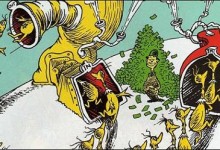
Is Charlie and the Chocolate Factory just another adventurous book written for children or could there be a hidden lesson for Organizational Change Practitioners? In this article Cool Friend Filip Michiels shares his insights on Charlie’s adventures and tells us how he applied them as CIO of an HR services provider.

Some time ago, my children and I were watching the movie Charlie and the Chocolate Factory. The story, written by Roald Dahl, is about Willy Wonka and his chocolate factory.

Years ago, after rival chocolate makers sent in spies, disguised as workers, stole his recipes, Mr. Wonka had decided to send everybody home and to close the factory completely to the outside world. Since then, the gates remained locked. However, somehow the factory had resumed operations in complete mystery.

A Case For Change

One day, Wonka realizes that even though his business is good and stable, the knowledge about the operations of his factory would not be covered in case something happened to him. At the same time, being shielded off from the outside world, he fears losing touch with the evolving marketplace, as recent launches of new products had not always been that successful.

Thus he decides to hold a worldwide contest, in which five Golden Tickets are hidden under the wrappers of his candy bars; the prize for those who find them is a day-long tour of the factory and a lifetime supply of chocolate. But, the real reason Wonka has sent out these Golden Tickets is to find a child to be his heir, and carry on his work.

Five Change Agents

Five kids arrive:

1. Spoiled Veruca Salt had managed to get her father, a rich industrial, to buy as many chocolate bars as he could find on the market, to have his work force to open them one by one looking for a golden ticket, with no interest at all in the chocolate itself. Veruca attempts to take one of Wonka’s nut-cracking squirrels for her own and is thrown down a garbage chute.

2. Violet Beauregarde, a very successful and competitive kid, whose only ambition is to be better than any other kid at whatever she does (as with finding the golden tickets). Violet blows up into a blueberry after consuming experimental chewing gum and has to be taken to the Juicing Room to get the juice out of her.

3. Mike Teavee, a wiz computer geek kid, who had developed a computer analysis algorithm to determine from all production runs which chocolate bar would hold a golden ticket, without even eating chocolate himself. Mike is shrunk after meddling with dangerous television equipment and has to be taken to the Taffy Puller to be stretched back to normal.

4. Gluttonous Augustus Gloop eats that many chocolate, so he could not get any other than one of the five bars holding a golden ticket in his hands. From the minute Augustus steps into the factory he blindly starts eating and tasting anything he can get hold off. Eventually, Augustus falls into a chocolate river and is sucked up a pipe to the fudge room.

5. Charlie Bucket, a nice boy from a poor family, lives with his parents and both sets of elderly grandparents. From these four, especially Grandpa Joe (a former Wonka employee), he hears stories about the candymaker Willy Wonka and the chocolate factory he built in Charlie’s hometown.

From the minute Charlie steps into the factory, he starts questioning Wonka about his work force, methods, ingredients and so on…and tells him about all he learned about the factory from his grandfather.

Finally, Wonka announces that Charlie has “won.” He receives the entire factory and will take over the company after Wonka retires.

The Takeaway for Organizational Change Practitioners & CIO’s

A while ago, the organization I had recently joined faced similar challenges as Willy Wonka did: there was a growing gap between the IT department and the business needs. However, in a services environment business and IT alignment is absolutely crucial.

Apart from being very busy at all times, nobody really knew what the IT-people where up to, what they were working on, which priorities they followed or whether it was what the business most needed.

On top of that, most of the knowledge was trapped in people’s heads and within a growing organization this became more and more a continuity risk.
I was the lucky one who drew the golden ticket to tackle this…

Here We Are. Now What?

Below is the presentation that summarizes the ‘Charlie Bucket’ approach – as I now like to call it.

It turns out that there are five ways to go about with this challenge. And that ‘Aha’ moment I experienced while I was watching Charlie’s adventures turned out to be very beneficial in choosing the right approach:

1. Maybe we could have used (big) money to create a whole new set-up entirely replacing what existed (people, procedures, systems,..) ? I am sure that is what the Veruca Salts would do.

2. Or were we the unlucky ones who had attracted all the dumb IT professionals from the marketplace, so replacing all of them with Violet Beauregardes (all new and bright talents from the outside) would do the thing…

3. Or would it have been wiser to look solely at technology – maybe our organization was just victim of running old outdated rubbish and wheeling in bleading edge new high techs offered by the Mike Teavees of this world was what we needed?

4. Another option would be to do it Augustus’ way, having a go at anything we encountered next, just having a taste of it, changing it a bit, but not finishing at all before tasting something new?

5. Instead, I told my Willy Wonka to take the Charlie Bucket approach: first learn about the current set-up, get as much information possible, before determining a strategy.

In brief: work with the existing organization to accomplish our goals, led by a clear objectives, a very open and continuous communication, with lots of room for participation and a strong buy-in from the whole organization.

Free e-book: 20 Shortcuts on Organizational Change

Tuesday, April 13th, 2010

If you would ask me to summarize our field of expertise in 20 points, this e-book would be my answer. It contains my personal view on the basics of Organizational Change Management.

I use it as a companion to my trainings on Change Management because I don’t do PowerPoint. I do People instead.

You will note that the pages of this e-book can be used separately – that is: one shortcut per page.

You will find out about my heroes, big and small. Thinkers and doers. Hard and soft. Rational and off the charts. So in a sense this e-book tells a little bit of who I am.

Please use it for your own learning and teaching and pass it on in your emails, blogs and tweets.

Consulting 2.0

Sunday, November 29th, 2009

What would our sector look like if we gave our value proposition a little twist? What would the results be like? The difference a subscription makes over a contract … “When you change the way you look at things, the things you look at change

Until recently I thought that there was no alternative for ‘consulting as we know it’: onsite, full-time, fixed-rate, and mostly during office-hours. As it happens my net value as a knowledge worker varies according to the challenge at hand: sometimes I am solving a problem; other times I am filling a gap in operations and sometimes I invoice idle time (that frustrates the hell out of me).

The Switch

Knowledge follows different rules than a tangible product. If we want to get more value out of my services as a knowledge worker, we should use it differently: by means of a ‘subscription’ instead of a ‘contract’.

Let’s have a different look at the way knowledge workers go to market. In management science the elements of the marketing mix are often referred to as ‘the four Ps’: Product, Price, Place and Promotion. Because this model came into existence for selling tangible products, I have added a different emphasis as I address the 4 P’s below:

1. Product: Knowledge

Building a stock of knowledge made sense in a stable world. But in this rapidly changing world an inventory of knowledge gathers dust: the problems we face today cannot be solved with the knowledge of yesterday. The warehouse value of knowledge is close to 0.

The good news: knowledge gets better when it is shared and used where you need it and when you need it.

What if we used consultants no longer for building an inventory of knowledge and more for solving today’s problems?

2. Price: Value in Hindsight

For consulting, training and facilitation you can’t know in advance whether an intervention will create value. Sometimes it does, sometimes it doesn’t. And sometimes it exceeds expectations. The value of knowledge always appears in hindsight.

What if we agreed on the price of consulting after delivery? The price you pay is the value in hindsight. Instead of a proposal upfront we agree on added value afterwards.

3. Place: Plug-in

Let’s face it: most knowledge workers are not performing 100% every hour of the day. But at specific moments we perform 200% or 300%. That’s when we make the difference.

What if you could hire consultants at the moments when they make a difference? Plug-in when peak performance is needed, both onsite and online.

4. Promotion: Only the Knowledge you Care About

Customers who are satisfied with my services tell their friends. Don’t tell your friends when you paid me too much for a problem that was not fixed. Tell me. I will learn and in return you don’t pay.

What if you only paid when you were satisfied? ‘No cure, no pay’; that is: zero for online work and only the expenses for onsite work.

Old Wine in New Bottles

OK, now let’s imagine – only for a second – that this model would work and that the mainstream of all self-employed knowledge workers would switch over to consulting 2.0. What would be the consequences?

What About Parasites?

What if customers abuse you in order to get the value and then rate your services as bad so they can catch free rides? Rationally speaking I would be selling myself out of the market in no time.

But I’m an economist and I happen to remember Adam Smith, who is widely cited as the father of modern economics. In his work The Theory of Moral Sentiments, published in 1759, he critically examined the moral thinking of the time and suggested that conscience arises from social relationships.

In short: customers who are satisfied may give you a hard time, some will take a free-ride, but the majority will gracefully put the money where their mouth is.

And the other customers? You let them go as they continue to build a bad reputation for themselves.

Market Dynamics

In these times of ‘open source’, ‘open code’, ‘open access’, ‘open licenses’, etc. I consider it rather dangerous to go to the market with a ‘closed’ mindset.

‘Open contract’ is the answer for launching consulting 2.0. Again, this is not a new idea as the same Adam Smith mentioned it in 1776. That’s when he published The Wealth of Nations, in which he introduced the idea of an invisible hand to describe the self-regulating nature of the marketplace.

The point is that ‘open contracts’ will remove impediments for the market to tell you what you are good at. As an example, take the partner of a big consulting company that I met about a year ago. His philosophy is to say yes to every customer request for services, ‘and then I work my way out, because the customer will pay anyway’. This person is in for hard times in the new pricing model: No cure, no pay.

The market will tell you what you are good at and vice versa. To put it in the words of Adam Smith:
“It is not from the benevolence of the butcher, the brewer, or the baker that we expect our dinner, but from their regard to their own self-interest. We address ourselves, not to their humanity but to their self-love, and never talk to them of our own necessities but of their advantages.”

Related articles:
- Good Lemonade – February 16th, 2008
-
Web 2.0 includes Invisible Hand – June 29th, 2009

Important note:
All the credits for this idea go to
Martijn Aslander, a guy from the Netherlands who calls himself a lifehacker.

! ! ! EXPERIMENT ! ! !
Contribute to a mindmap on Consulting 2.0
- 04-Dec-2009 -

This article has caught the attention of a lot of people who came back with tons of questions. Seems I hit a nail but did not get to the bottom of the concept.

Therefore:
- Do you want to edit the mindmap online and lean in on the discussion? Let me know your email address and you’ll receive a mail with the link to EDIT the mindmap on the MindMeister platform;
- Are you skeptical but curious anyway? Let me know your email address and you’ll receive a mail with the link to VIEW the mindmap on the same platform

And here is my word: I will not use your email for any other purpose than having you access the MindMeister platform.

Thanks!
luc[dot]galoppin[at]reply-mc[dot]com

Smart Consultants? (Part 2)

Monday, July 27th, 2009

Another research on the critical factors that determine our performance. Although not as scientifically significant as the research of professor Gardner that I mentioned last week; Organizational Change Practitioner Jim Markowsky decided to ask his colleagues how they would define success.

He launched the question: "What is the single most important trait of a successful Organizational Change Consultant in today’s economy? Please only list one!". From the 70+ responses he distilled the below list. Participants were members of the Organizational Change Practitioners group on LinkedIn – a group of over 5.000 global OCM professionals. Frequency shown in brackets:

1.(4) Agility – intellectual fleetness of foot; adapt on the fly; fluidity; adapt to internal and external environment; be as good at Plans B, C, D, E as Plan A.
2.(4) Listening – generative listening; discovery by listening and collaborative thinking; without it you cannot start the change journey; the client will tell you.
3.(3) Confidence – positive body language, building it with client; attitude and behavior.
4.(3) Facilitating – generative thinking with client to see possibilities; of collaborative learning process.
5.(2) Questioning – requiring client to see themselves as they are and as they want to be; asking the right payoff questions.
6.(2) Results – we are paid to produce; what the client is paying for.
7.(2) Systems Approach – wear systems glasses.
8.(2) Truthfulness – integrity; bring up the difficult issues
   (1) All of the following:
9.Awareness
10.Billable
11.Chaos – comfort
12.Clarity – of focus
13.Communication – two way and ongoing
14.Conceptual and global thinking Dialogue – around tough and delicate issues
15.Directionally correct
16.Expectations – clarifying
17.Experience
18.Extraction – of salient points from client… reading between the lines
19.Faith
20.Flexibility
21.Gap analysis – utilization to implement needed changes
22.Influencing
23.Innovative solution – getting out of the safe zone
24.Integrity
25.Intentional – 100%, while radiating agility
26.Journey – preparation and setting expectations with client
27.Live and Practice Change – day in and day out
28.Observation – includes active listening
29.Opportunistic – there are opportunities during this downturn
30.Outcome – develop clear and concise with client
31.Patience
32.Perception
33.Persistence
34.Realism
35.Reflexivity – reflect and help client make sense of change
36.Saavy – navigation of the organization to get things implemented
37.Seeing – really seeing and not force-fitting
38.Sense-making – in complex situations
39.Synthesis – process and activity
40.Teamwork – collaboration
41.Tenacity – in the real value of the end state
42.Vision – ability to hold
43.Wisdom – to see the truth


Smart consultants?

Tuesday, July 21st, 2009

In a recent working paper of Harvard Business School, Heidi Gardner suggests that staffing your project with high level performers is necessary but not sufficient to get the job done. Instead of focusing on the mere presence of consultants, the emphasis should be on how well you are using their expertise. That’s right: we are talking workplace dynamics here; the secret interpersonal ingredient that marks the difference between compliance and performance.

Symptoms
‘When will accurate expertise recognition lead to effective utilization?’ Gardner went out to identify and examine the critical factor that influences team members’ willingness and ability to perform. She focused on a sample of 82 accounting and consulting project teams from a Big 4 audit firm. Gardner’s research findings suggest that teams facing performance pressures tend to default to high-status peers at the expense of using team members with deep knowledge of the client, resulting in poor team performance. She concludes by stating that there is a paradox affecting teams’ use of members’ knowledge: ‘the more important the project, the less effective the team’.

This research is a painful reminder of something every consultant knows: the customer would be better of if we wouldn’t be so shortsighted, egocentric and above all: hierarchically conditioned. For example, Gardner’s research highlights that the extent to which consultants master client-specific expertise is significantly related to customer retention. This includes all the skills and interpersonal relationships that are associated with a particular client and knowledge of the business!

Diagnosis
The trouble is that this deficiency seems to be built in – just like a deficient chromosome of the consulting gene. A consultant needs to be the ‘best individual’ in order to make a good career within a firm. This deficiency, which is instigated by the classic ‘up-or-out’ virus that is commonly known as the ‘one best way’ to manage a professional services firm, works against the dynamic of sharing knowledge among peers and connecting with the customer. In the end, consultants become exactly the way their companies hire, manage, appraise, reward and develop: smart individuals with an underdeveloped literacy on the level of knowledge sharing and customer involvement – not to mention: a lack of PASSION!

Therapy for the deficient consultant gene
What should consulting companies and customers do in the face of this diagnosis? Using the Michigan model of HRM, this diagnosis is easily translated into a cure.
1.) Selection: Hire smart consultants, not their ego: Teams that more effectively utilize their members’ general professional expertise will have higher client satisfaction;
2.) Performance: Make them work hand in hand with the customer: project and team organization matters! Teams that more effectively utilize their members’ client-specific expertise will have higher client satisfaction
3.) Appraisal and Rewarding: Set performance indicators that measure and reward team performance, community participation and customer retention instead of individual performance or individual certification in any domain.
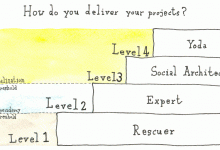
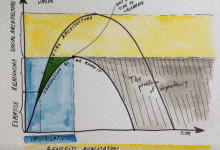
4.) Development: It is no secret anymore that being a social architect is valued more and better in terms of customer satisfaction and overall project performance than being the expert. So the investment on the level of learning should be at least as high in consulting skills as in subject matter expertise.

So this is to the classic up-or-out managers that’ are populating the senior ranks of today’s consulting companies: you are so dead! – and my gut feeling says that this working paper is only the beginning of scientific evidence!
________________
Source:
Feeling the heat: The effects of performance pressure on teams’ knowledge use and performance, by Heidi K. Gardner – Working Paper 09-126 – Harvard Business School.

Related articles:
-
Music and Management Consulting – September 27th, 2008
-
Open Letter To My Colleagues (Incl. Myself) – August 13th, 2007
-
One, Two, Three, Seven?! – April 15th, 2008
-
2008 … Highway To Hell – January 5th, 2008

Pareto would have been a good project manager

Monday, June 1st, 2009

If things seem under control, you’re just not going fast enough. – Mario Andretti

Vilfredo Pareto is the father of the Pareto Principle, also known as the 80/20 rule. Pareto noticed that 80% of Italy’s wealth was owned by 20% of the population. He then carried out surveys on a variety of other countries and found to his surprise that a similar distribution applied.

As a matter of fact, the same distribution applies to project management. I tend to look at projects as a lifecycle of different phases. I theory they are sequential. However, in real life none of the phases are completely over until the full project is finished. But each phase is dominant at a particular time.

As you can see in the drawing below, even when the project is officially in the design phase, some activities belonging to the previous and next phases, such as project setup and deployment, will be going on as well. Generally speaking, 80% of the work you are performing belongs to the official project phase you are in, and the remaining 20% of the activities belong either to the previous or the next phase.


[CLICK ON THE DRAWING TO ENLARGE]

In real life, projects are a sequence of non-discrete project phases. Certified nincompoops wearing a ‘PMP’ or a ‘PRINCE’ tag will have a hard time understanding the paradox that one can only close a project phase for the full 100% by moving to the next phase. Typically, the threshold is at an 80% completion rate. The best way to complete the remaining 20% is not by sticking to that phase, for you will be wasting 80% of the resources and the same share of momentum.


[CLICK ON THE DRAWING TO ENLARGE]

The point is that moving on simply keeps you with both feet on the ground because you will immediately face the constraints of the next project phase. And it is exactly these down-to-earth and real-life constraints that will allow you to complete the remaining 20% of the previous phase. Those who fail to understand this principle will be stuck in theoretical discussions and should be prepared to lose momentum.

Therefore, each time you are reaching 80% completion of a certain project phase, you should ask yourself 3 questions:
1. How much value am I adding by completing the current phase and not yet starting up the next phase?
2. How much value am I wasting by doing so?
3. How will I redistribute my resources: time, money, manpower and attention by switching phases?

Related article:
Good Wine Needs No Bush – February 18th, 2008

Do I need to paint a picture? SAP and Learning!

Saturday, December 20th, 2008

When it comes to implementing SAP, there is a large gap between what users need and what consultants think they need.  The drawing points out the difference between Training (restricted to the classroom) and Learning (anything that is needed to prepare a user) by looking at the question: “Where is the knowledge users need when they start using SAP from scratch?” (Click on the drawing to enlarge.)

Regular readers of this blog know that you can’t blame the consultants for missing out the largest part of the iceberg… after all, they are only ducks – unable to spot what could possibily be going on below the surface.

Music and Management Consulting

Saturday, September 27th, 2008

The below video shows a concert by Bobby McFerrin, the world famous vocalist of the tune “don’t worry, be happy”. We can see how he gives the Gounod version of Bach’s Ave Maria a new dimension. The way he does it is quite remarkable and simple at the same time: he makes the audience contribute to the performance.

Regular readers of this blog know that I like to make far-fetched comparisons. This post is no exception as I contend that McFerrin’s performance is a showcase for all management consultants. Anyway, in this performance he shows us what contribution is all about: he sings the marvelous undertones of the Bach melody and he inspires the public to take the central stage and sing the melody. This results in an extraordinary experience for both, the artist (whom I would compare with the management consultant) and the audience (whom I would compare with the organization).

As I have stated in a previous post (Open Letter To My Colleagues (incl. Myself)) management consultants should know that their place is in the chair of the play director. On stage is the customer and any intervention on their behalf only makes the customer weaker and their ego stronger.

As the movie shows, McFerrin has found the key to a better customer experience: moving the stage over to where the customer is. The key element is of course contribution and involvement. As you can see it takes a gentle nudge and some instructions. But most of all it takes a consultant with leadership traits: decisive and determined that it will work.

A mediocre management consultant knows which actions are needed in order to get the job done. He will perform the job well and deliver the result to the customer. Just like a good performer he is entitled to applause of the audience and his invoice will be paid.

The excellent management consultant knows how to make the customer get the job done. He will not perform the job but create the context for the customer to perform the job and to continue doing that when he is gone. Like an excellent director, he applauds for his performer and coaxes the performer into the best conditions for an excellent performance.

Sometimes it’s Not Resistance

Monday, June 2nd, 2008

This is the title of a paragraph in Peter Block’s book ‘Flawless Consulting’. He warns against the paranoid habit of some consultants interpreting every line manager’s objections as resistance. Resistance is often a label used by consultants who want to be right – in spite of the customer relationship.

Here’s a quote of that paragraph:

As Freud once said when he was asked whether the cigar he was smoking was also a phallic symbol, “Sometimes a cigar is just a cigar”; sometimes client objections are not resistance. The client just doesn’t want to do the project.

We can all become paranoid by interpreting every line manager’s objections as resistance covering some underlying anxieties. If a manager says directly, “No, I do not choose to begin this project. I don’t believe in it”, that is not resistance. There is nothing in that statement that blames the consultant or presses the responsibility for the difficulties on the consultant. The manager is taking responsibility for his or her own organization and has a right to choose. If we think it is the wrong choice, well that’s life.

Consultants Conversation
We are getting paid to consult, not to manage. If a manager says to me, “I am too vulnerable a position to begin this project now”, I feel appreciative of the direct expression. I know where I stand with that manager. I don’t have to worry whether I should have done something differently. I also feel the manager understands the project and knows the risks, and it turned out that the risks were just too high. I may be disappointed that the project didn’t go, but the process was flawless.

As I said before, you should always suspect yourself first before jumping to conclusions, like the two consultants above are doing…

Execution: Organizational Change Management in Practice

Sunday, April 20th, 2008

In an earlier article I have argued that Organizational Change Management is a discipline and not a leisure activity. Here I would like to focus on the part where it gets real: execution and how to get all that stuff done in practice. In short: in order to be successful, organizational change efforts are not exercises in democracy but rather military deployments. This article builds further on that military metaphor to clarify my point.

Lessons Learned from Silicon Valley

In the chapter "On The Beach" of his 1993 book Accidental Empires, Robert Cringely talks about the three distinct groups of people that define the lifetime of a company: Commandos, Infantry, and Police. Whether invading countries or markets, the first wave of troops to see battle are the commandos. A start-up’s biggest advantage is speed, and speed is what commandos live for. They work hard, fast, and cheap, though often with a low level of professionalism, which is okay, too, because professionalism is expensive. Their job is to do lots of damage with surprise and teamwork, establishing a beachhead before the enemy is even aware that they exist. Ideally, they do this by building the prototype of a product that is so creative, so exactly correct for its purpose that by its very existence it leads to the destruction of other products. They make creativity a destructive act.

Grouping offshore as the commandos do their work is the second wave of soldiers, the infantry. On big projects these are the multitudes of ‘big 5′ consultants who get the job done: blueprinting, designing, testing, training, collecting and cleansing data, etc. The most important thing here is that an infantry takes on a structured approach. In the words of Cringely :
"While the commandos make success possible, it’s the infantry that makes success happen. These are the people who hit the beach en masse and slog out the early victory, building on the start given them by the commandos. [...] Because there are so many more of these soldiers and their duties are so varied, they require an infrastructure of rules and procedures for getting things done."

What happens then is that the commandos and the infantry head off in the direction of Berlin or Baghdad, advancing into new territories, performing their same jobs again and again, though each time in a slightly different way. But there is still a need for a military presence in the territory they leave behind, which they have liberated. These third-wave troops hate change. They aren’t troops at all but police. They want to fuel growth not by planning more invasions and landing on more beaches but by adding people and building economies and empires of scale. They can’t even remember their first- and second-wave founders.

UN Peace Keeping Troops

To my experience, this same distinction applies to big organizational change projects. However, in order to make this approach effective in that context, Cringely fails to notice that you need UN Peace Keeping Troops between the infantry and the local police.

Once your prototype is ready to be tested, you will find that UN Peace Keeping Troops are quintessential in order ‘to get organizational change management done’. This is the fragile process of handing over knowledge from project agents (infantry) to the target users (police and citizens) and to manage the process of political buy-in. 

In most of the SAP projects where I am involved we call them ‘local coaches’ or ‘transition teams’ They manage the fragile process of handing over knowledge from project agents to the target users. Their only purpose is to stabilize the new order and eventually to hand over to the local peacekeepers: the police.

A Best Practice from SAP Implementations

The below drawing shows a model that I would tag as ‘best practice’ because I have been refining it over the course of multiple projects. The yellow boxes indicate the basic principles we want to achieve.

drawing-un-troops.jpg

Examples of typical coaching assignments include the following:
– Attaching people to new functional roles and having the subsequent trainings validated
– Communicating the vision and strategy and translating these to the level of the site (‘does this make sense to you?’)
– Communicating the future processes and highlighting the what’s in it for me (WIIFM)
– Local testing of processes
– Implementation and follow up of key performance indicators (KPIs)
– Following up data collection and data cleansing
– Supporting local training initiatives and evaluate the learning of the users after they went to training
– Assisting with the local technical systems deployment

The most important thing is to note that underneath these examples are some fundamental ’soft’ returns on investment:
– By their physical presence and time they spend locally the coaches can do the job of ‘handholding’ that is necessary in times of change
– They provide psychological safety by translating the central concepts to local practice
– UN Peace Keeping Troops leverage the impact of the experts in the central team on a local level because they have direct access to all implementation team members
– If you gather them on a weekly basis and if you facilitate their weekly meeting, they will accelerate best practices and stick to common standards.

UN Peace Keeping Troops need to be there to prevent simple things from going wrong and to help people make their first small victories in ‘real life’.