


Archives


Web 2.0 includes Invisible Hand
Over the past week I experienced that the good old brainstorming techniques that are derived from de Bono’s Six Thinking Hats don’t need a nudge in the Web 2.0 age.

Stakeholder management is dead – Announcing community facilitation!
Stakeholder management passed away June 20, 2009 surrounded by his family. He died of top-down-command-and-control disease. He was the widow of certified nincompoops. Born in theory to social scientists, he leaves his beloved children Dullness and Cognitive Dissonance. He is also survived by his grandchildren Workshop-till-you-drop, Toolkit-from-here-to-Tokyo and Audit-the-hell-out-of-you. He leaves behind numerous devoted flipchart […]

Parenting as a Management Skill … Huh? (part 5)
We don’t need to attend the courses of prestigious business schools in order to discover the essence of change management.

Healthy Meetings
Last week, someone made me aware of the fact that a 4 hour meeting we attended with 30 persons accounted for almost one man-month. Unfortunately, it never says so on the invoices or the time-sheets of the participants.

The Anatomy of an Apology
I am currently reading The Manager’s Book of Decencies – How Small Gestures Build Great Companies, by Stephen Harrison. Actually, it is more a field guide than a book, because it’s packed with real-life examples of decencies that result in major business impact, and that you can put to use in your company. Examples include: […]

Exactly HOW can I be Responsible for the Communication?
Some things in life are too simple to be true. Take for example the most effective tools that allows people to be responsible for relationships. Hint: they are available to all human beings.
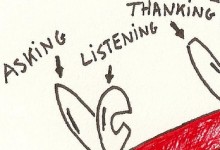
Who is responsible for communication?
If you want to know who is responsible for communication, have a closer look at the meaning of ‘responsibility’.
What on Earth are we Communicating for?
What should be the result of successful communication? In this article I am building further on earlier insights about the format and the quantity of communication. Now it is time to dive into the qualitative aspect.
Emergency communication
In all projects, sooner or later, the question of ’emergency communication’ comes up; i.e.: how do we communicate when there is an emergency? My answer: the same way – just faster. If you are communicating well in normal times, the odds are that you will be just fine in the case of an emergency. With […]
Feedback takes Courage
“You are NOT paid for wasting your time with performance evaluation. You are here to do your bloody job!”.
Apparently, those are the words of a senior program director my friend Christopher bumped into while checking out the idea of evaluating the performance of the consultants of his team.