

Archive for the ‘Chris Anderson’ Category

Welcome to my Bell-Shaped World

Tuesday, August 31st, 2010

Take a seat on the other side of my eyeballs. You will discover that I look at the world through a pair of bell-curve-shaped lenses. I keep tinkering until they make sense. So there you go: Ten Tinkered Bells!
It all started in 1809, when Carl Friedrich Gauss published the monograph  “Theoria motus corporum coelestium in sectionibus conicis solem ambientium” (now repeat that one more time with your eyes closed…) where among other things he introduced the normal distribution. This is a bell-shaped curve where most values cluster around a mean, while outliers can be found above and below the mean.

For example, human height often follows a bell  curve, with outliers who are unusually short and tall and the bulk of people being concentrated around a mean height, such as 70 inches (178 centimeters) for American men. When data which follows a normal distribution pattern is graphed, the graph often resembles a bell in cross section, explaining the term “bell  curve.”

These Normal or Gaussian distributions can be found in a wide variety of contexts, and if you ask me: they are everywhere! As you go through these 10 bell-shaped thoughts you will note that I am recycling some stuff I have published over the past three years. Also, I am mixing in some new elements. Old wine in new bottles if you will – but for me it does the trick.

1. The Diffusion of Innovations

What is it?


For starters, in a 1962 book called The Diffusion of Innovations, Everett Rogers stated that adopters of any new innovation or idea could be categorized on a classic bell-shaped curve as described here:

  • Innovators (2.5 %) Venturesome, educated, multiple information sources, greater propensity to take risk;
  • Early Adopters (13.5%) Social leaders, popular, educated;
  • Early Majority (34%) Deliberate, many informal social contacts;
  • Late Majority (34%) Skeptical, traditional, lower socio-economic status;
  • Laggards (16%) Neighbors and friends are main information sources, fear of debt.

Why is it important?

If you are about to introduce and organizational change you will find the exact same diffusion of crowds inside organizations.

How do I use it?

In short: I use it as a compass. Rogers found out that this diffusion – and these proportions form a reliable pattern. Therefore, this chart gives me patience and reassurance in difficult moments.

Imagine you have just kicked off an organizational change program and you get nothing but very bad reactions. Of course there is some feedback in there, but chances are that you just landed your change vehicle in the middle of the laggards’ nest. So stay positive and keep looking for the other slices of the curve!

2. The Chasm

What is it?


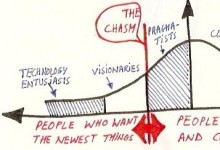
Building further on Rogers’ observations, Geoffrey Moore’s key insight is that the groups adopt innovations for different reasons. According to Moore, early adopters are technology enthusiasts looking for a radical shift, while the early majority wants a productivity improvement. Both groups are divided by a chasm. According to Moore:

  • Technology Enthusiasts (Innovators) are explorers;
  • Visionaries (Early Adopters) are more geared towards exploitation. They are not especially bothered by the fact that the product doesn’t work. They are willing to make it work;
  • Pragmatists (Early Majority) want a product that works. They want a 100% solution to their business problem. If they get the 80 % that delighted the visionary, they feel cheated, and they tell their pragmatist friends;
  • Conservatives (Late Majority) buy products because they really have no choice. They are not reassured by having books about the product, because the existence of books implies the product isn’t simple enough to use. Conservatives will not tolerate complexity;
  • Skeptics (Laggards) are not going to buy, though they may talk other people out of buying.

Why is it important?

Now that we know that different crowds come to the surface each time you introduce a change, Moore’s observations tell us where the real challenge lies: crossing the chasm; i.e.: winning the hearts and minds of the 85% who want solutions and convenience. The problem in crossing the chasm is that the visionaries aren’t good references for the pragmatists. They provide tales of heroics. Pragmatists want references from other pragmatists.

How do I use it?

In short: I use it to keep my head out of the clouds and to get my feet on the shop floor. It is obvious that the innovators and the early adopters will never oppose or object the changes you are implementing. Another word for the left hand side of the chasm is a project cocoon: a safe group of like-minded people. On the right hand side of the chasm you will find people who want solutions and convenience. And they represent 85% of your target population!

The challenge of organizational change management is to get your ass to the other side of the chasm. And it takes a great deal of emotional intelligence to cross the chasm. The interactions you have at the other side increase the quality of the solution you are building – to the same extent as they are grinding your nerves. Just remember: the best work is done with the heart breaking or overflowing.

3. The Tipping Point

What is it?


In his book The Tipping Point: How Little Things Can Make a Big Difference, Malcolm Gladwell investigated what determines the moment of critical mass, the threshold, or even the boiling point of a marketing effort.

Wikipedia describes it even better: “the levels at which the momentum for change becomes unstoppable.”

Why is it important?

Once you hit a tipping point all the dynamics change. All of a sudden your product, idea or trend you have been pushing starts spreading like a virus. What once seemed impossible now all of a sudden has become unstoppable. Inexperienced project managers are often taken by surprise when the tipping point pulls them into an ugly acceleration.

In times of ugly acceleration hanging on to control will kill you. Experienced project managers know that ‘control’ is the way to the tipping point, but they also know that they need to switch to coordination and trust once their project becomes unstoppable.

How do I use it?

In short: managing expectations. I integrate the expectation of “ugly acceleration” into my approach. Tipping points are points of no return – the very times when procrastination ends. From here on it’s action, so one should keep it simple and make sure to be on the same page.

Each project – big or small – has a tipping point, and it occurs when your deliverables hit solid ground: usability testing, user training, physical changes on the shop floor, etc.
That is when you meet the pragmatists face-to-face. They want solutions and convenience. You no longer need to tell WHY the program exists. Instead, you are prompted to explain in detail HOW it is going to work. They won’t let up until it makes sense to them.

Wanna know another lesson learned? Don’t over-promise. It is painful to be applauded for announcing or demonstrating a feature only to discover it won’t be part of the solution. Trust me: on large scale projects this happens all the time.

4. Broken Windows Theory

What is it?


The broken windows theory is a notion that comes from the same book by Gladwell. Consider a building with a few broken windows. If the windows are not repaired, the tendency is for vandals to break a few more windows. Scientists in the field of criminology found that disorder invites even more disorder and that a small deviation from the norm can set into motion a cascade of vandalism and criminality.

Why is it important?

Litter encourages more litter. A broken window is a crack that allows negative behavior to slip in. And human beings are herding animals: we resonate to the influences nearest at hand.

As Gladwell notes: “Why was the Transit Authority so intent on removing graffiti from every car and cracking down on the people who leaped over turnstiles without paying? Because those two trivial problems were thought to be tipping points-broken windows-that invited far more serious crimes“.

How do I use it?

People who work with me know that I’m a neurotic when it comes to broken windows. When I see a crack, I want to repair it instantly. Right now. An unpleased customer, a deliverable missing a beat, a target group we forgot to involve, or resistance brewing underground (mostly you pick that up accidentally standing by the coffee machine).

Attention here: fixing a broken window is not the same as denying it. Saying it ain’t so won’t solve the tension; neither does jumping to conclusions. Fixing the broken windows of dissatisfaction is done with respect instead of judgement. The broken windows theory reminds me to be sensitive for cynicism and indifference and to provide platform for these emotions to turn into contributions.

Final note: the strange thing about change management broken windows is that they are best fixed by the inhabitants. Your role is to spot them and to provide the means, the time and the space to do so.

5. The Red Monkey

What is it?


Jef Staes introduced the concept of a red monkey. According to the latest insights in biodiversity, new species do not start in the middle of a forest but at the edge. At the edge! – where different species from different ecosystems ‘meet’. That’s when Jef created a metaphor of a brown monkey from the jungle who meets a red fish from the sea (an adjacent ecosystem). Through their conversation a new confrontational idea is born: a red monkey.

Why is it important?

What would happen if that confrontational idea would be dropped in the middle of the jungle? It would be killed immediately. Jef notes that the same thing happens with confrontational ideas that are ‘dropped’ in the middle of an organization … they get killed as well. Innovation ‘never’ starts in the middle of an organization but on the edge, where ecosystems meet.

By default your red monkey disturbs the balance in people, teams and organizations. It tilts the stability of an ecosystem, and therefore it will get killed if there is no critical mass to protect it in order to survive and mature.

How do I use it?

Think of red monkeys as your next innovation project. And think of yourself as the one responsible for its survival. It takes a serious amount of conflict handling skills to coax a red monkey to the right hand side of the chasm. This is a step-by-step process and it requires a different view on resistance. One thing is sure: you should start at the edge and move gradually to the middle.

When I look at my job that way, I tend to see it as a vocation and myself as a linchpin instead of a cog. And this – in its turn – radically influences my persistence and the quality of my work.

6. The Elephant Dilemma

What is it?


Just like Jef Staes constructs theories involving monkeys, I do the same thing with elephants. It started when I was attending a phone conference that lasted too long. I started drawing randomly and without knowing it uncovered an elephant out of my favorite bell-shaped curve.

Why is it important?

In all organizational change programs there is a moment when the work ahead looks so massive that you don’t know where and how to start. Those moments are paralyzing and you feel pretty small. Project managers refer to this situation as the ‘how to eat the elephant dilemma’. The elephant is hidden in the target population and the chunks of the elephant are the audiences that you encounter while introducing a new product or initiative.

The secret?  On the drawing above you go tail first: making sure that the innovators and the early adopters (most of the times this is your own core team and the sponsor of your program) get through that change cycle first. Once you have won their minds and hearts they will help you to attack the next big chunk: the pragmatists (these may be key users or testers of whatever you are implementing) and so on.

How do I use it?

The elephant reminds me that I can shape the path of the project just by channeling the emotions and the energy towards the main deliverables. If you think people will whine or be angry you should make sure that they ‘whine forward’ or ‘complain forward’ People make sense of the change as they react to the prototype of your deliverables.

The solution is to provide a series of deliverables that people can shoot at, nicely ordered in the same direction: forward. Not only will this improve the quality and the accuracy of the deliverables, it will also get their minds in motion and their noses pointed in the direction of the program.

7. Warcraft Wisdom

What is it?


In the chapter “On The Beach” of his 1993 book Accidental Empires, Robert Cringely talks about the three distinct groups of people that define the lifetime of a company: Commandos, Infantry, and Police.In my opinion these forces all represent the management styme that is needed as you progress through the lifecycle of an innovation.

For instance, the destructive (literally: ‘ground-breaking’) work of commandos who prepare territory for the infantry is described by Robert Cringely as follows: “Commandos parachute behind enemy lines or quietly crawl ashore at night. Their job is to do lots of damage with surprise and teamwork, establishing a beachhead before the enemy is even aware that they exist.”

This is exactly how difficult and large change projects kick-off: they have been planned and budgeted for long before they officially kick-off. Once the path is cleared, changing can start. Now you will need an infantry of agents to get the job done: blueprinting, designing, testing, training, collecting and cleansing data, etc.

Finally, the new structures are in place, you will find that there is still the need for a military presence by means of local coaching (often referred to as ‘hypercare’). These are the UN peacekeeping troops, a remainder of the infantry (note: you will find nothing about UN peace keeping troops in Cringely’s book – please allow me to stretch the concept). Their only purpose is to stabilize the new order and eventually to hand over to the local peacekeepers: the police.

Why is it important?

You need a commando style in order to create the circumstances for change.  Whether it is to obtain commitment for blueprinting, design, testing, training or go-live, without the commando actions the efforts will be ignored as long as there is no pressure or hard evidence that things will change.

For the infantry the most important thing here is to take on a structured approach. In the words of Cringely: “While the commandos make success possible, it’s the infantry that makes success happen.”

How do I use it?

The one thing to remember is that it takes different team styles: the commandos are the agents that make success possible, the infantry make success happen and UN peace keepers and police are needed to refreeze the new structures and habits like a stabilizing force.

8. Mapping the Added Value

What is it?


After reading Seth Godin’s Purple Cow, blogger Thomas Baekdal wrote a wonderful piece on what you should plan, do and support. He calls for a strategy with 4 layers: plan and prepare for the future, work in the present, support what you did yesterday, and ignore out-of-date ideas. To illustrate this, he tops the bell-shaped curve with a value curve.

Why is it important?

The value curve illustrates where you should focus your energy and resources. If you want to be successful, then most of your time must be spent on what Baekdal calls ‘the next thing,’ and the rest should be maintained and automated to the best of your abilities.

How do I use it?

This is what your project plan should look like from a time management perspective:

  1. Actively devote attention to your future plans and test out new ideas
  2. Spend most of your time making sure that your deliverables cross the chasm and get picked up at the other side.
  3. Continue to support the project phases that you launched ‘yesterday,’ even if they are no longer an active part of your dashboard. As Baekdal puts it: “Answer people’s questions, provide tips and gently push them towards your new ideas.”
  4. Finally, you need to unhook your attention from the laggards (usually they are experts at sucking up your precious time for futile details that add no value what-so-ever.)

9. The Long Tail

What is it?


The long tail refers to the statistical property that a larger share of population rests within the tail of a probability distribution than observed under a Gaussian distribution. The term has gained popularity in recent times because it identifies the digital economy and the effects of the internet on business as we know it.

In his book The Long Tail, Chris Anderson does a very good job at explaining these dynamics in depth. According to Anderson, the internet flips some basic economic theories of Adam Smith, Vilfredo Pareto, Karl Marx and very basic concepts such as transaction costs, distribution, shelf space and (above all) scarcity.

Why is it important?

The long tail of normal distributions has changed since the internet mainly through three dynamics:

  1. The means of production are available to anyone in the digital economy;
  2. Transaction costs and shelf-space costs are close to 0 in this digital economy;
  3. “Wisdom of crowds”: your brand is no longer a logo or a slogan: it is the story your customers tell about your product.

The point is not that you should no longer try to get into the top position of big hits. Since the internet the niches have become the new big. But in order to survive in the niches you should be a platform for these niches instead of a final big hit destination.

How do I use it?

Being platform  (aka: ‘crowdsourcing‘)instead of a know-it-all destination is a good thing. Rather than seeking uniformity, and the full control of one single ‘hit’ destination, the long tail tells us it is better to be a platform for a crowd of alternative solutions.

10. The Three Strategies

What is it?


Building further NYU professor Clay Shirky’s statement that ‘Institutions will try to preserve the problem to which they are the solution.’ More specifically, Shirky refers to how the media industry is incapable of changing because they are solving the wrong problem.

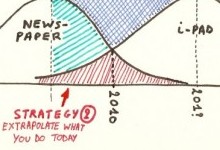
Let’s face it: newspapers are the solution to the problem of … news gathering and news distribution. AND THAT PROBLEM NO LONGER EXISTS. That inspired me to identify three strategies to cope with the reversed dynamics of the digital economy: No Problem, Extrapolating the Problem, and Reinventing the Problem from Scratch.

Why is it important?

Let’s take my favorite example: the dying newspaper industry. Nowadays if we all want news we simply go to Google to get it.  Who published it isn’t nearly as important to readers any more.  Nor is the packaging. There are 3 strategies for newspapers to react to the downturn in their business:

  • NO PROBLEM: This is where most newspapers and magazines are today: Do nothing unless the competition forces you to. Paper is the main business and the internet, well… because we have to.
  • EXTRAPOLATING THE PROBLEM: these companies know that printing will be out of business some day, so they just make the technical switch to a new medium (the internet and e-readers). However, they have fallen in love with the problem that no longer exists: they still view themselves as gatherers and distributors of news (and what sucks even more: they still package the news on these e-readers in ‘pages’ and ‘issues’ – a constraint that was due to the printing press!)
    Note on the drawing:  be careful here because this area splits in half:
    - The left part is EXTRAPOLATING the problem that no longer exists.
    - The right part is what one could call the LONG TAIL
  • REINVENTING THE PROBLEM FROM SCRATCH: Today’s problem is an abundance of news and a need to make sense of it all. So the future is to be a platform for sense-making. This will require the newspapers business to let go of their attachment to the producer-consumer model. Only then will they be able to search for new revenues and growth.

How do I use it?

To me these three strategies are a razorsharp analysis tool to separate wanna-be innovations from real innovations. The three strategies open my eyes to the fact that each product and each project has a lifecycle and that you have the choice to:

  • Do nothing and – to you own amazement – die at the end of the lifecycle;
  • Try out a new lifecycle but with both feet firmly anchored in your current world-view: you will never be a leader in your segment;
  • Take a risk; jump; and invent your own game.

11. What’s In a Bell?

As I was writing this article it became obvious that there is more to my bell-shaped world than this. Have a look at the following dilemma’s which somehow- will fit in a bell-shaped world, but I still need to map them on a chart to discover what is holding us back.

  • Money as an exchange mechanism versus the revival of the gift economy. Let’s face it: money has not been there since the beginning of business and trade. And in the beginning it came into being rather as a side-effect of some smart traders.
  • Fossil fuel versus renewable energy sources. How and when will we switch? Someone pointed out that this is a classical example of the prisoner’s dilemma. The prisoner’s dilemma is a fundamental problem in game theory that demonstrates why two people might not cooperate even if it is in both their best interests to do so.

Fascinating … to be continued!

(but I think it’s enough for now…)

Do I Need To Paint A Picture?

Monday, August 23rd, 2010

The Three Strategies for innovation.

Remember the three strategies I mentioned two weeks ago? This is how I prefer to map them visually.

Knowing that each product has a lifecycle, this chart shows what is happening to printed newspapers today. It is similar to what happened to analog photography and to the music industry some years ago.

1.) The Green area is where most companies are today. And this is also where they will die. I called this the NO PROBLEM strategy: complete denial.

2.) The Red area is where some companies are going today. Extrapolating the present. But be careful here: this area splits in half:

- The left part is EXTRAPOLATING the problem that no longer exists.

- The right part is what one could call the LONGTAIL.

3.) The Blue area is where real innovation and future employment resides. I called this strategy REINVENTING the problem.

Can you think of other examples?

(PS: thanks to @kodel for challenging me on this)

Oh, The Places You’ll Go!

Tuesday, July 6th, 2010

“If things start happening, don’t worry, don’t stew, just go right along and you’ll start happening too.”
— Dr. Seuss
As the Organizational Change Practitioner’s group on LinkedIn is about to reach 10.000 members, it’s time for me to look back and wonder how on earth the group got this big so fast? Sure enough, it is tempting to think that it’s all about me. But ego-centered games usually don’t last so long and don’t get so big.

Digital Natives and Digital Immigrants

I am sure you have come across these terms already. They are used to describe the division between generations who are connecting digitally and those who don’t. Unfortunately, most us think this is a generational gap. It isn’t. Today I saw a presentation indicating that the gap can even be split according to year of birth: 1980 seems to be the year of birth that indicates the great divide.

But age is irrelevant. Rather than talking about a generation gap, there is another difference: those who create, contribute and communicate digitally and those who don’t. In short: we are all digital natives once we decide to contribute digitally.

Trust Agents

“The stupidest possible creative act is a still a creative act.” says Clay Shirky, the most cited thinker on new media and digital economy. The thresholds for participating digitally have never been so low and not participating is no longer a matter of being too old or not being computer literate. Shirky underscores that the greatest difference between digital natives and digital immigrants is the difference between doing anything and doing nothing at all.

Chris Brogan, another icon of the digital age published a book in 2009, co-authored by Julien Smith, titled Trust Agents: Using the Web to Build Influence, Improve Reputation, and Earn Trust
The authors hand out practical advice for social media etiquette. And they make it all very tangible through the analogy of a cocktail party. They conclude that the internet and all of its tribes and communities is ultimately human because it rewards social behavior and punishes anti-social behavior.

The Bank Account

So the good old metaphor of the emotional bank account that is often used by Stephen Covey in his book The 7 Habits of Highly Effective People still stands. It’s like a financial bank account into which you can make deposits and take withdrawals.

The most important of all deposits into the emotional bank account of trust is empathy – and that is no different in the world of bits than it is in the world of atoms.

Covey defines empathy as: “listening to another person within his or her frame of reference. Empathy tells you what the important deposits are to that person.” And that is even more true on the internet.

The Platform

Of course, there are some principles you need to change in order to make things work in the digital age. That’s where Jeff Jarvis’ advice comes in. In his book What Would Google Do?
Jarvis explains some principles that would even make sense if we would also apply them in the non-digital world.

The first is to be a platform for other people to express their uniqueness instead of a big-hit-final-destination. Second, the insight that you don’t create a community but provide  elegant organization and then the community will let you help them (if you are lucky). You don’t own the community, so getting out of the way is a strength.

The Long Tail

Jarvis’ advice becomes clearer once you have a look at the dynamics and the mechanics underpinning the digital economy. In his book The Long Tail: Why the Future of Business is Selling Less of More, Chris Anderson does a very good job at explaining these dynamics in depth.

In short, there are three forces shaping the digital economy and they are bullwhipping the most fundamental laws of economics:
1. The means of production are available to anyone in the digital economy;
2. Transaction costs and shelf-space costs are close to 0 in this digital economy;
3. “Wisdom of crowds“: your brand is no longer a logo or a slogan: it is the story your customers tell about your product.

This means we need to review our basic understanding of transaction costs, distribution, shelf space and (above all) scarcity.

Is the Internet Making us Stupid?

The next question is the dumb-and-dumber question: is the internet sucking every bit of intelligence, education and sociability out of us? Again, looking at the generation Y’s and how they are most of the time behind a computer screen or any other device, it is tempting to say they are dumb and anti-social.

Think again, because what they are tapping into is way more intelligent, social and human than you can imagine. Here are three reasons why I think the internet is making us MORE INTELLIGENT:

1. Multiple Intelligence

First, in 2000 (!) John Seely Brown noted that the internet is the first medium to honor multiple intelligences. He invites us to have another look at literacy. In our narrow view of the world literacy involves only text, but there is also image and screen literacy. The ability to “read” multimedia texts and to feel comfortable with new, multiple-media genres is important.

According to Seely Brown, the new literacy, beyond text and image, is one of information navigation. My ability to watch TV does not exclude my reading abilities, just as my ability to tweet does not exclude my ability to have a decent conversation at the dinner table. They are all new layers of literacy that add up in out multiple intelligence. No need to be afraid of unlearning any skill.

As Seely Brown concludes: “Navigation” may well be the main form of literacy for the 21st century. In my humble opinion, this ‘navigation literacy‘ is being topped by  a new literacy: Collaboration Literacy.

2. The Medium Shapes the Message

Socrates worried about how writing affected the way ideas would be conveyed as opposed to speaking and conversation. Nietsche worried about how a typewriter would affect how his ideas would be conveyed as opposed to handwriting. A 2008 article of The Atlantic explains that the same is true for the internet:

“Never has a communications system played so many roles in our lives—or exerted such broad influence over our thoughts—as the Internet does today. Yet, for all that’s been written about the Net, there’s been little consideration of how, exactly, it’s reprogramming us.”

The internet as a medium shapes the message differently than offline. That much is true. But it does not make the connection poorer, nor does it make the participants dumber. The medium merely opened another can of possibilities.

3. Cognitive Surplus

In the below TED talk Clay Shirky takes the example of the platform Ushahidi to explain what he calls Cognitive surplus. In short: “Cognitive surplus = human generosity + digital tools”

Since the post-election violence in Kenya in 2008 the Ushahidi Platform has grown into a large open-source project impacting a number of communities around the world. It was deployed in the DR Congo to monitor unrest; Al Jazeera used it to track violence in Gaza; It was used to help monitor the 2009 Indian Elections; And to help gather reports globally about the recent Swine Flu outbreak.

Anybody can contribute information. Whether itʼs a simple text message from a SMS-capable phone, a photo or video from a smartphone, or a report submitted online, Ushahidi can gather information from any device with a digital data connection.

To me this platform proves that the internet can really make us more intelligent, because intelligence is the ability to interact and make new understanding. A platform that can do the powerful math of “1+1=3″ is a social platform.

The Places You’ll Go

“Online” is a different literacy and even puts an extra layer on off-line communications. I became aware of this when I discovered some new things about friends and family by interacting with them via Facebook (which I restrict to family and friends). Some of them I know for more than 20 years and still I discover things I would otherwise not have known about them.

Is that a sign of bad communication during my pre-internet years? No. Now we just have more than one channel to resonate and each channel shapes a different aspect of my friends and family.

And there is so much more to discover… Oh, the Places You’ll Go!

“You’ll get mixed up, of course, as you already know. You’ll get mixed up with many strange birds as you go. So be sure when you step. Step with care and great tact and remember that Life’s a Great Balancing Act. Just never forget to be dexterous and deft. And never mix up your right foot with your left.”
— Dr. Seuss