
Archive for the ‘Charles Handy’ Category

Feedback takes Courage

Sunday, January 25th, 2009

"You are NOT paid for wasting your time with performance evaluation. You are here to do your bloody job!".

Apparently, those are the words of a senior program director my friend Christopher bumped into while checking out the idea of evaluating the performance of the consultants of his team. It could have been a bad-hair-day, but the odds are that this director – who unmistakably brings a great deal of assets to the company – turned down an opportunity to discover the liabilities that result from his temperament.
A window of growth opportunities

If we can stop, listen and think about how others see us, we have a great opportunity. We can compare the "assets" we want to be with the assets we present to the world, and then we can work to close the liabilities between our professed "self" and the actual "self".

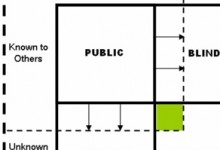
The Johari Window is a good representation to underscore the point I am trying to make. It’s a four-pane grid that divides self-awareness into what is known and unknown about us to other people and what is known and unknown about us to ourselves.

The most valuable feedback, in this four-part diagram, is the stuff others know about us that we don’t know about ourselves. The interesting part is that revealing these blind spots often produces tremendous personal growth. Here are some extra guidlines for analyzing this window:

  • Feedback: this is the extent to which others are wiling to share with you and to be open.  It is also the extent to which you attempt to perceive the verbal and non-verbal information of others.
  • Disclosure: this is the extent to which you are willing to share with others information about yourself.
  • The closer your self-perception is to the perception of others about you, the larger the public area. Maturity, dignity, integrity and empathy are the tools to widen the public area.
  • Your window varies from setting to setting (home, work, individually, in groups,…)
  • Those who would benefit most from feedback are often those resisting it with furious anger.

Note: Charles Handy calls this concept the Johari House with four rooms. Room 1 is the part of ourselves that we see and others see. Room 2 is the aspect that others see but we are not aware of. Room 3 is the most mysterious room in that the unconscious or subconscious bit of us is seen by neither ourselves nor others. Room 4 is our private space, which we know but keep from others.

Let it go!

OK – now back to Christopher and his boss.  There is only one advice that I can give and it’s the same that Marshall Goldsmith gave when he was asked "How do you deal with people who have no desire to change?" His reply:

"I don’t.  Have you ever tried to change the behavior of an adult who had absolutely no interest in changing? How much luck did you have with your attempts at this ‘religious conversion’? Have you ever tried to change the behavior of a spouse, partner or parent who had no interest in changing? How did that work out for you? My guess is that you have tried and have been consistently unsuccessful. You may have even alienated the person you were trying to enlighten. If they do not care, do not waste your time."

Not much I can add to that, frankly…

________________
Sources: Luft, J. and Ingham, H. (1955) "The Johari window, a graphic model of interpersonal awareness", Proceedings of the western training laboratory in group development. Los Angeles: UCLA

The Handy Guide to the Gurus of Management

Sunday, March 25th, 2007

The Best Things in Life are Free, Including Management Literature!

True, there is a lot of rubbish on the internet, but for those who are good at using search-strings on Google heaven awaits. As you may have guessed I found the Handy Guide by Googling my way through the information clutter. I found it on the site of BBC World Service under the sub-section ‘Learning English’ (Huh?!).

Charles Handy – a management guru himself – guides you through the lives and works of his choice of management gurus. I could not have imagined a better introduction to management. And as the text is being used in an online course of business English you will find short sentences and clear language (in management literature this is sometimes rare).

 
"To those of you who have just tuned in, I’m Charles Handy and you’re listening to the Handy Guide to the Gurus of Management, from the BBC World Service. There will be twelve gurus in all but, as I said earlier, I am going to begin with myself and my ideas. That’s so that you can get to know me and my prejudices, my way of looking at the world, even the way I talk."
 
Here is the list of management gurus that he brings to our attention:
Twelve gurus described by a guru in plain English – if it would be a book I would be the first one to buy it. All these summaries are available in audio as well in 15 minute talks. The best introduction one can find, although as Handy asserts in his concluding remark:
 
"It is impossible to do justice to someone’s lifetime collection of ideas in fifteen minutes. All I have been able to do is to introduce to you some of the best thinkers of our time in the hope that I can persuade you to get to know them better; I trust that the twelve gurus we’ve met in this Handy Guide will help you find your own way in the world."