
Archive for the ‘Bill Jensen’ Category

Healthy meetings

Monday, May 18th, 2009

Last week, someone made me aware of the fact that a 4 hour meeting we attended with 30 persons accounted for almost one man-month. Unfortunately, it never says so on the invoices or the time-sheets of the participants. In case this would be explicit, people would be meeting far more efficiently. And I am talking about plain and simple easy-to-implement improvements … no rocket science – just another point of view.

We need to realize that one of the most important communications instruments for a change manager is the meeting. In order to use this channel in the best possible manner you need to be aware of the different reasons why meetings are held and you need to adapt the format of the meeting accordingly. Here are some examples:
- providing/gathering information
- generating ideas/brainstorming
- listing of issues
- solving of issues
- taking decisions
- generating solidarity with the team/teambuilding

If you fail to clarify one of the above objectives in the beginning of the meeting, some participants may be tempted to take advantage of this situation in order to bring their own agenda forward.

The above diagram is titled ‘Doing away with belly-aching – the clover-four of a healthy meeting‘. If you are clear on all four of these ingredients, the odds are that you are about to chair a healthy meeting.

According to Bill Jensen participants are entrusting you with part of their life, i.e. the time that you are meeting with them. Therefore you should always ask yourself the three following questions before taking into hostage a part of your participant’s lives:
- What is the participant getting from this meeting?
- What is the participant’s added value?
- If the participant is suddenly taken ill, can the meeting take place without him/her?

We all know that meetings can be a big time consumer, but we also know that they are a necessary evil – so why wouldn’t we make the best of it?

Communication “1-N”: The Checklist

Sunday, January 4th, 2009

Building further on the Know-Feel-Do anatomy that I explained last week, there is a checklist that I often use for large scale communications on big organizational change projects. Again – it’s no rocket science – but it is amazing how many skilled communicators seem to be lacking these kinds of lists.
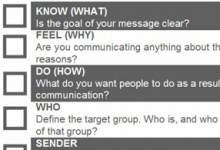
Each time an important outbound communication is about to be launched I always check these boxes. And now that I’ve blogged about it – you can do too. Have fun and let me know if it works, OK?

Know-Feel-Do = Bottom Line of Communication

Sunday, December 28th, 2008

In the world-famous book of John Kotter, ‘Leading Change’, we can find a striking calculation regarding communication of strategic large-scale organizational change projects.  Kotter uses the example of an important project that should bring about a significant change for a large organization. He then quantifies the amount of communication that is supposed to reach the target audience.
Over a period of 6 months, the total amount of communication that an employee gets ‘communicated upon’ averages 2.300.000 words. Over that same period  the communication about that strategic project averages 13.400 words (= a CEO speech of 30 minutes + a division meeting of 60 minutes + an article of 600 words in the company newsletter + a memo of 2000 words by the project manager). The interesting bit is the proportion of that communication compared to the average communication that a person receives over that same time span of six months. On average this is 0,58%!!

Conclusion: 0,58% is the attention slot that you get from an average person – just like an airplane gets a slot for takeoff. So you better make sure that your message is clear and to the point.

In case you would like to know how we can fill this 0,58% slot as effectively and efficiently as possible, you should start with the basic ingredients of organizational change management. As I have stated in another article some time ago, it all comes down to involvement and the only limits to good organizational change are determined by our own creativity, maturity and openness to involve our target audience.

As a reminder, the three ingredients of organizational change are Motivation (the emotional stuff below the surface), Knowledge and Skills. These determine the domains of action for making the change happen.
• Questions and reactions, which fall into the ‘Knowledge’ category, often indicate a need for vision, a business case or an overview. These refer to the ‘what’ of the change.
• The ‘Skills’ category indicates a need for concrete and explicit knowledge, tools and working instructions. In other words: people want to know ‘how’ they will make the change happen.
• In addition there is also an entire range of reactions that fall into the ‘Motivation’ category (the underlying reason that drives the change: the ‘why’). These reactions reflect people’s need for involvement and inspiration. The ingredient ‘Motivation’ determines whether people undergo the change or are part of it.

In the context of communication they translate to the following communication needs:
Know (relating to the Know-What): People need to know the rationale behind the changes and they need to come to their own conclusions.
Feel (relating to the Know-Why): People need to actively participate in the process of making decisions and need to create their own buy-in.
Do (relating to the Know-How): People need the right tools to implement the change

According to Bill Jensen, Know-feel-Do determines the anatomy of behavioral communication. Behavioral communication is communication tailored according to the information needs of the receiver.

The ‘Know-Feel-Do’ model can be used in any communication from email to a telephone conversation or in front of an audience. Know-Feel-Do forces you to see the receiver of your communication as decision makers and to organize your thoughts according to how they listen.

The receiver of a message is mostly waiting for the answer to three questions:
KNOW =>‘What is the one thing you want me to know?’
FEEL => ‘Why is it important?’
DO => ‘What do you want me to do as a result of your communication?’

Next time you have to make a big presentation, an important phone call or an email, of which you want the impact to last longer than a Blackberry-click, consider the ‘Know-Feel-Do’ anatomy. And here’s the trick to remember: if you want to communicate effectively anytime, anywhere, you should make sure that you talk to the head (know), the heart (feel) and the hands (do).

The Speed of Change

Tuesday, May 27th, 2008

This is just a reminder of two things we all know but fail to understand when it matters most: simplicity and synchronization. To my opinion these are the factors that determine the speed of change and the moment when they matter most is the delivery phase of your project. In this article I would like to point out why.
Simplicity: Keeping it Simple

One of my favorite quotes in this regard is the one of Bill Jensen: ‘Change all you want, just know that execution happens at the speed of making sense’. This means that people – and that includes you and me – will only do what they understand. At this point we are not even at the level of resistance – comprehension is the issue here!

However, there is a relationship: if you do a good job in sense-making you will be rewarded with less resistance. This implies that you not only tell people what they need to know to make the change happen, but you also listen, involve them and feed-back to them your understanding.

Synchronization: Staying on the Same Page

In the beginning of a project you may not be aware of the need for synchronization. Your project may still be building a prototype and you want to spread the word. In that phase any communication is good communication; whether it is structured or not, prepared or not, accurate or not – anything is better than radio silence (disclaimer: this is not an advice, it is an observed behavior).

But as you are approaching delivery and increasing the contact moments with your target audience people will urge you to get concrete, specific, accurate and fast. That is when your bunch of people (aka: the project team) needs to get disciplined about communication, testing and training (i.e.: the most important contact moments with the target audience).

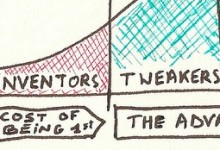
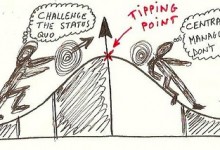
The speed of change

As the drawing above illustrates, during the implementation phase more people become closely involved in the work of the program. You should be aware that this is also the first time that you meet pragmatists that hook into the details of the testing and conservatives who start to wonder what this is going to mean for them.

You will feel as if the big boulder of the project has reached a tipping point and is now rolling downhill. In other words: from now on you will have to pace the majority of pragmatists and conservatives who will be pushing you for concrete details. Therefore, during your communication it is important that you set the right expectations and that you do not over-promise with regards to delivering prototypes and demonstrating solutions. It is painful to be applauded for the demonstration of a certain solution only to find out that you overlooked some important elements because you did not consult the implementation team at large.

Your team is probably a big team by now and you must align solutions internally first before making promises to the organization. Minor and major incidents in this area will make you aware that you will need to centralize communication as you are approaching the delivery.

So if there is one sentence that you should keep telling yourself when your project is in the delivery mode it’s this one: Let’s keep it simple and make sure we’re on the same page’.

Good luck!

______________________
In the illustration I make use of the following specific terms and representations:
1. The bell-shaped graph: Rogers, E.: Diffusion of Innovations, Free Press 1962
2. "The Chasm": Moore, G.A.: Crossing the Chasm: Marketing and Selling High-Tech Products to Mainstream Customers, HarperBusiness 1999
3. "The Tipping Point": Gladwell, M.: The Tipping Point. How Little Things Can Make a Big Difference,Little Brown 2000

Four Knowledgeable Facts About Executives

Sunday, July 29th, 2007

From my experience, I know that chief executives are not the easiest persons to deal with. But you do need them as an authorizing and reinforcing driver behind the program during the complete lifecycle. What’s more, they are your one and only point of reference in the organization when you are starting up. Therefore, it may be good to know what sets executives apart from other people in the organization.

Here are four major differences:

1. Executives have attention spans comparable to that of a seven year old; i. e., between 30 seconds and five minutes. This is because they operate in a world of continuous context-switching. Unfortunately for you, this enhances their ability to detect when you are beating about the bush. As a consequence, your communication towards them should be brief. According to Bill Jensen you should apply the following law when communicating to executives: “Anything that has a staple through it will not get read.”


2. Executives want to have a stake in the solution.
They want to build up arguments, make decisions, take actions, and move on. That is what they are good at; otherwise they would not be in that position. In terms of your communication, this means that you should prepare for a conversation instead of a monologue. An executive who cares about the topic will interrupt with a question after approximately one minute of your monologue. As a result, you should be presenting facts and asking for opinions, or presenting alternatives and asking for pros and cons.

3. Executives hate surprises. Sponsors of the program hate to be surprised about the program in front of their colleagues. Therefore, you should have preliminary meetings with all the sponsoring board members before you present at an executive meeting. Ask for their input and view points upfront, and they will back you up and guide you during the meeting and the decision-making. True, this takes time and may add several iterations.

4. Numbers will only set you free to the extent that they support your arguments. You should only use statistics and numbers to the extent that they significantly support the arguments that you are making. Keep all the statistics as a backup for the conversation, and stick to the numbers they really need to know about.

Your awareness of these characteristics will determine how you approach the validation of the business case, the feasibility study, and the involvement of the program sponsors. The purpose of the above guidelines is to save you from coming out of an executive meeting with more questions than you had when you entered.

More Marketing Mumbo-Jumbo: 4 P’s

Thursday, July 12th, 2007

The Marketing Mix of Organizational Change
By now you must know that I am a firm believer and a copycat of successful marketing concepts. The ‘marketing mix’ of Philip Kotler is another one of those basics I keep referring to. Remember what the 4 P’s of marketing are? (they are: Place, Product, Promotion and Price) Well, in organizational change management, there is also a mix that applies. And it equally contains 4 P’s…

Marketing Made Simple
The 4 P’s of Organizational Change are not a plain copy of the marketing mix as the context is not one of consumers with a buying potential but one of employees with an attention potential. The idea comes from Bill Jensen as he builds a case for simplicity. According to him it is essential to formulate the need for change as clear and simple as possible, because people tolerate management’s logic but still they will draw their own conclusions. As a result you need to practice what he calls ‘behavioral communication’; i.e.: communicating on the level of the information needs of the receiver (as opposed to: ‘the justification needs of the sender’).

Cooking Class
In my trainings I often compare an organizational change effort with the chemistry that is involved in cooking. Even though the comparison with cooking may not seem so obvious, it’s worth noting that the chemistry of cooking involves molecules of different ingredients to be blended through heating into a new form: a prepared meal. The same goes for organizational change: heating up existing ingredients, occasionally adding some elements and blending them into a new shape with a new objective. In this perspective the 4 P’s are the boiler plates that you need in order to create the exact heat that is needed for the chemistry to happen.

Ok now, back to the 4 P’s of Organizational Change; what are they and do I have a simple trick to remember them?

Well, just as a good cook knows his way around the kitchen and knows how to handle the kitchen equipment, a compelling case for change is always built up along the lines of these 4 boiler plates:

1. PUSH: people will only take the leap into the unknown if their house is on fire. That is why the first step always serves to indicate that there is no other option than change.

2. PROGRESS: the answer to the question: ‘where are we and what have we accomplished to date?’, which clearly indicates which certainties and means are at our disposal to undertake this process of change.

3. PLAN: a clarification of the different steps ahead of us and actions that we need to undertake in order to reach the nearest milestone and the one after that and so on.

4. PULL: the final destination, which serves as the magnetic North or the lodestar in case people would lose a sense of direction.

There is also a 5th P: getting all the information on one and the same Page!

The Daily Routine of Great Cooks
The point is that these 4 P’s are so essential that you should not keep them as a one-off exercise or a ‘nice brain teaser’ (this statement is usually followed by "and now back to work"). If you are serious about making a compelling case for change and weaving it into to your approach of managing your project then these 4 P’s should be shaping your status reporting at all levels.

If you want be become a good cook, it will take some practice and “failing forward”. Along the road you will discover how the heating equipment works and how to make best use of it: gas, electricity, induction, fire, grill,…In the language of Organizational Change Management: along the way you will find out what works best in your environment to heat up or cool down things in your organization. All the best in practicing the 4 P’s!

30 Dirty Truths about SAP & Organizational Change

Friday, December 29th, 2006


Here they are , in arbitrary order:
1. People don’t want to change. Not for the worse, not for the better.
2. Things will get worse before they get better.
3. Automate your project administration, not your project planning.
4. We think we see the world as it is, but in fact we see it as we are (Stephen Covey).
5. Change is in the details.
6. The real purpose of change management is to help people make sense of the change-pains – not to avoid them.
7. HR is not an agent of change but an agent of stability.
8. If integration is the destination, then make it part of the strategy and reorganize before you deploy systems.
9. The more accurate I start to plan, the more precise co-incidence will hit me (aka: ‘death by detail’).
10. Software does not replace discipline (aka: ‘the Debby rule’)
11. Legacy systems will always be better – from a rearview mirror point of view.
12. A good project manager is like a good parent: trustworthy, predictable and unpopular.
13. Real change takes time because it requires perception shifts.
14. The purpose is to make agents of your targets.
15. Uncertainty is worse than bad news.
16. Trust is the currency of change.
17. Communication will happen anyway, so better be at the steering wheel.
18. Seek first to understand, then to be understood (Stephen Covey).
19. Real participation means allowing people have a stake in the sense-making (this includes whining and letting-go rituals).
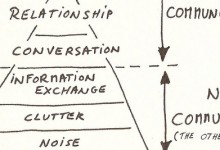
20. The essence of communication is to create community. Any exchange of information that does not accomplish this purpose is non-communication. Scan your meeting behavior as you keep this rule in mind.
21. Approach resistance with respect because it covers people’s most vulnerable and valuable part: their motivation and inspiration.
22. We choose our responses to the world – perception is a choice.
23. A vision is the shortest path between what is in my head and what people will see or hear (Bill Jensen). Compare this to your 180 slides Power Point presentation.
24. Communication is the message sent, not the message received (Bill Jensen).
25. Change all you want – but execution happens at the speed of sense making (Bill Jensen).
26. Although Organizational Change is not mathematical science, one truth stands out: OO + NT = EOO (Old Organization + New Technology = Expensive Old Organization) (Michael Hammer).
27. The bottleneck to human performance is in the limitations of available attention and learning capacity.
28. Gathering feedback and not taking action based on the findings can be more damaging than not gathering feedback at all (Naomi Karten).
29. In order to understand a system, you should try to change it (Kurt Lewin).
30. Culture is by far the best excuse for not changing. Don’t try to understand, rationalize or categorize culture. Rather, take it as a given and learn to navigate it.