
Archive for the ‘Adam Smith’ Category

Consulting 2.0

Sunday, November 29th, 2009

What would our sector look like if we gave our value proposition a little twist? What would the results be like? The difference a subscription makes over a contract … “When you change the way you look at things, the things you look at change

Until recently I thought that there was no alternative for ‘consulting as we know it’: onsite, full-time, fixed-rate, and mostly during office-hours. As it happens my net value as a knowledge worker varies according to the challenge at hand: sometimes I am solving a problem; other times I am filling a gap in operations and sometimes I invoice idle time (that frustrates the hell out of me).

The Switch

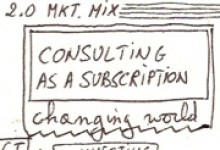
Knowledge follows different rules than a tangible product. If we want to get more value out of my services as a knowledge worker, we should use it differently: by means of a ‘subscription’ instead of a ‘contract’.

Let’s have a different look at the way knowledge workers go to market. In management science the elements of the marketing mix are often referred to as ‘the four Ps’: Product, Price, Place and Promotion. Because this model came into existence for selling tangible products, I have added a different emphasis as I address the 4 P’s below:

1. Product: Knowledge

Building a stock of knowledge made sense in a stable world. But in this rapidly changing world an inventory of knowledge gathers dust: the problems we face today cannot be solved with the knowledge of yesterday. The warehouse value of knowledge is close to 0.

The good news: knowledge gets better when it is shared and used where you need it and when you need it.

What if we used consultants no longer for building an inventory of knowledge and more for solving today’s problems?

2. Price: Value in Hindsight

For consulting, training and facilitation you can’t know in advance whether an intervention will create value. Sometimes it does, sometimes it doesn’t. And sometimes it exceeds expectations. The value of knowledge always appears in hindsight.

What if we agreed on the price of consulting after delivery? The price you pay is the value in hindsight. Instead of a proposal upfront we agree on added value afterwards.

3. Place: Plug-in

Let’s face it: most knowledge workers are not performing 100% every hour of the day. But at specific moments we perform 200% or 300%. That’s when we make the difference.

What if you could hire consultants at the moments when they make a difference? Plug-in when peak performance is needed, both onsite and online.

4. Promotion: Only the Knowledge you Care About

Customers who are satisfied with my services tell their friends. Don’t tell your friends when you paid me too much for a problem that was not fixed. Tell me. I will learn and in return you don’t pay.

What if you only paid when you were satisfied? ‘No cure, no pay’; that is: zero for online work and only the expenses for onsite work.

Old Wine in New Bottles

OK, now let’s imagine – only for a second – that this model would work and that the mainstream of all self-employed knowledge workers would switch over to consulting 2.0. What would be the consequences?

What About Parasites?

What if customers abuse you in order to get the value and then rate your services as bad so they can catch free rides? Rationally speaking I would be selling myself out of the market in no time.

But I’m an economist and I happen to remember Adam Smith, who is widely cited as the father of modern economics. In his work The Theory of Moral Sentiments, published in 1759, he critically examined the moral thinking of the time and suggested that conscience arises from social relationships.

In short: customers who are satisfied may give you a hard time, some will take a free-ride, but the majority will gracefully put the money where their mouth is.

And the other customers? You let them go as they continue to build a bad reputation for themselves.

Market Dynamics

In these times of ‘open source’, ‘open code’, ‘open access’, ‘open licenses’, etc. I consider it rather dangerous to go to the market with a ‘closed’ mindset.

‘Open contract’ is the answer for launching consulting 2.0. Again, this is not a new idea as the same Adam Smith mentioned it in 1776. That’s when he published The Wealth of Nations, in which he introduced the idea of an invisible hand to describe the self-regulating nature of the marketplace.

The point is that ‘open contracts’ will remove impediments for the market to tell you what you are good at. As an example, take the partner of a big consulting company that I met about a year ago. His philosophy is to say yes to every customer request for services, ‘and then I work my way out, because the customer will pay anyway’. This person is in for hard times in the new pricing model: No cure, no pay.

The market will tell you what you are good at and vice versa. To put it in the words of Adam Smith:
“It is not from the benevolence of the butcher, the brewer, or the baker that we expect our dinner, but from their regard to their own self-interest. We address ourselves, not to their humanity but to their self-love, and never talk to them of our own necessities but of their advantages.”

Related articles:
- Good Lemonade – February 16th, 2008
-
Web 2.0 includes Invisible Hand – June 29th, 2009

Important note:
All the credits for this idea go to
Martijn Aslander, a guy from the Netherlands who calls himself a lifehacker.

! ! ! EXPERIMENT ! ! !
Contribute to a mindmap on Consulting 2.0
- 04-Dec-2009 -

This article has caught the attention of a lot of people who came back with tons of questions. Seems I hit a nail but did not get to the bottom of the concept.

Therefore:
- Do you want to edit the mindmap online and lean in on the discussion? Let me know your email address and you’ll receive a mail with the link to EDIT the mindmap on the MindMeister platform;
- Are you skeptical but curious anyway? Let me know your email address and you’ll receive a mail with the link to VIEW the mindmap on the same platform

And here is my word: I will not use your email for any other purpose than having you access the MindMeister platform.

Thanks!
luc[dot]galoppin[at]reply-mc[dot]com

Web 2.0 includes Invisible Hand

Monday, June 29th, 2009

Over the past week I experienced that the good old brainstorming techniques that are derived from de Bono’s Six Thinking Hats don’t need a nudge in the Web 2.0 age.

6 Thinking Hats

I have used this brainstorming technique in a variety of different settings: to generate ideas, to solve complex problems, etc.  The Six Thinking Hats method provides a way for groups to think together more effectively. ‘Together’ is the absolute key word here: instead of having individuals reacting their own way (as usual), the group agrees to deliberately step into each possible ‘way of thinking’ sequentially. There are 6 different types of thinking or hats one can wear in a discussion:

* Neutrality (white) – considering purely what information is available, what are the facts?
* Feeling (Red) – instinctive gut reaction or statements of emotional feeling (but not any justification)
* Negative judgment (Black) – logic applied to identifying flaws or barriers, seeking mismatch
* Positive Judgment (Yellow) – logic applied to identifying benefits, seeking harmony
* Creative thinking (Green) – statements of provocation and investigation, seeing where a thought goes
* Process control (Blue) – thinking about thinking

In my experience until last week – the Six Thinking Hats was a powerful tool to generate ideas and solve complex problems through parallel thinking. On top of that it creates a greater feeling of momentum in team that otherwise would be cluttered in a ‘being right’ discussion.

6 hats on Web 2.0??

By now most readers of this blog must have noticed that I am making my first babysteps into the Web 2.0 communities. One of them is LinkedIn, where I am lucky enough to manage the Organizational Change Practitioners group (4.722 members subscribed at the time of writing). Recently I decided to have ask the members contribute in which subgroups we would create in this forum.

What I witnessed next was multi-thinking at different dimensions at the same time. One of the most beautiful examples of Six Thinking Hats I have ever witnessed from close by!  At the time of writing, there were over 85 reactions that demonstrated the six thinking styles:

* Neutrality: people responding directly to the question at hand (e.g.:"I suggest to creat a subgroup on human behavior")
* Feeling: people volunteering to become a subgroup manager (e.g.: "Great idea, Luc. If you need help, I would be ready to facilitate/moderate the Web 2.0 group")
* Negative judgement (Black): people opposing to the idea of subgroups (e.g.:"Seems to me the additional structure may add bureaucracy rather than make it easier to navigate and participate.")
* Positive Judgement (Yellow): people supporting the idea (e.g.: "I think having focused discussions would be great so that when dealing with a particular issue, you wouldn’t be all over the place.")
* Creative thinking (Green): people suggesting additional ideas (e.g.:"Maybe a poll would be a good idea to select the final five")
* Process control (Blue): people looking at this process happening (e.g.: "watching and participating in a wonderful new (to me at least) process: asynchronous, large-group virtual conversation and decision making"); one participant even Twittered this discussion thread!

Invisible Hand

The most fascinating observation however, was that the discussion thread almost chronologically went through all of these hats. In the same way as during brainstorming sessions each thinking hat is triggered by one reaction, which sparks a range of reactions that belong to the same thinking type.

Coincidence? Not in a million years. But then, what caused this to happen? How did the group trigger a specific hat, go to a climax of reactions, a decline and then moved on to a next hat? How did the group decide the order of the hats to think by? Honestly – I DON’T KNOW. But I did experience that we were parallel thinking! We simply cannot deny that there is some kind of invisible hand doing some fine work.

Good Lemonade

Saturday, February 16th, 2008

The subject of this post is borrowed from a book with the same title. The 1976 book Good Lemonade by Frank Asch and Marie Zimmerman tells the story of Hank who sells lemonade to his friends. Throughout the story we learn that the quality of his lemonade is not so terrific and – no matter how hard he tries to sell and repackage the product – the competing lemonade from his friend Howie sells better.

Hank is convinced that bad tasting lemonade can be salvaged. All he needs is a little advertising and promotion. The moral of the story is clear: no matter how good you package and sell your product – if the quality is no good – people will feel betrayed and turn you down. Likewise, if you have a good product it will stand out – regardless of the marketing campaign. Good lemonade seems to benefit from an invisible hand as customers become fans.

Good Lemonade

Regular readers already know that I gracefully pick up marketing logic in order to recycle the insights on the inside of an organization. If it works for a customer there is a fair chance that it also works for an employee – because neither of them is stupid. In the context of organizational change projects – be it a process re-engineering, an ERP implementation, a merger or a downsizing operation – you will be selling lemonade as well. Only in this case the lemonade is called ‘future state’.

Resistance to organizational change is the way lemonade buyers come to your market. If your lemonade is of good quality an invisible hand will be there to help you. However, if the opposite is true, no matter how hard you try, people will just see trough your phony slideshows, road shows, posters, advertising, newsletters, training and management speak.

It only takes one extra step to see where indifference comes from. In business bad lemonade is not bought and you go out of market, period. In organizational change we tend to ‘be right’ instead of ‘in relationship’ when the lemonade is bad so we push the initiative so hard that the resistance goes underground. Unlike customers, employees have no other choice than to buy your bad lemonade. That is where stinking indifference starts – sucking every last drop of energy out of your people.

The moral of this article: don’t abuse change management activities to repackage and advertise bad lemonade. If the lemonade is bad, be straight about it. Work on the lemonade instead of accusing the buyers. Use change management activities to bring about involvement and participation that triggers an invisible hand.